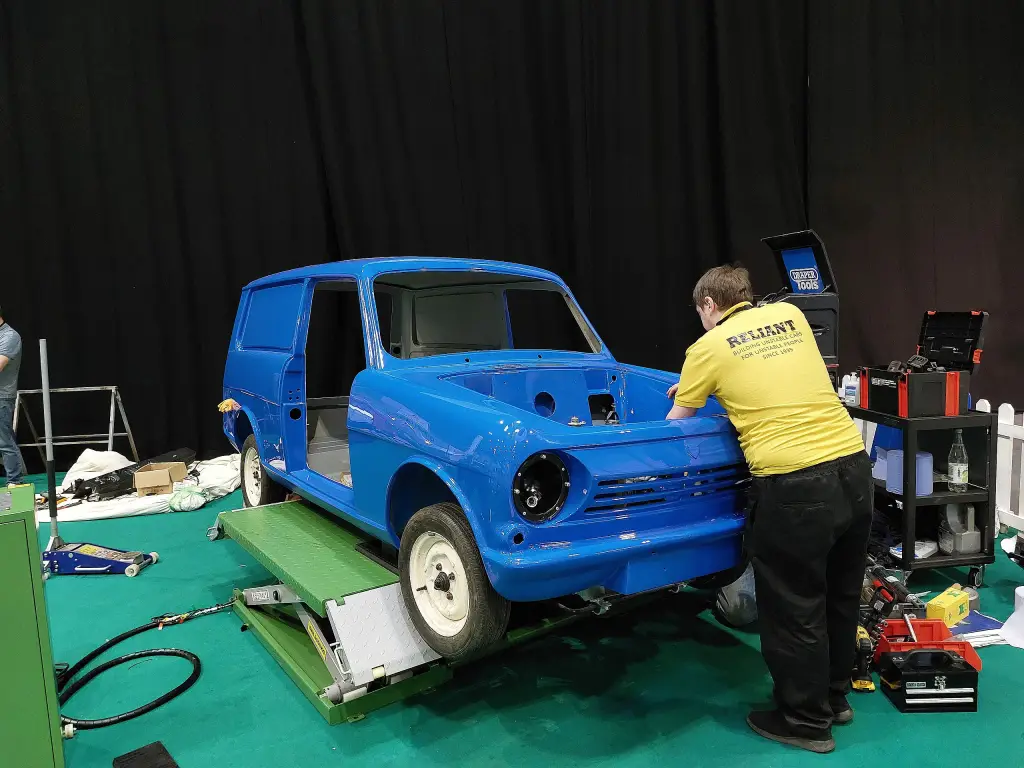
The Reliant Rebel is a small four-wheeled economy car that was produced by Reliant between 1964 and 1974. It was designed as a market test to push the company into other parts of the market instead of only three-wheelers, and it was sold as a rust-free alternative to the Austin Mini and the Hillman Imp.
Reliant Rebel at a glance
| Production | 1964–1974, Tamworth |
|---|---|
| Bodies | saloon, estate, van |
| Engines | 598 cc, 701 cc and 748 cc four-cylinder |
| Power | about 35 bhp from the 701 cc engine |
| Length | 138 in (3,505 mm) |
| Width | 58 in (1,473 mm) |
| Wheelbase | 89 in (2,261 mm) |
| Kerb weight | 1,185–1,327 lb (539–603 kg) |
| Front suspension | from the Triumph Herald |
| Brakes | from the Triumph Courier van |
| Steering box | from the Standard 10 |
| Design | Ogle Design |
The article follows the English Wikipedia page on the Rebel. Based on one source.
History of the Reliant Rebel
Why Reliant built a four-wheeler
The Rebel was the idea of Reliant managing director Ray Wiggin, and it was developed after the death of T. L. Williams, the founder of Reliant. Wiggin believed that in future people would be driving small four-wheeled cars in a new segment, as the Austin Mini had been so successful, and that the British microcar and three-wheeler market would die off. After Reliant engineers had worked on the four-wheeled Sabra Carmel with Autocars of Haifa in Israel, they decided to modify the then-current Regal 3/25 into a four-wheeled vehicle. They built a rolling chassis from a cut and welded Regal 3/25 frame and drove it around the Two Gates factory to see whether the idea would work.
The 598 cc engine was thought too weak to pull the weight of a finished car, so engineers skimmed the cylinder head and fitted larger valves to give better torque. The Rebel took its front suspension from the Triumph Herald, its brakes from the Triumph Courier van and its steering box from the Standard 10. Reliant asked Ogle Design to style the car so that it looked completely different from the Regal while keeping some Regal parts, such as the doors, windscreen and dashboard, to save production costs.
Launch at Earls Court
The resulting car was 138 inches (3,505 mm) long, 58 inches (1,473 mm) wide, with a wheelbase of 89 inches (2,261 mm), and it weighed between 1,185 and 1,327 lb (539 to 603 kg) depending on the model. The Rebel made its public debut at the Earls Court Motor Show in 1964; the show cars were pre-production models, built in Turkey and driven to Earls Court to test their durability. The press praised the new small four-wheeler and Reliant took over a thousand notices of interest from the public at the show.
Reliant could not fill those early orders. Production was low because the factory had not been expanded to give the Rebel its own line: every Rebel built meant stopping Regal production, and management did not want to do that while the Regal was in demand and more profitable. The money went instead into a new line and factory building for the Scimitar Coupé, launched alongside the Rebel in 1964. The Rebel did not get a dedicated production line until 1971, during Rebel 700 production, and lost it again in 1974 together with the Bond Bug so that Reliant could increase output of the new Robin.
The 600 and the 700
The Rebel launched in October 1964 as a saloon with the 598 cc engine of the Regal 3/25, one trim level and a long accessory list. Only about 100 of these first cars were built, in two batches in November and December, and they are now regarded as pre-production cars: the specification changed between individual vehicles as the factory tested different fabrics and materials. Prototypes had a larger grille, but testing showed that it made the cars run too cool, so on early cars the grille was left uncut, producing what owners call a dummy grille.
Six months after the launch, in 1965, the car was relaunched with a new dashboard and instruments, thicker seats and five leaf springs at the rear instead of seven for a softer ride. The top half of the grille was deleted and filled in smooth, orange front indicators replaced the clear units and a unique steering wheel was fitted. This model was later simply named the Rebel 600. The Rebel 700, introduced in October 1967, brought a full chassis redesign in stronger steel, a new 701 cc engine, a change to negative earth and many other specification changes; the estate was shown at the Earls Court Motor Show for the first time.
Design and features
- Glass-fibre body: rust-free panels on a separate steel chassis, a Reliant speciality.
- Off-the-shelf parts: Triumph Herald front suspension, Triumph Courier van brakes and a Standard 10 steering box.
- Economy emphasis: small engines and light weight, with the 701 cc unit giving about 35 bhp.
- More room than a three-wheeler: four wheels, a proper boot and space for four.
Reliant Rebel versions
- Rebel 600 (1964–1967): the original saloon with the 598 cc engine, later with the Deluxe interior.
- Rebel 700 (1967–1974): the 701 cc engine and a stronger chassis.
- Estate: shown at Earls Court in 1967.
- Van: a commercial version of the same car.
- Early pre-production cars (1964): about 100 built with a dummy grille and Regal instruments.
The Rebel was Reliant’s four-wheeled alternative to the Reliant Regal; its four-wheeled successor was the Reliant Kitten. More cars are in the Reliant collection.
Video: Black Reliant Rebel Saloon Restoration
Video on YouTube.
Sources
- Reliant Rebel, English Wikipedia: development, dimensions, models, production