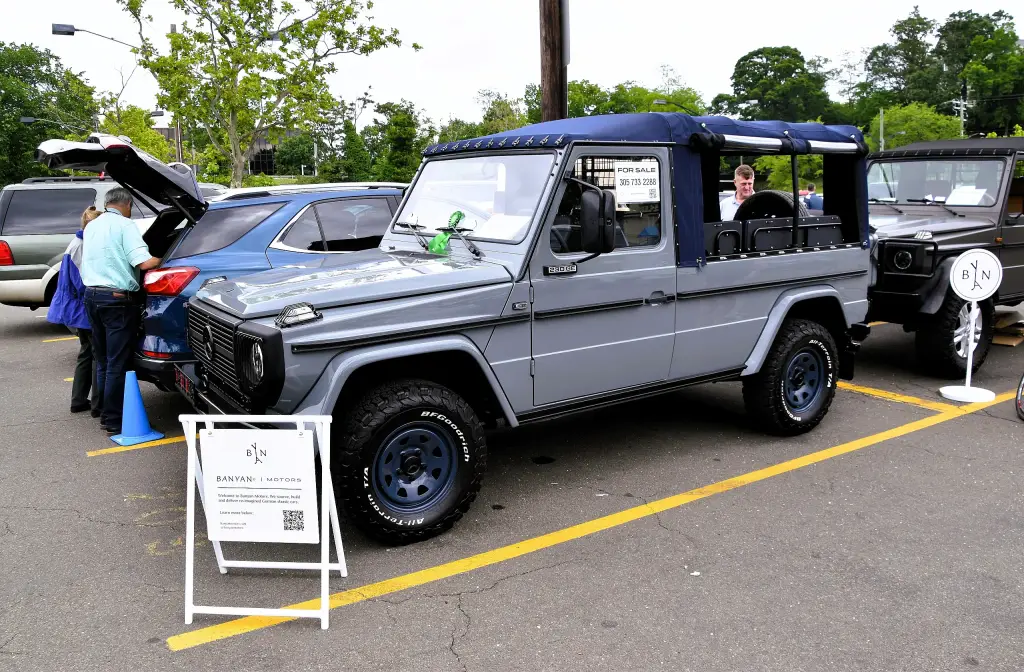
The Puch G is the Austrian version of the Mercedes-Benz G-Class, built at Graz by Steyr-Daimler-Puch and sold under the Puch name in Austria and some other markets until 2000. It shares the boxy body, the body-on-frame construction and the three locking differentials of the Mercedes original.
Puch G at a glance
| Maker | Steyr-Daimler-Puch, Graz, for Mercedes-Benz |
|---|---|
| Sold as | Puch G in Austria and some markets until 2000; elsewhere Mercedes-Benz G-Class |
| Production | from 1979 |
| First generation | W460, 1979–1991 |
| Body | body-on-frame, three fully locking differentials |
| Launch engines | 2.4-litre four-cylinder diesel of 53 kW (72 PS) and others |
| 230 GE | introduced in 1982 with fuel injection |
| 300 GD | 3-litre five-cylinder diesel, the most popular early version |
| Joint venture | Geländefahrzeug Gesellschaft mbH, founded February 1977, 50/50 |
| Assembly | Graz, largely by hand |
| Milestone | 100,000th G built in Graz in 1992 |
| Built | over 50,000 by 1986 |
The Puch G is the Austrian-market version of the Mercedes-Benz G-Class; this page follows the G-Class articles and the Puch-badged records of the archive.
History of the Puch G
Development of the G-Class began in 1972 with a cooperation agreement between Daimler-Benz and Steyr-Daimler-Puch in Graz. The German Wikipedia adds that the project was pushed by the Shah of Iran, Mohammad Reza Pahlavi, who held up to 18 per cent of Daimler-Benz and wanted the vehicle for border patrols and hunting. Mercedes-Benz engineers in Stuttgart were in charge of design and testing, while the team in Graz developed the production plans. The first wooden model was shown to Daimler-Benz management in 1973, and the first drivable prototype began testing in 1974 in places as different as German coalfields, the Sahara and the Arctic Circle. In February 1977 the two firms founded the Geländefahrzeug Gesellschaft mbH in Graz, with 50 per cent each, and production of the G Model began there in 1979.
The Puch name
From the start the vehicle was assembled in Graz, largely by hand, and in Austria and some other markets it was sold as the Puch G rather than as a Mercedes-Benz. In 1981 the cooperation was reorganised: Daimler-Benz took over development alone and Steyr-Puch built the vehicle on contract, and from 1 August 1981 Daimler-Benz was entered as the manufacturer in the vehicle papers. The Puch name stayed on the Austrian cars until 2000. The early range had three body styles for civilian use — a two-door cabriolet, a closed three-door and a five-door long version — and the W460 was built until 1990, after which the range split into the W461 for authorities and the military and the more luxurious W463.
Engines and equipment
At launch in 1979 the smallest engine was the Mercedes OM 616, a 2.4-litre four-cylinder diesel of 53 kW (72 PS) with a top speed of 117 km/h. The most popular early version became the 300 GD with the 3-litre five-cylinder diesel known from the passenger cars. The first major refinements came in 1981, with automatic transmission, air conditioning, an auxiliary fuel tank, headlamp grilles and a cable winch; fuel injection arrived in 1982 with the 230 GE, introduced in Turin, together with more comfortable front seats, auxiliary heating, wider tyres and fender flares. For 1985 differential locks, central door locking and a tachometer became standard, and by 1986 more than 50,000 G Models had been produced.
Why it lasted
The G-Class is one of the most capable everyday off-roaders ever built. Its chassis is a box frame of closed longitudinal profiles and cross members, the axles are rigid, and long suspension travel, good ground clearance and switchable differential locks make up for limited axle articulation compared with a Land Rover Defender. Three locking differentials are still rare among passenger cars. The military version, known as the Wolf, is used by several armed forces, and the vehicle also serves fire services, civil defence and the United Nations. The 100,000th G Model was built in Graz in 1992, and in 1994 the line was officially renamed the G-Class.
Design and features
- Three locking differentials: one of very few passenger vehicles with locks on both axles and the centre differential.
- Body-on-frame: a box frame with rigid axles and long suspension travel.
- Hand assembly in Graz: the G was built largely by hand in Austria from 1979.
- Puch badge: sold as the Puch G in Austria and some other markets until 2000.
- Military and civilian: the Wolf military version served alongside the luxurious W463.
Puch G versions
- 230 GE: petrol version with fuel injection, introduced in 1982.
- 300 GD: 3-litre five-cylinder diesel, the most popular early model.
- 240 GD and other launch versions: the first W460 range of 1979.
- W461: the simpler version for authorities, municipalities and the military.
- W463: the more luxurious permanent-four-wheel-drive version from 1990.
- Wolf: the military version used by several armed forces.
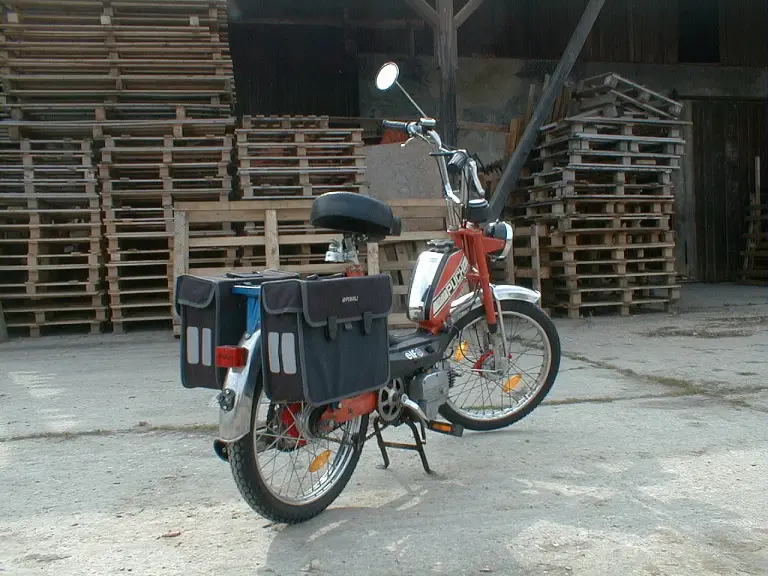
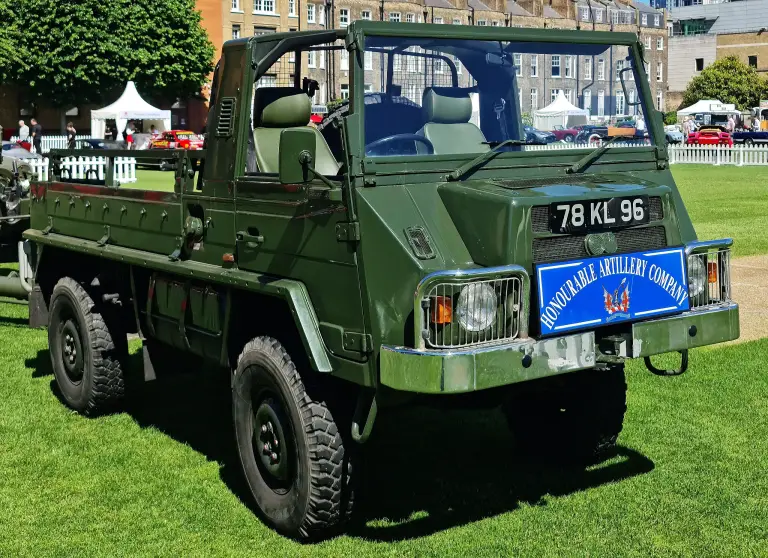
The Steyr-Puch Pinzgauer was the other off-roader built in Graz, and the Puch Maxi was the firm’s best-known moped. More vehicles are in the Puch collection.
Video: Puch G and Pinzgauer
Video by PuchG Pinzgauer on YouTube.
Sources
- Mercedes-Benz G-Class, English Wikipedia: development, W460, 230 GE, equipment changes
- Mercedes-Benz G-Klasse, German Wikipedia: Graz production, joint venture, 300 GD, Puch G name