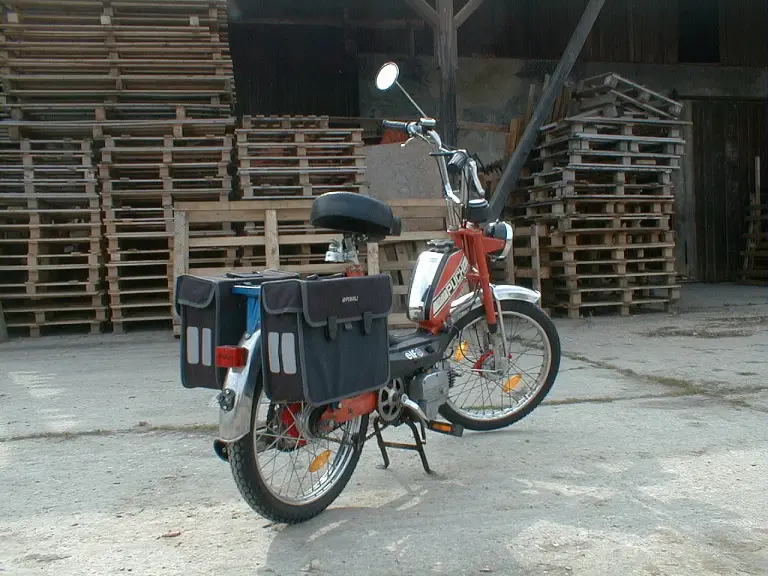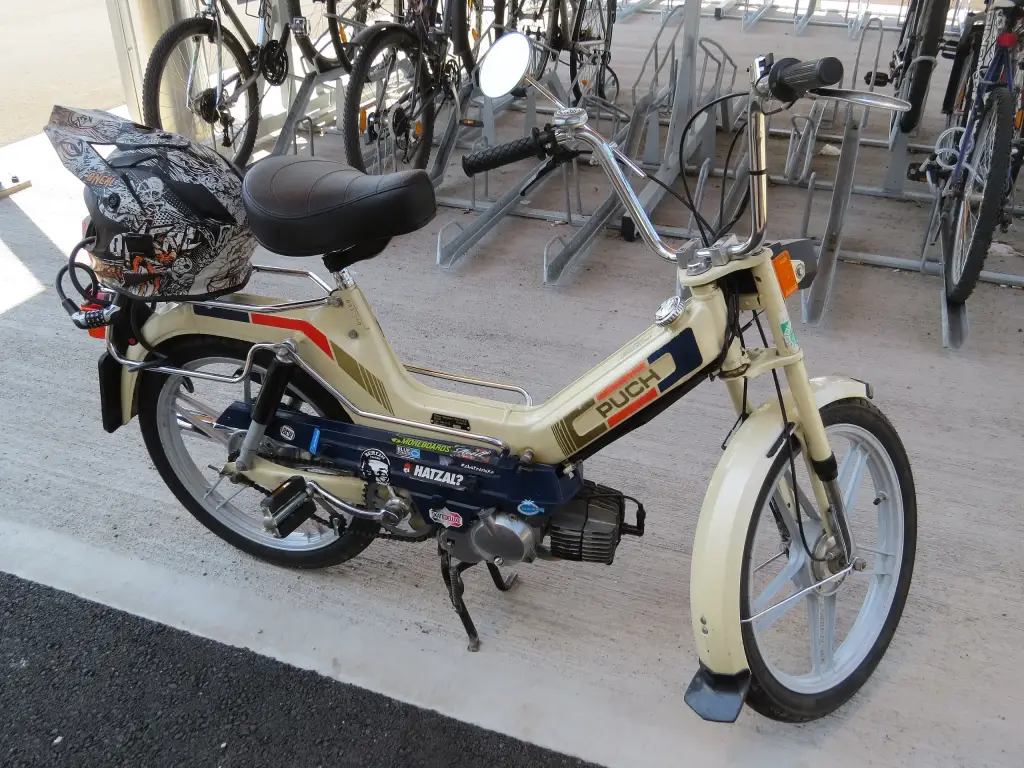
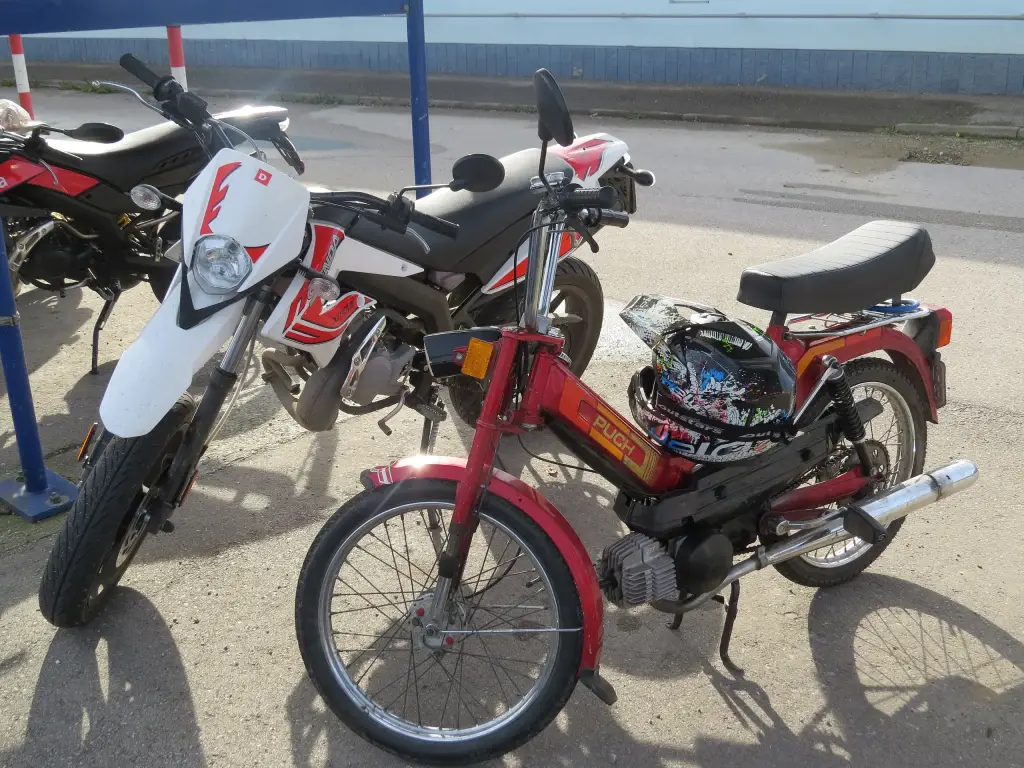
The Puch Maxi is a moped that the Austrian firm Puch built from 1969 to 1995, known for its reliability, easy maintenance and fuel economy of up to 120 mpg. Its 48 cc two-stroke engine, a simple frame with the fuel tank inside it and a long list of versions made it one of the most common mopeds in Europe.
Puch Maxi at a glance
| Maker | Steyr Daimler Puch, Graz, Austria; later Piaggio |
|---|---|
| Production | 1969–1995; named LG1 and LG2 from 1991 |
| Designer | Louis Lucien Lepoix |
| Engine | 48 cc air-cooled two-stroke single |
| Bore × stroke | 38 × 42 mm |
| Power | 1.0, 1.5 or 2 hp |
| Top speed | 32, 40 or 48 km/h (20, 25 or 30 mph) |
| Transmission | single-speed E50 or two-speed ZA50, centrifugal clutch |
| Fuel economy | up to 120 mpg |
| Starting | pedals; kick start on later models |
| Fuel tank | built into the frame |
| Built | about 1.8 million |
History of the Puch Maxi
The Maxi was the last moped Puch built before the moped and bicycle production was sold to Piaggio, and it stayed in production from 1969 until 1995, when the range was renamed LG1 and LG2. The design came from Louis Lucien Lepoix. In the 1970s the Maxi became one of the firm’s best-selling products: the English Wikipedia article on Puch puts the total at 1.8 million, and the moped gained wide acceptance during the 1973 oil crisis. Its simplicity is the reason it is still easy to find parts for: the pedals start the engine, and with the engine disengaged the Maxi can be ridden like a bicycle; later models were given a kick start.
From the X30 and the MS 50
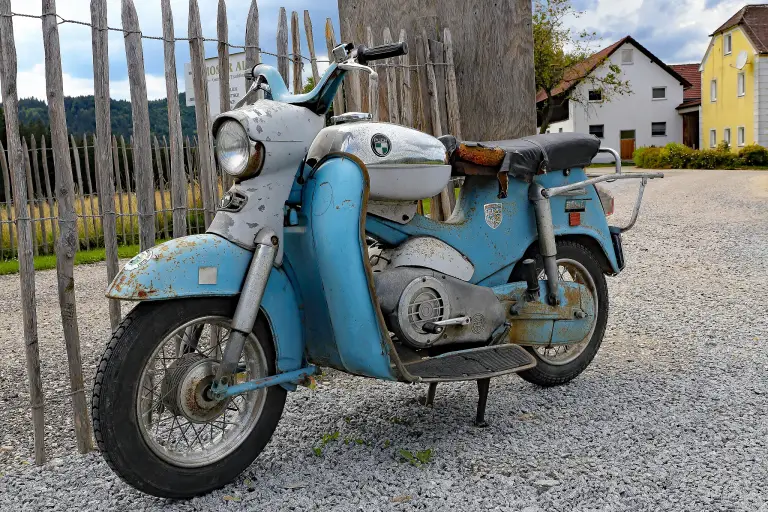
The Maxi did not come out of nothing. The Puch X30, as built for Switzerland in 1962, is named by the two-wheel historian Friedrich F. Ehn as its immediate predecessor, and the X30 was in turn a completely different construction from the older MS 50 of 1954. The MS 50 had been the successful step into the gap between the motor-assisted bicycle and the motorcycle; the Maxi took that idea further with a frame that carried its own tank and, on most versions, rear suspension. The German Wikipedia calls the Maxi the last Puch moped built before the sale of the moped and bicycle business to Piaggio, and notes that the name “Maxi” became a category of its own in Austria, often applied to mopeds of other makes.
One engine, many models
The Maxi was sold in a long series of versions that shared the same basic engine and frame. The Maxi S had full suspension and the single-speed E50 engine; the Maxi D and LS had a longer seat for a passenger; the Maxi Luxe added a high-torque cylinder head and mudflaps; the Maxi N was the cheapest model, with a rigid frame and no speedometer, and was nicknamed the “poor man’s Maxi”. The Maxi Sport MKII used the two-speed ZA50 engine and cast wheels, the Maxi Nostalgia was a black and gold model sold only in 1976, and the Supermaxi LG1 and LG2 carried the Maxi name into the 1990s. The Newport versions, with pinstriping, a brown saddle and whitewall tyres, were part of the same family, and the Maxi BMX Special of 1976 was a three-month limited run that sold poorly.
Design and features
- Simple two-stroke: a 48 cc engine with 38 mm bore and 42 mm stroke, built in 1.0, 1.5 and 2 hp ratings.
- Two gearboxes: the round single-speed E50 or the rectangular two-speed ZA50, both with centrifugal clutches — one on the E50, two on the ZA50.
- Tank in the frame: the fuel tank is part of the frame, which keeps the moped narrow and light.
- Easy to live with: pedal starting, a bicycle mode with the engine disengaged and a reputation for fuel economy of up to 120 mpg.
- Huge parts supply: the Maxi is still widely served by the aftermarket, and clean examples are valued by collectors.
Puch Maxi versions
- Maxi S: full suspension and the single-speed E50 engine.
- Maxi D / LS: as the S, with a longer seat for a passenger.
- Maxi N: rigid frame, no speedometer, the cheapest version.
- Maxi Sport MKII: two-speed ZA50, cast wheels, longer seat.
- Maxi Nostalgia: black and gold, built only in 1976.
- Supermaxi LG1 / LG2: the 1990s versions, with automatic E50 or ZA50 engines.
The Maxi followed the Puch X30 and the Puch MS 50; more Puch mopeds and motorcycles are in the Puch collection.
Video: Puch Maxi S first start after 33 years
Video by MichiMotorFreak on YouTube.
Sources
- Puch Maxi, English Wikipedia: models, engine, transmission, fuel economy
- Puch Maxi, German Wikipedia: production years, designer, place in the range
- Puch, English Wikipedia: 1.8 million built, 1973 oil crisis