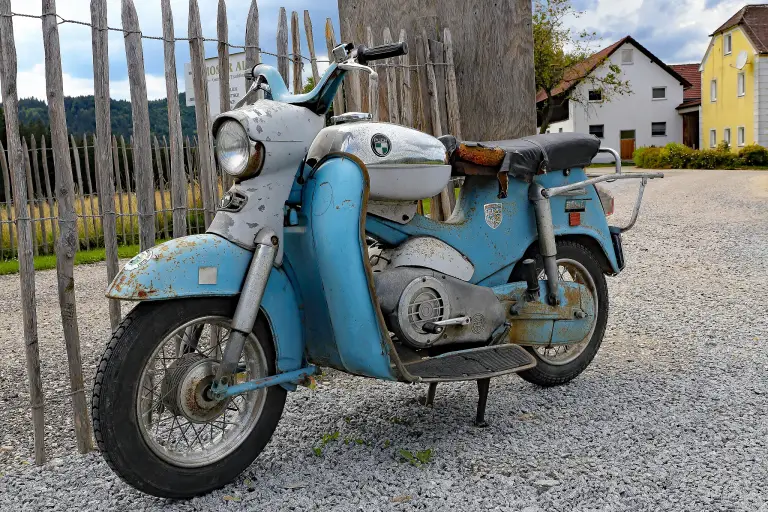
The Puch MS 50 is a moped with a 48.8 cc two-stroke engine that Steyr-Daimler-Puch built from 1954 to 1982. Its initials stand for Moped-Schalenrahmen — a pressed-steel shell frame — and it was made almost unchanged for twenty-eight years, which the German Wikipedia describes as the longest production run of any moped in the world.
Puch MS 50 at a glance
| Maker | Steyr-Daimler-Puch, Graz, Austria |
|---|---|
| Production | 1954–1982 |
| Designer | Walter Kuttler |
| Engine | 48.8 cc fan-cooled two-stroke single |
| Bore × stroke | 38 × 43 mm |
| Power | 1.0–1.7 kW |
| Gearbox | two-speed automatic or three-speed, depending on version |
| Frame | pressed-steel shell frame |
| Tyres | 23″ × 2.25″ |
| Tank | 4.6 litres |
| Weight | 39 kg ready to ride |
| Licensed builds | Tomos (Yugoslavia), Bianchi (Italy) |
| Built | practically unchanged for 28 years |
The MS 50 is described only in the German Wikipedia, and this page is based on that article, with the launch date from the English article on Puch.
History of the Puch MS 50
Puch began design work on the MS 50 in the autumn of 1952 and showed the first pre-series machine in the summer of 1954. The moped reached the market in the autumn of 1954 in a grey-green colour. Its developer was the engineer Walter Kuttler. The most innovative feature was the relatively small wheels compared with mopeds such as the NSU Quickly, while the way the tank was joined to the frame was judged less successful. The central frame tube, called the Stangel in Austria, gave the MS 50 its best-known nickname, Stangelpuch; because of its long use by the Austrian post it was also called Postler-Puch or Postfrosch, and other nicknames were Maurerbock and Maurersachs.
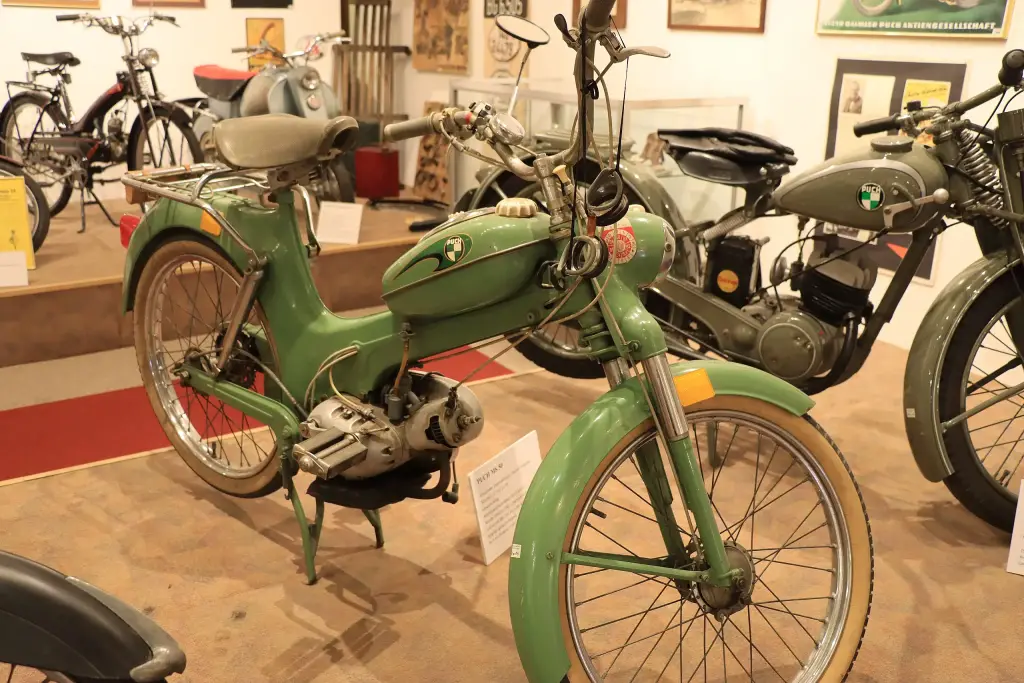
The basis of later Puch mopeds
The MS 50 and its fan-cooled engine served as the model for most later Puch mopeds and small scooters, among them the VS, DS, VZ, MV, MC and X50. The first series used the frame of the pre-series machine, and the round transition from the seat tube to the luggage carrier gave it the name Sicke-Puch. Later models had an almost straight transition, a thinner central tube, a larger tank and wider mudguards. From 1955 the MS 50 had a 4.6-litre tank, a stronger frame, deeper and wider mudguards, larger tyres and rims, a stronger chain and a new chain cover, and it was painted red instead of grey-green.
Versions for every market
Puch used the names MS 50, MS 50 L and MS 50 V at the same time in different markets. The MS 50 L of 1955 was the luxury version, with chrome rims, hubs and tool-box lid and whitewall tyres, sold in lime green, red and black. The MSK 50 of 1956 was a scooter version with a kick starter and an ungoverned 2.3 hp engine; the MS 50 V of 1958 had the 5.5-litre tank and stronger rear dampers of the VS 50; the MS 25 was a 25 km/h moped version. For Sweden there were the MS 50 VK and VKF of 1961, for Britain the three-speed MS 50 D with a VS frame, and for Denmark the MS 50 P, K2T and K3T. The variety of products, versions and markets makes a complete list of models and years almost impossible.
Built abroad
Puch also made the MS 50 for Sears Roebuck in the United States and Simpson-Sears in Canada under the Allstate brand. From the late 1950s the Slovenian firm Tomos assembled MS and VS models under licence and later built its own machines under the name Colibri, the beginning of the successful Tomos moped programme. In Italy, Bianchi built the MS 50 under licence as the Bianchi Sparviero in 1956.
Design and features
- Longest-running moped: practically unchanged from 1954 to 1982.
- Small wheels: a deliberate break with the larger wheels of mopeds such as the NSU Quickly.
- Shell frame: a pressed-steel frame with the central Stangel tube that gave the moped its nickname.
- Engine for a generation: the fan-cooled 48.8 cc unit was reused in the VS, DS, VZ, MV, MC and X50.
- Licensed abroad: built by Tomos in Yugoslavia and by Bianchi in Italy.
Puch MS 50 versions
- MS 50: the standard moped, grey-green at first and red from 1955.
- MS 50 L (1955): luxury version with chrome rims and hubs and whitewall tyres.
- MSK 50 (1956): scooter version with kick starter and 2.3 hp engine.
- MS 50 V (1958): 5.5-litre tank and stronger rear dampers.
- MS 25: moped version limited to 25 km/h.
- Export versions: MS 50 VK and VKF for Sweden, MS 50 D for Britain, MS 50 P, K2T and K3T for Denmark.
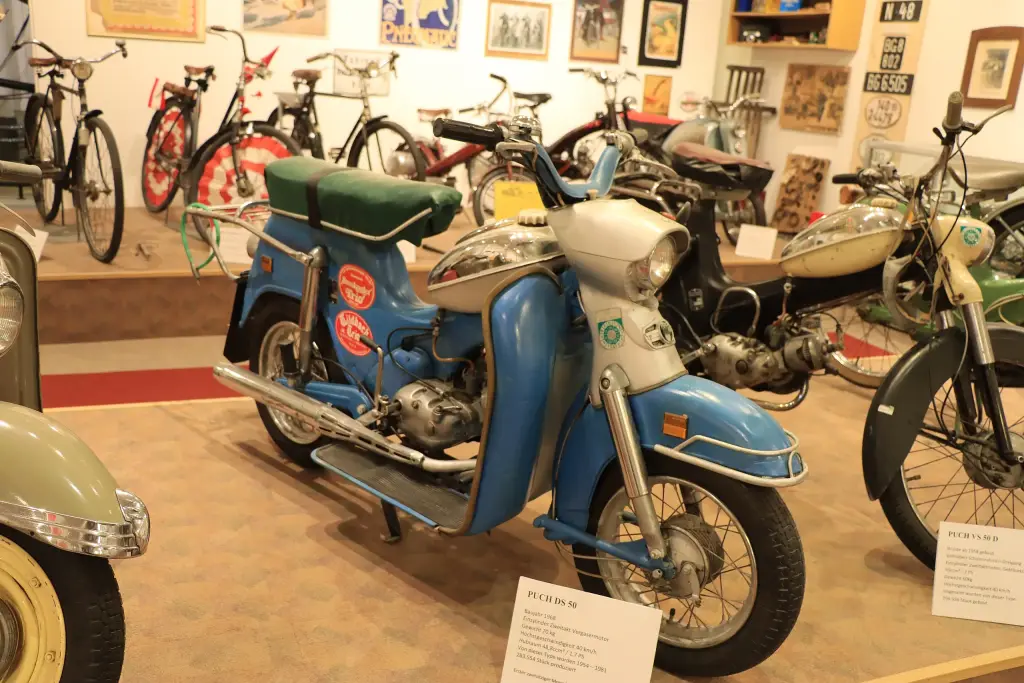
The MS 50’s engine went into the Puch DS 50, and the later Puch Maxi was a different construction altogether. More Puch models are in the Puch collection.
Video: Overhaul of a Puch MS
Video by puch maxi on YouTube.
Sources
- Puch MS 50, German Wikipedia: history, versions, technical data, licensed builds
- Puch, English Wikipedia: launch in 1954, place in the range