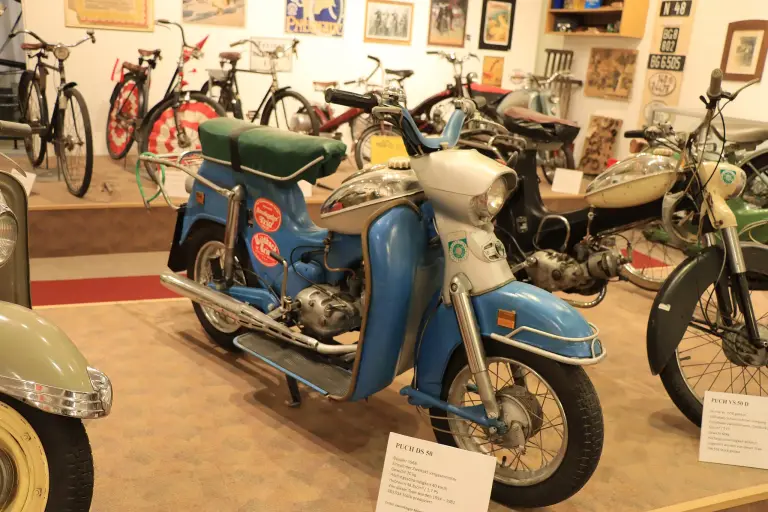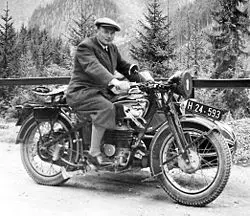
The Puch 250 SGS (Schwing-Gabel-Sport) is a motorcycle that the Austrian Steyr Daimler Puch AG built in its works at Thondorf near Graz from 1953 to 1969. Its engine is a split-single two-stroke, with two pistons sharing a single combustion chamber, and in the United States Sears sold the machine as the Allstate 250 or Twingle.
Puch 250 SGS at a glance
| Maker | Steyr Daimler Puch AG, Thondorf near Graz |
|---|---|
| Production | 1953–1969, sold into 1970 |
| Launched | 1 October 1953, in Paris |
| Engine | 250 cc split-single two-stroke, two pistons, one combustion chamber |
| Frame | pressed-steel shell frame, patented in 1953 |
| Frame design | Erwin Musger and Alfred Oswald |
| SG series | 250 SG touring, 250 SGSS sport, 250 MCH military |
| Name | SGS = Schwing-Gabel-Sport |
| US market | Sears Allstate 250, type SR 250 |
| Built | 38,584 |
History of the Puch 250 SGS
The 250 SGS was presented to the public in Paris on 1 October 1953 and remained in production until 1969, with the last machines sold in 1970. The German Wikipedia gives the total as 38,584, the same figure as the English article. The motorcycle belonged to the SG series: alongside the 250 SGS there were the touring version 250 SG, the sport version SGSS and a military version, the 250 MCH. The letters were used systematically — SG for Schwinggabel, SGA for Schwinggabel with starter, SGS for Schwinggabel-Sport and SGSA for the sport version with starter.
The split-single engine
The engine is a two-stroke split-single: two pistons share one combustion chamber, a layout that Puch had developed in the years between the wars. The same idea was used in the smaller 125 and 175 SV models, where the two pistons sit one behind the other in the direction of travel. The advantage claimed for the layout was better breathing and lower fuel consumption than an ordinary single, and Puch kept the split-single in production until about 1970.
The shell frame
The 250 SGS used a pressed-steel shell frame, designed by Erwin Musger and Alfred Oswald and patented in 1953. It gave the motorcycle a distinctive look and a stiff structure without a tubular frame, and it carried the rear mudguard, the battery and tool box and the upper mounts of the rear suspension as part of the same pressing. The frame and the engine together made the SGS a robust machine rather than a light sporting one.
The Twingle in America
In the United States the 250 SGS was marketed by Sears as the Allstate 250, or Twingle, under the model number SR 250, and it was sold mainly through the Sears catalogue. That route made it a common first motorcycle for American riders, and it is the reason the model is better known in the United States by the Sears name than by the Puch one. In Europe the SGS remained one of the firm’s standard large motorcycles of the 1950s.
Design and features
- Split-single engine: two pistons and one combustion chamber in a 250 cc two-stroke.
- Pressed-steel shell frame: patented in 1953, with the mudguard and boxes formed as part of the structure.
- SG series: touring, sport and military versions shared the basic design.
- American career: sold through the Sears catalogue as the Allstate 250, type SR 250.
- Long run: sixteen years in production and 38,584 machines built.
Puch 250 SGS versions
- 250 SGS: the standard sport version, Schwing-Gabel-Sport.
- 250 SG: the touring version of the same series.
- 250 SGSS: the sport version of the SG line.
- 250 SGA / SGSA: versions with an electric starter.
- 250 MCH: the military version of the SG series.
- Allstate 250 / SR 250: the Sears version for the United States.
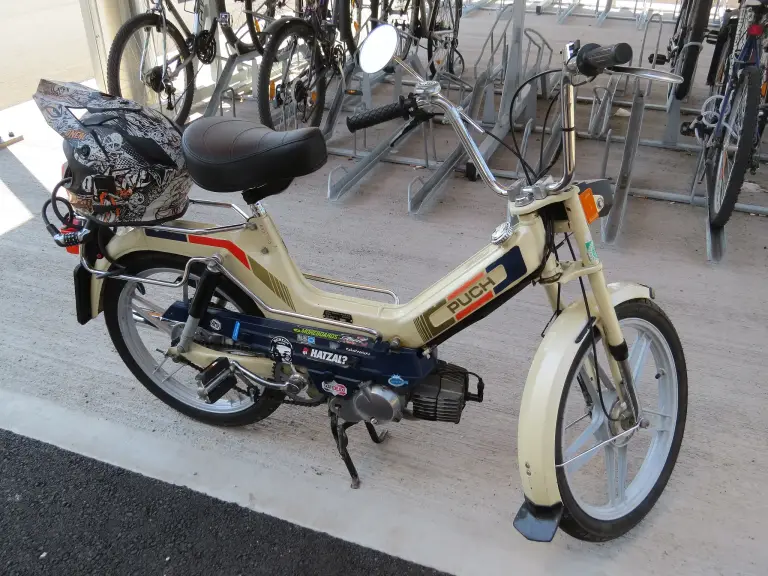
The smaller Puch 125 and 175 SV used the same split-single layout, and the Puch Maxi shows what the firm did with simple two-strokes later. More machines are in the Puch collection.
Video: Puch 250 MCH with twin carburettor, acceleration
Video by Muli puch on YouTube.
Sources
- Puch 250 SGS, English Wikipedia: engine layout, Sears sales, production total
- Puch 250 SGS, German Wikipedia: launch date, SG series, frame designers