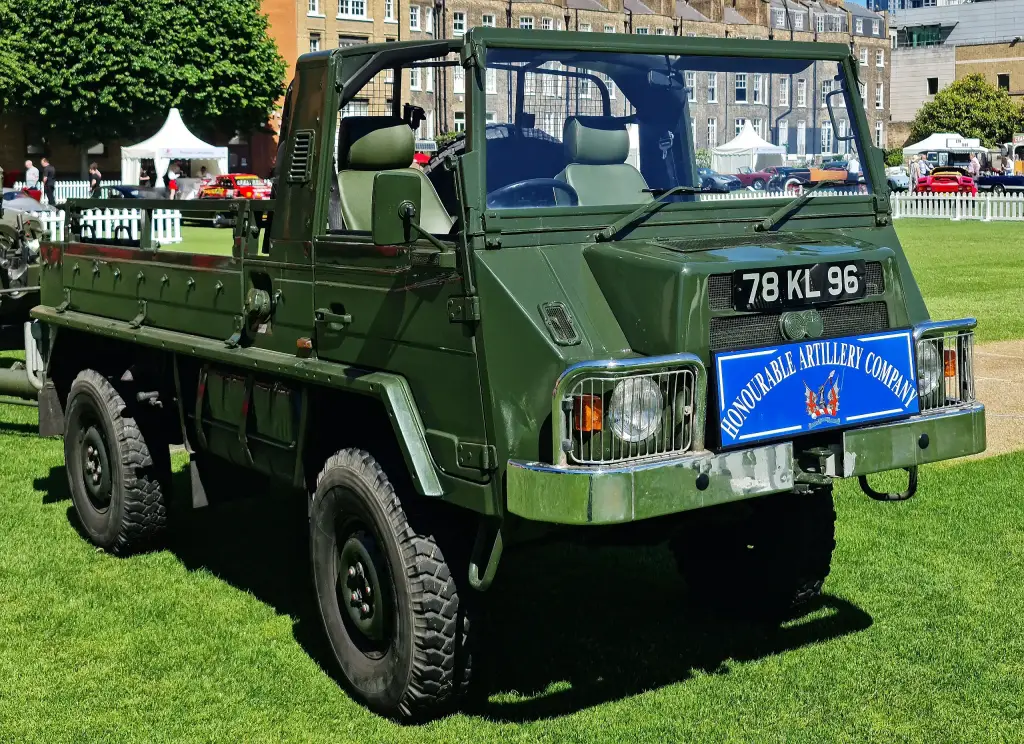
The Steyr-Puch Pinzgauer is a family of high-mobility all-terrain military utility vehicles with four or six driven wheels. It was developed in the late 1960s and built by Steyr-Daimler-Puch in Graz, Austria, from 1971, as the successor to the Steyr-Puch Haflinger.
Steyr-Puch Pinzgauer at a glance
| Maker | Steyr-Daimler-Puch, Graz, Austria |
|---|---|
| Production | 1971–2000 in Graz (first generation) |
| Predecessor | Steyr-Puch Haflinger |
| Models | 710 (4×4) and 712 (6×6) |
| Engine | 2.5-litre air-cooled inline-four petrol |
| Power | 65 kW (88 PS), 180 Nm |
| Transmission | five-speed manual, two-speed transfer case |
| Chassis | central-tube backbone, portal axles, independent suspension |
| Top speed | 110 km/h |
| Payload | 10 people or two NATO pallets |
| Towing | 5,000 kg on road |
| Range | over 400 km; about 700 km with the 125-litre tank |
| Built (first generation) | 18,349 between 1971 and 1985 |
History of the Steyr-Puch Pinzgauer
The Pinzgauer was developed as the successor to the Haflinger, the small 4×4 that Steyr-Puch had built since 1958. The original prototype was developed around 1969 and production began in 1971 in Graz. The vehicle was named, like its predecessor, after an Austrian breed of cattle — the Pinzgauer, also called the Noriker — and it won the competition against the ÖAF Husar to become the standard vehicle of the Austrian army. Unlike the Haflinger, which had its engine in the rear, the Pinzgauer carries its engine above the front axle, and its central-tube chassis allows a wide range of bodies. Like the Haflinger it was developed in Graz under Erich Ledwinka, the son of Hans Ledwinka of Tatra and Steyr.
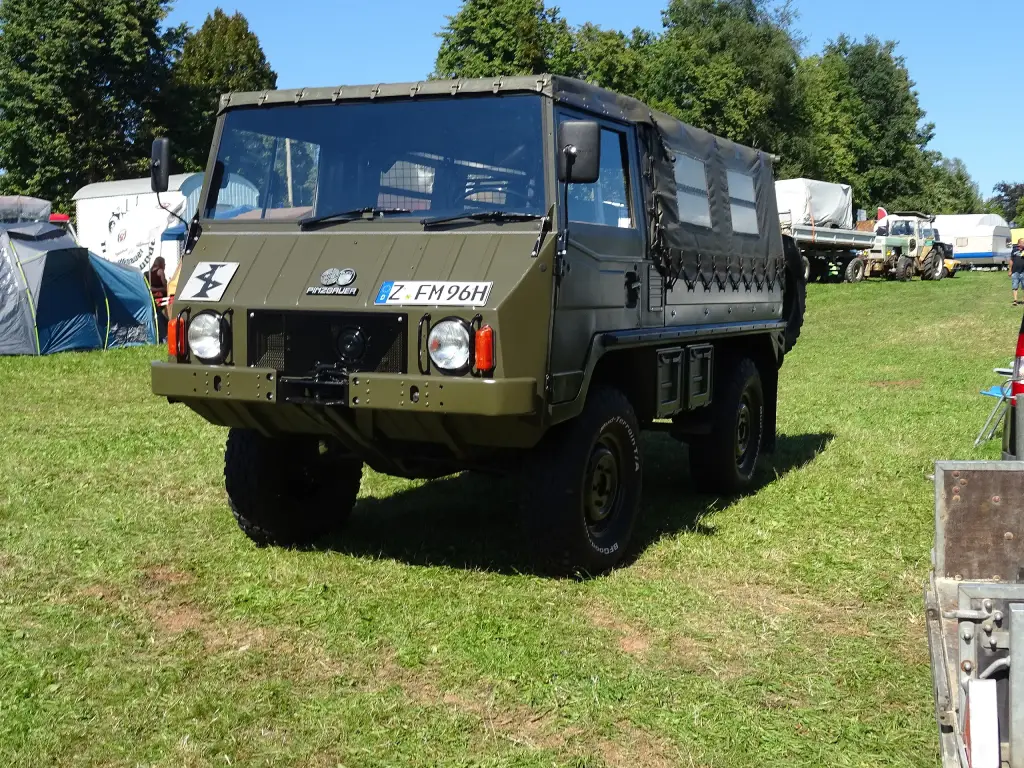
Chassis and running gear
The Pinzgauer’s mobility comes from its chassis. A central-tube backbone carries a transaxle that distributes the weight evenly and keeps the centre of gravity low. The differentials are sealed units needing little extra lubrication, and portal axles, as on the Unimog, give extra clearance over obstacles. Suspension is fully independent. The engine was designed specifically for the vehicle and has more than one oil pump, so that it is not starved of oil whatever the angle of the vehicle. The first generation used a 2.5-litre air-cooled inline-four petrol engine with twin Zenith 36 mm NDIX carburettors, rated at 65 kW (88 PS) and 180 Nm, with a five-speed manual gearbox and a two-speed transfer case.
Four or six wheels
The first generation came as the 710 with four-wheel drive and the 712 with six-wheel drive; the 710 was the more popular variant, but the Pinzgauer was designed from the start to work well as a 6×6, and the rear suspension of the 712 was laid out for maximum traction, towing and load carrying. Body types were mainly the hard-topped K and the soft-topped M, with ambulance and pick-up versions as well. The vehicle can carry ten people or two NATO pallets in its smallest form, tow 5,000 kg on the road and reach 110 km/h, and it has a range of over 400 km, or nearly 700 km with the optional 125-litre tank. Between 1971 and 1985, 18,349 first-generation 710s and 712s were built for military and civilian customers.
Second generation and the end in Graz
In 1980 Steyr-Daimler-Puch began work on a second-generation Pinzgauer, which reached the assembly line in 1986 as the 716 (4×4) and 718 (6×6). These cars used a Volkswagen turbocharged diesel, a four-speed automatic or five-speed manual gearbox, a slightly wider track, bigger tyres and disc brakes. In 2000 the rights and production were sold to Automotive Technik in the United Kingdom, which was later taken over by Armor Holdings and then by BAE Systems; production ended around 2009. The Graz plant, meanwhile, went on building the Mercedes-Benz G-Class, which Puch also sold as the Puch G.
Design and features
- Central-tube chassis: a backbone frame with a transaxle for even weight distribution and a low centre of gravity.
- Portal axles: extra ground clearance, with fully independent suspension.
- Air-cooled engine: a 2.5-litre four with two oil pumps so that it works at any angle.
- 4×4 or 6×6: the 710 and 712, with the 712 designed for maximum traction and towing.
- Military and civilian use: armies from Austria to Bolivia, and at home also the post, fire service and Red Cross.
Steyr-Puch Pinzgauer versions
- 710 (4×4): the more popular first-generation model.
- 712 (6×6): six-wheel drive with a longer body and higher payload.
- K and M bodies: hard-topped and soft-topped versions, plus pick-ups and ambulances.
- 716 and 718: the second generation of 1986, with Volkswagen turbo diesel engines.
- Pinzgauer II: developed in the United Kingdom after production left Graz.
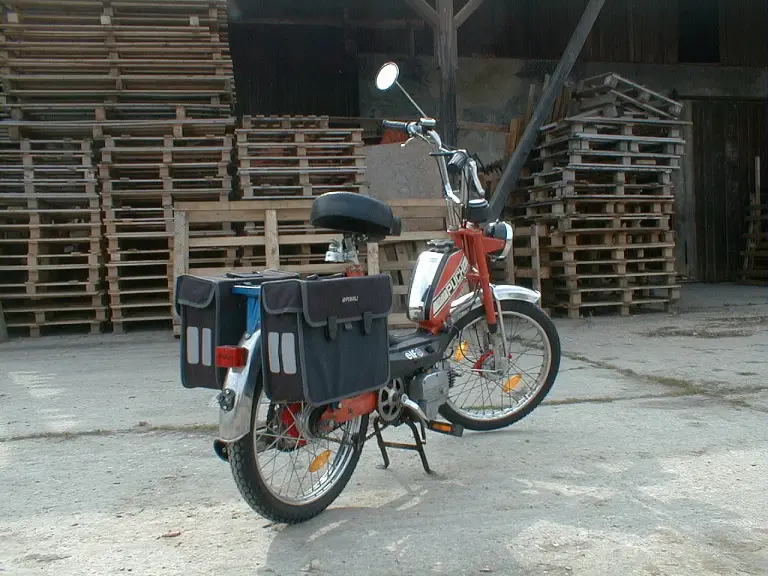
The Pinzgauer’s stablemate in Graz was the Puch G, the Austrian version of the Mercedes-Benz G-Class, and the Puch Maxi shows the firm’s other side. More vehicles are in the Puch collection.
Video: Pinzgauer in extreme terrain
Video by Lenz Mariacher on YouTube.
Sources
- Steyr-Puch Pinzgauer, English Wikipedia: development, chassis, engine, production figures
- Steyr-Puch Pinzgauer, German Wikipedia: Erich Ledwinka, model range, Austrian service