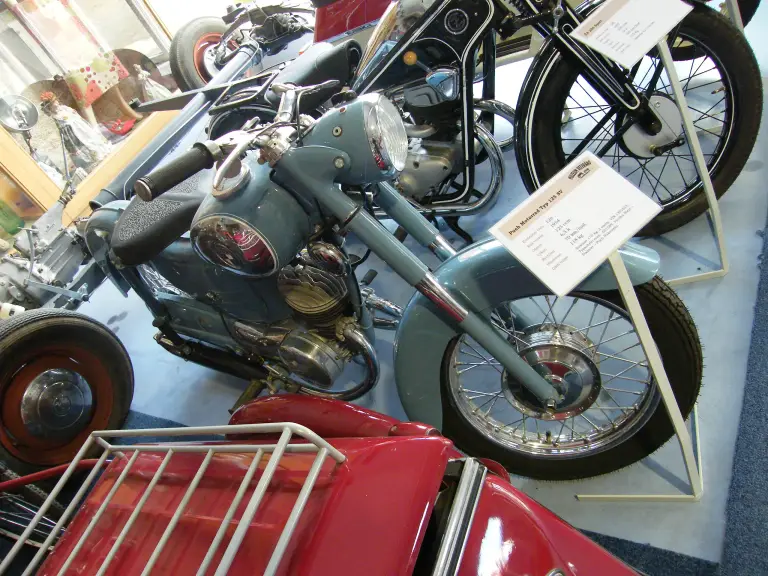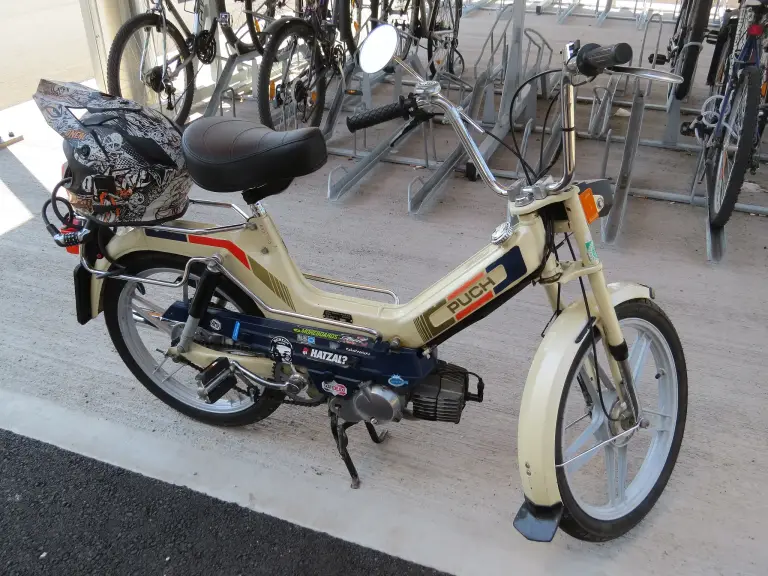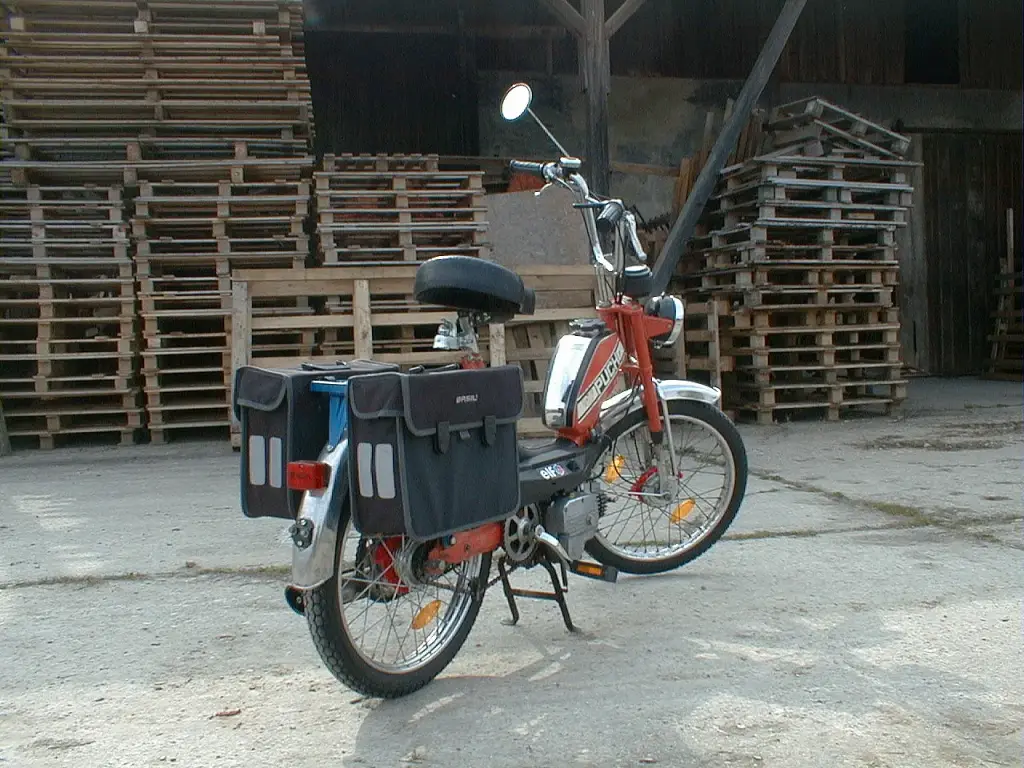
The Puch X30, known in Austria as the Sprinter, is a moped built by Steyr-Daimler-Puch in Graz. It is technically related to the Puch Maxi but was sold as the more refined “half-sister” of that model, with a single-tube frame, a slim tank and large chrome-spoked wheels.
Puch X30 at a glance
| Maker | Steyr-Daimler-Puch, Graz, Austria |
|---|---|
| Also called | Sprinter, in Austria |
| Related model | Puch Maxi |
| Engine | Z50 air-cooled or ZA50 fan-cooled two-stroke single |
| Displacement | 48.8 cc |
| Power | 1 kW (1.36 PS) at 3,300 rpm |
| Gearbox | two-speed, hand shift or rarely automatic, wet clutch |
| Frame | single-tube frame with rear swing arm |
| Tyres | 2¼ × 17 |
| Top speed | 25, 30 or 40 km/h, depending on the market |
The X30 is described only in the German Wikipedia, with a short mention in the article on the Maxi; this page is based on those two articles.
History of the Puch X30
The X30 belongs to the rarer Puch mopeds. It used a single-tube frame with a rear swing arm and a simple telescopic fork at the front, a slim and relatively small fuel tank — a “hole tank” was sometimes used in Switzerland — and large chrome-spoked wheels, although some models had cast wheels. Puch saw the X30 as a high-quality half-sister of the Maxi and advertised it accordingly, hoping to attract younger buyers. That worked only in part: especially in Germany and Switzerland the X30 was too expensive against the competition, and many customers chose the Maxi instead.
Before the Maxi
The X30 has a place in the Maxi’s own history. The two-wheel historian Friedrich F. Ehn names the Puch X30, as it was built for Switzerland in 1962, as the immediate predecessor of the Maxi, and the German Wikipedia article on the Maxi repeats the point: the X30 was a completely different construction from the older MS 50 of 1954. The two models were then sold side by side, the X30 as the more expensive and more sporting machine and the Maxi as the cheap mass-market moped.
Engines and gearboxes
Although several engines were used over the long production life of the X30, the basic figures stayed almost the same. The Z50 was air-cooled and the ZA50 fan-cooled; both were single-cylinder two-strokes of 48.8 cc producing 1 kW (1.36 PS) at 3,300 rpm. The gearbox had two speeds and was usually shifted by hand, with an automatic version offered but rarely ordered, and it ran in oil with a wet clutch. Tyres were 2¼ × 17, and the top speed depended on the market: 25, 30 or 40 km/h.
The X30 today
The good chassis and robust engine make the X30 a popular basis for tuning and conversions, and many were used up in moped racing. Most surviving machines are in Switzerland; in Germany and Austria the X30 is relatively rare. Early versions with the pedal crank in the frame — later models had it in the engine housing — are almost extinct and, like the special models, fetch high prices among collectors. X30s still in everyday use are rare, and in Germany spare parts are hard to find, which makes keeping one on the road expensive.
Design and features
- Single-tube frame: a light frame with a rear swing arm and a simple front fork.
- Slim tank: a narrow tank, sometimes the Swiss “hole tank” version.
- Two-speed gearbox: hand shift as standard, automatic rare, wet clutch in oil.
- Big wheels: chrome-spoked 17-inch wheels on most models, cast wheels on some.
- Tuning basis: a strong chassis and engine that made the X30 a favourite for moped racing.
Puch X30 versions
- Early X30: pedal crank mounted in the frame; almost extinct today.
- Later X30: pedal crank moved into the engine housing.
- Swiss models: sometimes fitted with the “hole tank”.
- Cast-wheel versions: a small number left the factory on cast rather than spoked wheels.
- Special models: the rarest versions, now expensive among collectors.
The X30 was the immediate predecessor of the Puch Maxi and a different construction from the older Puch MS 50. More Puch models are in the Puch collection.
Sources
- Puch X 30, German Wikipedia: models, engine, gearbox, market position
- Puch Maxi, German Wikipedia: X30 as the Maxi’s predecessor
- Puch, English Wikipedia: the Graz factory and its moped production