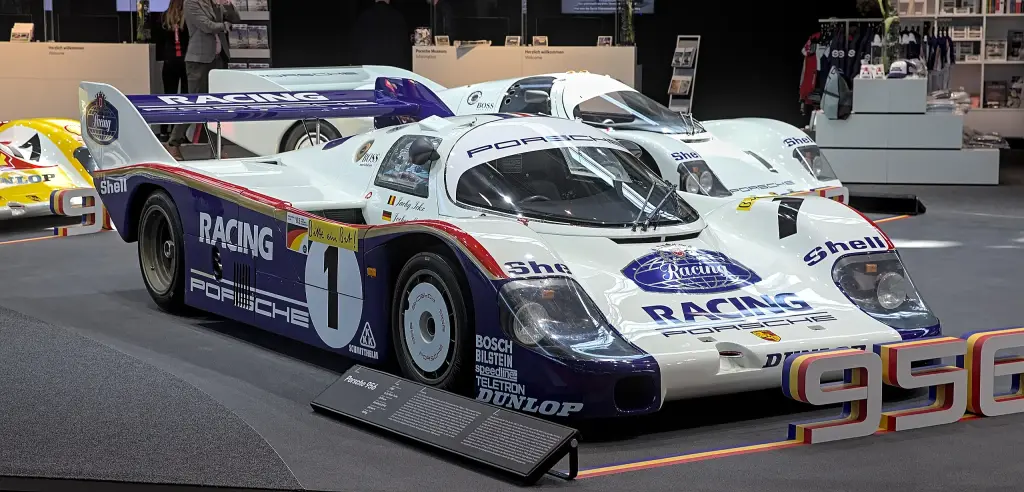
The Porsche 956 is a Group C sports-prototype designed by Norbert Singer and built in 1982 for the FIA World Sportscar Championship. It replaced the 936, became the first Porsche with an aluminium monocoque and ground-effect aerodynamics, and was upgraded to the 956B in 1984.
Porsche 956 at a glance
| Maker | Porsche, Stuttgart |
|---|---|
| Designer | Norbert Singer |
| Built for | Group C, from 1982 |
| Chassis | aluminium monocoque, Porsche’s first |
| Weight minimum | 800 kg in Group C |
| Engine | 2.65-litre Type 935 turbocharged flat-six |
| Power | about 635 hp |
| Aerodynamics | ground effect, over three times the downforce of a 917 |
| Upgrade | 956B in 1984, with Bosch Motronic for better fuel economy |
| Built | 28 by Porsche, plus an unofficial 29th from spare parts |
| Lap record | 6:11.13 at the Nürburgring Nordschleife, Stefan Bellof, 1983 |
History of the Porsche 956
The 956 was built to the new Group C rules introduced in 1982, replacing the 936 of the old Group 6 championship. Work began in June 1981 and the first prototype chassis was finished on 27 March 1982, in time for the start of the season; Jürgen Barth tested it on Porsche’s private track. The car was the first Porsche with an aluminium monocoque, which helped it meet the Group C minimum weight of 800 kg, and the first with ground-effect aerodynamics: it produced more than three times the downforce of the 917 that had raced a decade earlier.
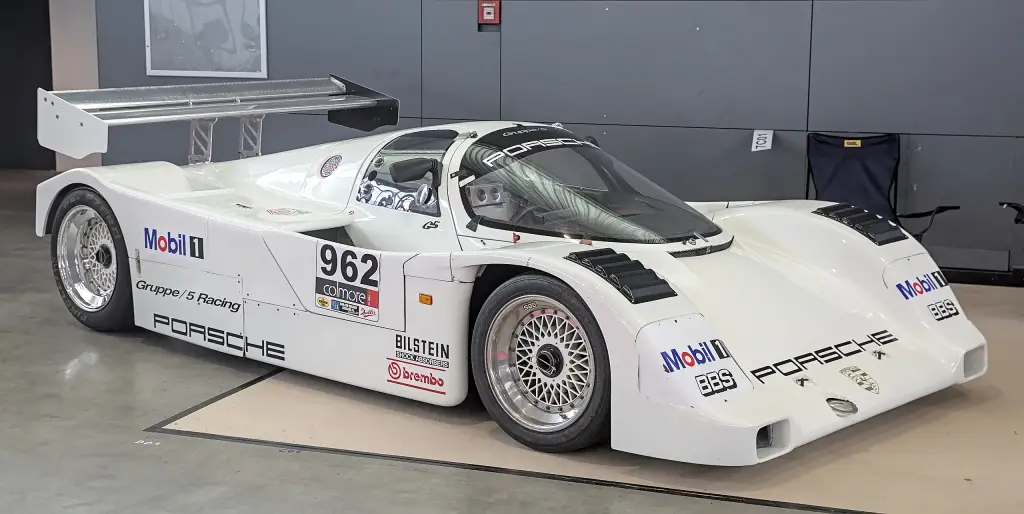
The engine was the one used in the 936/81, the 2.65-litre Type 935 turbocharged flat-six of about 635 hp, originally developed as an Indycar engine, which explains its capacity. For 1984 an improved chassis with better fuel economy from a Bosch Motronic electronic system was developed as the 956B. Porsche built 28 cars between 1982 and 1984, and Richard Lloyd Racing assembled an unofficial 29th from spare parts.
The 956 two rear wing designs: a larger high-downforce wing for most circuits, and for Le Mans a much lower and smaller low-drag wing so that the cars could reach around 362 km/h on the Mulsanne Straight. Some privateer teams experimented with a front wing at tight circuits, but wind tunnel work found it disturbed the airflow and added drag. The factory-backed Rothmans cars used a one-piece body undertray, which helped the ground effect, while customer cars had a twin undertray that slightly reduced downforce.
The debut came at the Silverstone 6 Hours, the second round of the championship, with Jacky Ickx and Derek Bell driving. After missing the Nürburgring for development reasons, the pair reappeared at the 24 Hours of Le Mans, led for the whole race and won, the two other factory 956s following them home for a 1-2-3 finish in starting-number order. Customer cars were then sold to Joest, Obermaier, John Fitzpatrick, Richard Lloyd, Kremer and Brun Motorsport, who raced them independently of the factory.
In 1983 Stefan Bellof set the all-time lap record for the 20.8 km Nürburgring Nordschleife during qualifying for the 1000 km race, lapping in 6:11.13 at an average of 202 km/h; the record stood for 35 years until Timo Bernhard beat it in a derestricted Porsche 919 Evo on 29 June 2018. Bellof also held the race lap record of 6:25.91. Chassis 107 served in 1983 as a testbed for the P01 Formula One engine that became the TAG-Porsche, winning 25 Grands Prix with McLaren between 1984 and 1987, and the 956 was used to test Porsche’s PDK dual-clutch gearbox, later fitted to the 962 and eventually to production cars. Bellof died at the 1985 1000 km of Spa when his 956 collided with Ickx’s newer 962, and safety concerns pushed teams towards the 962. The 956’s last win and last race came with Joest Racing at the end of the 1986 season.
Design and features
- Aluminium monocoque: a Porsche first, and a way to reach the 800 kg Group C minimum.
- Ground effect: more than three times the downforce of the 917.
- Two rear wings: high downforce for most tracks, low drag for the Mulsanne Straight.
- Technology testbed: PDK gearbox and the TAG Formula One engine were developed in it.
Porsche 956 versions
- 956 (1982–1983): the original Group C car.
- 956B (1984): Bosch Motronic and better fuel economy.
- Low-drag Le Mans cars: small rear wing for the long Mulsanne Straight.
- Customer cars: sold to Joest, Kremer, Brun and others.
The 956 replaced the Porsche 936 and was developed into the Porsche 962. More cars are in the Porsche collection.
Sources
- Porsche 956, English Wikipedia: development, chassis, engine, racing record