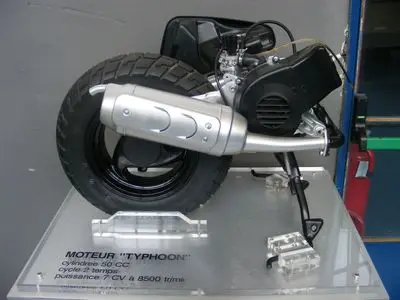
The Piaggio Typhoon, born as the Gilera Typhoon, is a scooter produced by Piaggio from 1993 to 2020. It was a sporty scooter, also suited to light use on unmade surfaces, and it became a Piaggio in 2000.
Piaggio Typhoon at a glance
| Production | 1993–2020 |
|---|---|
| Presented | 15 April 1993 at Bellagio, as the Gilera Typhoon |
| First-series engines | 50, 80 and 125 cc, two-stroke |
| Tyres | semi-knobbly, wide section and high shoulder, on 10-inch rims |
| Front suspension | upside-down Showa fork |
| Rear suspension | single shock absorber offset from the frame |
| Brakes | semi-hydraulic front disc and rear drum |
| Piaggio brand | from 2000 |
| 2006 update | new front fairing, mirrors and HI-PER2 engine |
| Second generation | from the end of 2010, with 12-inch knobbly tyres |
| Second-series engines | 49.4 cc two-stroke and 124 cc four-stroke |
| Aprilia twin | Aprilia SR Motard, from 2012 |
The article is based on a single source, the Italian Wikipedia page on the Typhoon; there is no English article on the model.
History of the Piaggio Typhoon
The Gilera Typhoon was presented on 15 April 1993 at Bellagio as a sporty scooter, suited to light distances on unmade surfaces as well. The first series had two-stroke engines of 50, 80 and 125 cm3, while in the second series the largest engine was replaced by one of the same capacity but four-stroke. Towards the end of the 1990s it was the flagship of the Piaggio group against the MBK Booster, whose technical characteristics it shared. The Typhoon used semi-knobbly tyres of wide section and high shoulder on 10-inch rims, which gave it the ability to deal with broken surfaces.
The Gilera years (1993–2000)
The cycle parts consisted of an upside-down Showa fork at the front and a single shock absorber offset from the frame at the rear. The adoption of the long Piaggio engine block, with a greater wheelbase than the standard version, improved stability compared with other Piaggio mopeds of the time. The brakes were a semi-hydraulic front disc and a rear drum. The two-stroke engines were a forced-air-cooled single of 49.7 or 124.7 cm3, in cast iron or aluminium respectively, with reed valve induction at the crankcase and CVT transmission; the four-stroke used a Piaggio LEADER engine of 124.9 cm3, a forced-air-cooled two-valve single with a single overhead camshaft and CVT. The line is marked by the characteristic shark nose, while at the rear the bodywork was shared with the first series of the Piaggio NRG. After the great success of the Typhoon, with over 75,000 units sold in Europe in a year, Gilera also marketed the twin Storm from April 1994, more road-oriented and distinguished by 13-inch wheels with smoother tyres and by the 50 engine only.
A Piaggio from 2000
In 2000 the Typhoon lost the Gilera badge and was sold as a Piaggio. In 2006 it was renewed with a new front fairing, new mirrors and the new Piaggio HI-PER2 engine. In 2007 a Gilera version returned, so the vehicle was sold both as the Piaggio Typhoon and as the Gilera Storm, the only differences being a 12-inch wheel and the 50 engine alone for the Storm. Production of the first-series Typhoon ended in 2010, replaced by the new generation, while the Gilera Storm was built until 2011.
Second generation (2010–2020)
At the end of 2010 the second generation was introduced, a complete evolution of the previous version: larger dimensions, a totally renewed and more streamlined design, and better cycle parts, with 12-inch knobbly tyres, air-cooled engines of 49.4 cm3 two-stroke and 124 cm3 four-stroke, a 220 mm front disc with a two-piston caliper and a 140 mm rear drum. The fork was changed for one with 120 mm of travel and conventional stanchions, and at the rear a spring shock absorber with 340 mm of travel was adopted, with a frame attachment of Minarelli derivation, using an eyelet instead of the previous bolt. The instrumentation lost the rev counter and got new graphics. From 2012 a twin scooter with 14-inch wheels, new graphics and colours was sold by Aprilia as the SR Motard. In November 2017 the Euro 4 Typhoon 50 made its debut.
The 125 two-stroke
Both the Piaggio and the Gilera Typhoon with the 124.4 cm3 engine used the same frame as the 50, with the only difference of a stiffer bar around the engine mount. With a compression ratio of 9.5:1 the engine gave about 13 hp and a top speed of about 115 km/h. The air-cooled two-stroke was reliable and powerful for its dry weight of 96 kg, and the six-transfer cylinder without a pneumatic exhaust valve allowed fuel consumption of about 18 km/l in town. An automatic mixer in the transmission casing, driven by a belt from the crankshaft, kept the oil mixture regular, with oil consumption of about one litre every 2,300 km. The moped was immediately popular with young riders thanks to its modern design, its motorcycle-like performance and the ease with which the two-stroke could be tuned; the famous Malossi kit of 172 cc, known as the “180 Malossi”, reached over 25 hp with a new carburettor and a suitable exhaust.
Design and features
- Shark nose: the most recognisable feature of the first generation.
- Knobbly tyres: 10-inch on the first series, 12-inch on the second, for broken surfaces.
- Sporty chassis: upside-down Showa fork and a long engine block for stability.
- Tuning friendly: the 125 two-stroke was easily modified, and Malossi kits were popular.
Piaggio Typhoon versions
- Gilera Typhoon (1993–2000): 50, 80 and 125 cc two-strokes.
- Gilera Storm (1994): the road-oriented twin with 13-inch wheels and the 50 engine.
- Piaggio Typhoon (from 2000): the same scooter under the Piaggio badge.
- 2006 update: new fairing, mirrors and HI-PER2 engine.
- Second generation (2010–2020): larger body, 12-inch wheels and 50 and 125 engines.
- Aprilia SR Motard (2012): the twin with 14-inch wheels.
The Typhoon shared its rear bodywork with the NRG and was developed from the platform of the Sfera. More scooters are in the Piaggio collection.
Video: Overview 2012 Piaggio Typhoon 125
Video by Vespa Motorsport on YouTube.
Sources
- Piaggio Typhoon, Italian Wikipedia: generations, engines, Gilera years, the 125 two-stroke