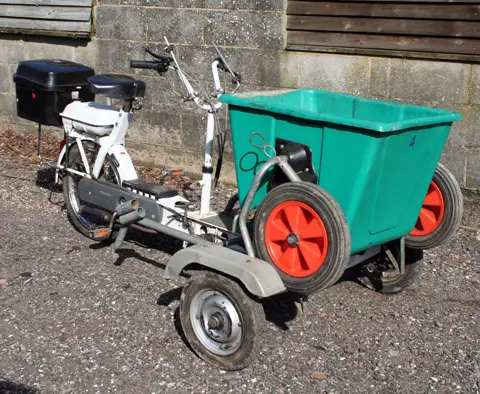
The Piaggio Bravo is a moped that the Italian manufacturer Piaggio presented in 1972 and sold from 1973 to 2001. It shared its mechanics with the Ciao but added rear suspension and a fuel tank separate from the frame.
Piaggio Bravo at a glance
| Presented | 1972 |
|---|---|
| On sale | 1973–2001 |
| Engine | two-stroke, running on an oil–petrol mixture |
| Rear suspension | engine and transmission in a cradle, located by two shock absorbers |
| Front fork | telescopic |
| Fuel tank | separate from the frame, in plastic or metal |
| First series | 1973–1974, types EEM1, ERM1, ETM1, EEV1 and ETV1 |
| Second series | 1975–1981, types Erre2, EEM1T and ETM1T |
| Third series | 1982–1987, types EEM2T and EEV2T |
| Third series versions | P with single-speed pulley drive, PV with variator, Ecology System |
| Tank fixing | three bolts on the first series, four on the second and third |
The article is based on a single source, the Italian Wikipedia page on the Bravo, and is shorter than usual for that reason.
History of the Piaggio Bravo
The Bravo was presented in 1972 and went on sale the following year, staying in production until 2001. What distinguishes it from the Ciao is the rear suspension: the engine and transmission sit inside a cradle that is hinged at the front and located at the rear by a pair of shock absorbers. The front fork is telescopic. The Bravo is the only moped of the Piaggio family with a tank separate from the frame, in plastic or metal and fixed to it with three or four bolts depending on the series. The mechanics are otherwise similar, with a two-stroke engine running on a mixture of oil and petrol.
Three series
The Bravo was built in three main series: the first from 1973 to 1974 with the types EEM1, ERM1, ETM1, EEV1 and ETV1; the second, called Erre2, from 1975 to 1981 with the types EEM1T and ETM1T; and the third from 1982 to 1987 with the types EEM2T and EEV2T. The third series came in three versions: the P with a single-speed pulley transmission, the PV with a variator, and the Ecology System, which used an engine designed to reduce polluting emissions. The first series is distinguished by a round saddle post and a different fork, and by a plastic tank with three holes for the frame; on the second and third series the tank was metal with four holes. First-series Bravos were two-tone. Every series was offered with either the variator or the single-speed transmission.
Superbravo
A sportier version of the normal Bravo was sold as the Superbravo, in several colour combinations of which the most common was grey and yellow, with a long saddle, specific stickers and a kick starter.
Superbravo 2 and 3, and the Bravo 3
The Superbravo 2 marce was made exclusively for the German market. It had a two-speed gearbox, a plastic tank and starting by the traditional pedals instead of a kick starter and footrests, and it used a rear brake worked by the pedal. It was produced in two red variants, one with black plastics and one with white plastics. The Superbravo 3 came in a single colour, red and black, with a three-speed gearchange on the handlebar and specific Redskin stickers. Finally, a very rare Bravo 3 differed from the standard moped only in its three-speed transmission.
Design and features
- Rear suspension: the engine cradle on two shock absorbers separated the Bravo from the rigid Ciao.
- Separate tank: the only Piaggio moped of the family with a tank bolted to the frame.
- Telescopic fork: a more modern front end than the leading-link fork of the Ciao.
- Two transmissions: single-speed pulley drive or a variator, depending on the version.
Piaggio Bravo versions
- First series (1973–1974): round saddle post, plastic tank with three bolts, two-tone paint.
- Second series Erre2 (1975–1981): metal tank with four bolts.
- Third series (1982–1987): P, PV and Ecology System versions.
- Superbravo: sporty version with a long saddle and a kick starter.
- Superbravo 2 marce: German-market version with a two-speed gearbox and pedals.
- Superbravo 3 and Bravo 3: three-speed versions with specific stickers.
The Bravo shared its engine with the Ciao and sat alongside the Boxer; the Si was the other derivative of the same family. More mopeds are in the Piaggio collection.
Sources
- Piaggio Bravo, Italian Wikipedia: series, versions, tank and suspension details