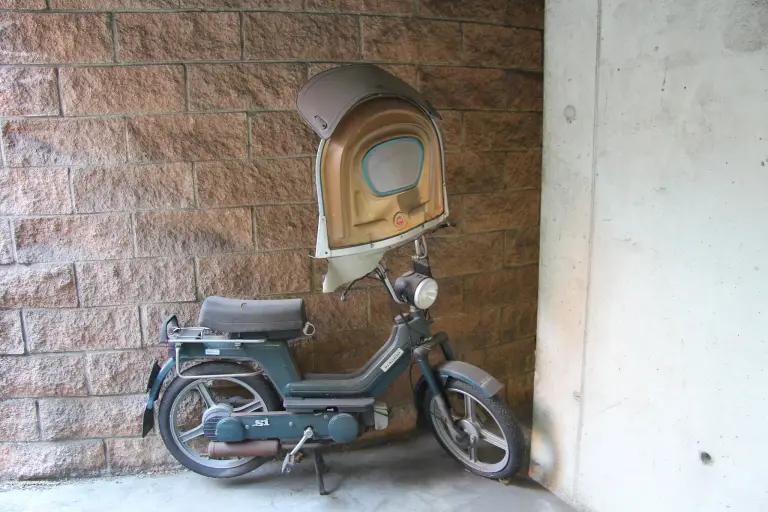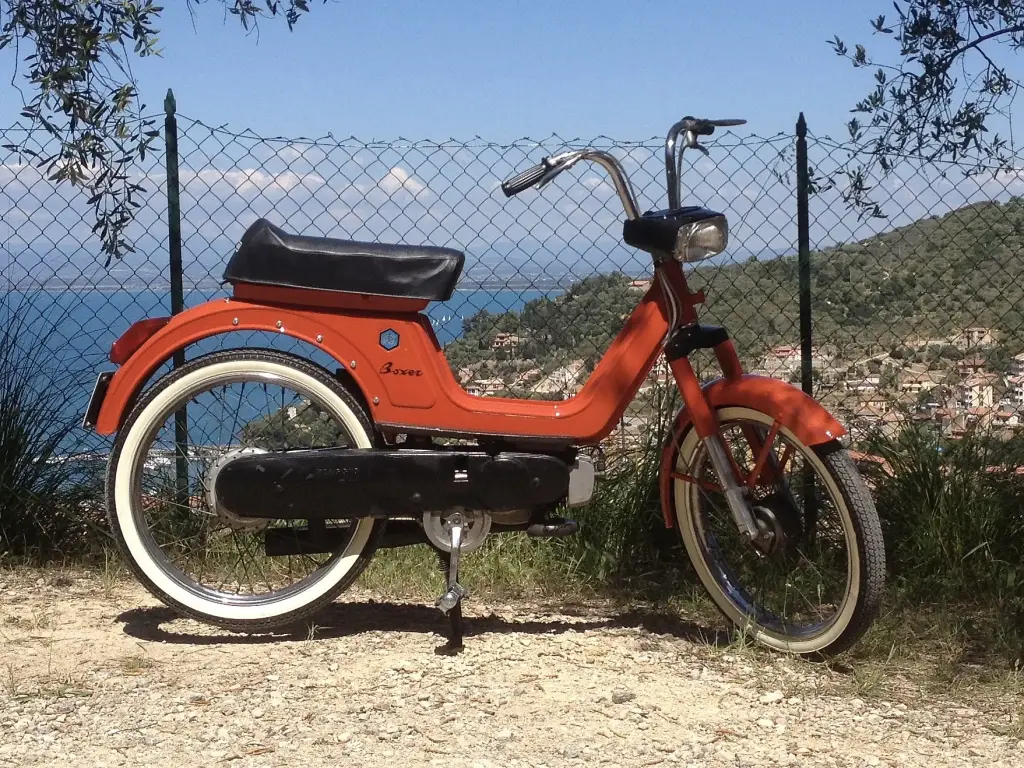
The Piaggio Boxer is a moped produced by the Italian manufacturer Piaggio in two series. The first used a plastic tank under the seat and 18-inch high wheels; the Boxer 2 changed the frame profile, the stickers, the front fender and the wheels, and the model was eventually replaced by the Piaggio Si.
Piaggio Boxer at a glance
| Type | moped |
|---|---|
| First series tank | plastic, housed under the seat |
| First series wheels | 18-inch high wheels |
| Saddle | single-seater, long saddle on request |
| Front suspension | telescopic fork on most cars; shackle type on rare early examples |
| First series versions | B1M and B3M with centrifugal clutch only; B2V with variator |
| Identification plate | moved to the end of the rear fender |
| Boxer 2 changes | stickers, frame profile, front fender without rods, grey plastic, 17-inch wheels |
| Boxer 2 versions | BTM single-speed and BTV with variator |
| Replaced by | Piaggio Si |
The article is based on a single source, the English Wikipedia page on the Boxer; it is shorter than usual for that reason.
History of the Piaggio Boxer
The first series of the Boxer was built using the underseat as a tank, in plastic, and it had 18-inch high wheels and a small single-seater saddle, with a long saddle available on request. Rare examples of the first series used the shackle-type front suspension already seen on the Piaggio Ciao in its B1M version, but the vast majority of Boxers left the assembly line with the telescopic fork of the B2V and B3M versions. Another novelty was the position of the identification plate carrying the chassis number, which was moved to the end of the rear fender.
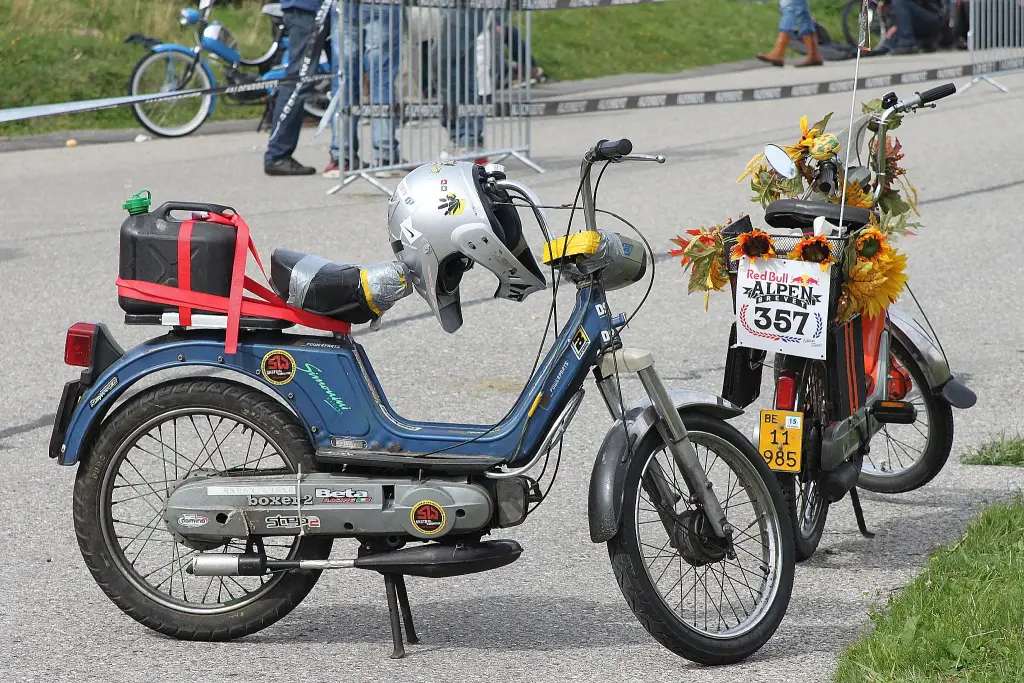
Two transmissions
The Boxer was sold with two different transmissions. The B2V version had a speed variator with expandable pulleys and an automatic centrifugal clutch, while the B1M and B3M versions had only a centrifugal clutch and a final pulley. The choice made the Boxer a simple moped to ride, with no gear lever and no chain to look after.
The Boxer 2
The second series, called Boxer 2, differed from the first in its stickers, frame profile, a front fender without rods, grey plastic parts and 17-inch wheels. It was produced in two versions, the BTM with a single speed and the BTV with a variator. The shackle suspension of the earliest cars was no longer offered.
Replaced by the Si
The Boxer was subsequently replaced by the Piaggio Si, which was practically a modernisation of the same idea: a new chassis, but the same layout and the same engine. Together with the Ciao and the Bravo, the Boxer belongs to the family of Piaggio mopeds of the 1970s and 1980s that used a two-stroke engine and a simple pressed frame.
Design and features
- Tank under the seat: a plastic tank used the space that other mopeds gave to a frame tube.
- High wheels: 18-inch wheels on the first series, 17-inch on the Boxer 2.
- Simple transmission: a centrifugal clutch alone or a variator with expandable pulleys.
- Easy maintenance: belt drive and an enclosed engine, as on the other Piaggio mopeds.
Piaggio Boxer versions
- Boxer first series: plastic underseat tank, 18-inch wheels, telescopic fork on most cars.
- Boxer B1M and B3M: centrifugal clutch and final pulley, no variator.
- Boxer B2V: speed variator with expandable pulleys and automatic clutch.
- Boxer 2 BTM: second series with a single speed and 17-inch wheels.
- Boxer 2 BTV: second series with the variator.
The Boxer shared its front suspension with early versions of the Ciao, and it was replaced by the Si. More mopeds and scooters are in the Piaggio collection.
Video: Piaggio Boxer.avi
Video by Fabio Ricca on YouTube.
Sources
- Piaggio Boxer, English Wikipedia: series, versions, transmissions, replacement by the Si