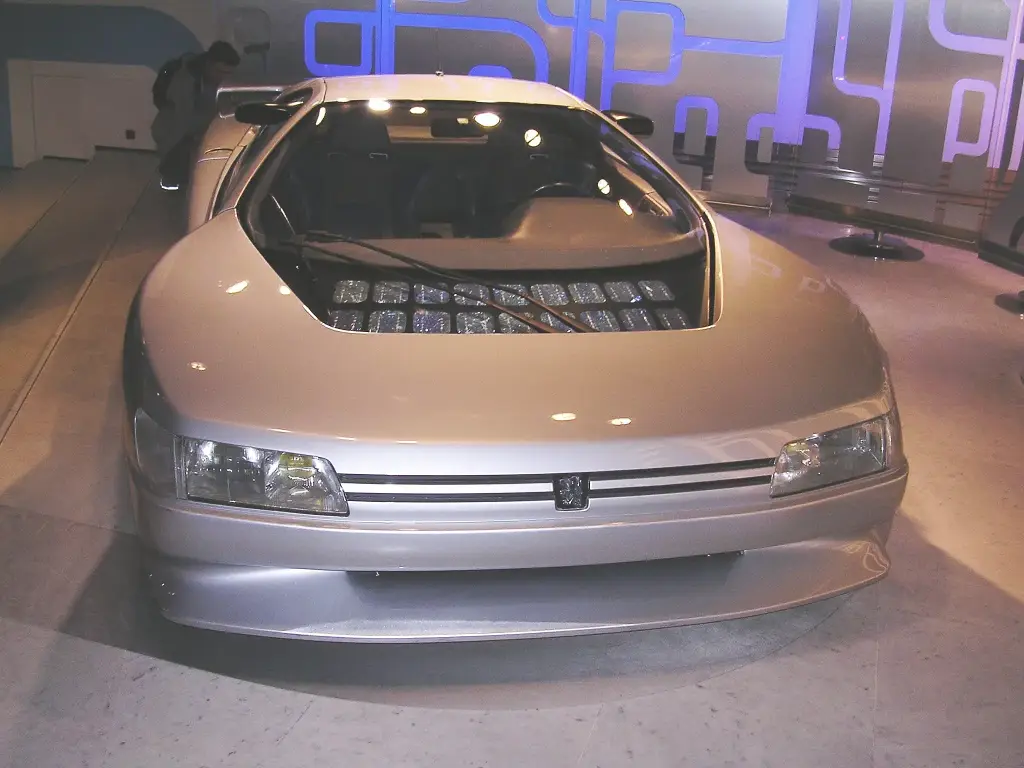
The Peugeot Oxia is a grand touring coupé prototype created by Peugeot in 1988 and designed at the La Garenne research centre. It was presented at the Paris Motor Show in 1988, and only two cars were built.
Peugeot Oxia at a glance
| Type | grand touring coupé prototype |
|---|---|
| Built | 1988, at La Garenne |
| Shown | Paris Motor Show, 1988 |
| Engine | 2.85-litre PRV V6, 24 valves, twin turbo |
| Power | 680 hp |
| Gearbox | six-speed manual |
| Drive | four-wheel drive |
| Top speed | 350 km/h recorded, 300 km/h declared |
| Body | kevlar and carbon fibre on an extruded aluminium chassis |
| Tyres | Michelin 235/45 ZR17 front, 285/40 ZR17 rear |
| Number built | two cars |
based on one source; no free photographs of the car were found, the existing thumbnail stays
History of the Peugeot Oxia
A car from another planet
The Oxia was designed in Peugeot’s La Garenne research centre and shown at the Paris Motor Show in 1988. Only two cars capable of reaching 350 km/h were built, which makes it the most powerful car Peugeot has ever produced in more than one example. Its name comes from Oxia Palus, a region of Mars.
Engineering
The car has a PRV V6 of 2.85 litres with 24 valves and two turbochargers, producing 680 hp through a six-speed manual gearbox and four-wheel drive. With the Michelin test driver Jean-Philippe Vittecocq at the wheel it reached 350 km/h, although Peugeot declared a top speed of 300 km/h. The body is made of kevlar and carbon fibre over an extruded aluminium chassis, with an adjustable rear spoiler that adapts to speed. Each cylinder had two electromagnetic injectors, the clutch is a hydraulic twin-plate unit, and the suspension uses double wishbones with coil springs. The engine is mounted in the centre.
Equipment
The interior was modern for its time: a telephone, a trip computer, eighteen photovoltaic cells at the bottom of the windscreen so that the air conditioning could keep working when the car was stopped, electrically adjustable seats and a radio with a CD input. Tyres were Michelin 235/45 ZR17 at the front and 285/40 ZR17 at the rear on magnesium wheels, and the brakes were two electronically controlled automatic units.
Design and features
- 680 hp: a twin-turbo 2.85-litre PRV V6 with 24 valves.
- Four-wheel drive: six-speed manual and a hydraulic twin-plate clutch.
- 350 km/h: the speed recorded with a Michelin test driver.
- Composite body: kevlar and carbon fibre on an aluminium chassis.
- Solar cells: photovoltaic panels that ran the air conditioning when parked.
Peugeot Oxia versions
- Oxia (1988): two prototypes built.
The Oxia followed the Proxima of 1986 and shares its PRV V6 family with the 605. More in the Peugeot collection.
Video: #3248. Peugeot oxia 1988 (Prototype Car)
Video by on YouTube.
Sources
- Peugeot Oxia, French Wikipedia: origin, engine, performance, body, equipment