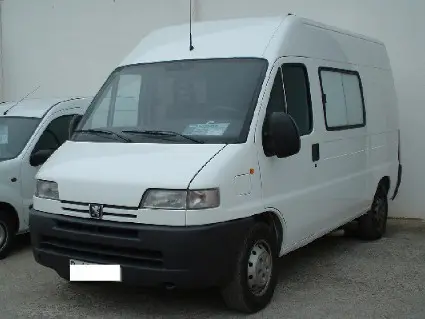
The Peugeot Boxer is a large light commercial vehicle, the Peugeot version of the Fiat Ducato, produced by the Sevel joint venture between Fiat and PSA Peugeot Citroën. It replaced the Peugeot J5 in 1994.
Peugeot Boxer at a glance
| Introduced | 1994 |
|---|---|
| Replaced | Peugeot J5 |
| Built by | Sevel, the Fiat and PSA joint venture |
| Plant | Sevel Sud, Atessa, Italy |
| Based on | the Fiat Ducato |
| Sister models | Fiat Ducato, Citroën Jumper (Relay) |
| Four-wheel drive | Dangel conversion with a central viscous coupling |
| Motorhome use | about two-thirds of European motorhomes |
| Other markets | sold as Ram ProMaster in North America from 2014 |
source page is about the shared Ducato and Boxer project; free photographs of the Peugeot version were not found, the existing thumbnail stays
History of the Peugeot Boxer
From the J5 to the Boxer
The Fiat Ducato was first launched in 1981, the result of a collaboration between Fiat and PSA Peugeot Citroën that began in 1978. The first generation was built at the Sevel Val di Sangro plant in Atessa in central Italy and at Sevel Campania in Pomigliano d’Arco near Naples, together with the Alfa Romeo AR6, the Citroën C25 and the Peugeot J5.
Those badges covered one van with different front ends. The Peugeot J5 was a 2.5-tonne van built from October 1981 to 1993, with transversely mounted petrol and diesel engines and a Citroën gearbox, and a series 2 with a new grille and headlights arrived in 1991. The J5 sold reasonably well in France but had little success elsewhere, overshadowed by the Ducato and its stronger dealer network. It was replaced in 1994 by the Peugeot Boxer, which was based on the second-generation Fiat Ducato.
The Sevel van
The Boxer belongs to the family of vans built mainly by Sevel, the joint venture between Fiat and PSA since 1981, and sold as the Fiat Ducato, the Citroën Jumper, known as the Relay in Britain, and the Peugeot Boxer. In Europe the vans are made at the Sevel Sud factory in Atessa, Italy, and also at the Iveco plant in Sete Lagoas in Brazil, at Karsan in Akçalar in Turkey, at the Fiat Chrysler Saltillo plant in Mexico and at the Fiat-Sollers factory in Elabuga in Russia. More than 3.5 million Ducatos have been produced since 1981, a figure that includes the Boxer and Jumper.
Uses
Because the van is sold with several wheelbases and roof heights, it is widely converted. Four-wheel-drive versions can be ordered, converted by the French company Dangel with a central viscous coupling. The Ducato family is the most common motorhome base in Europe, with about two-thirds of motorhomes using it, and in North America the same vehicle has been sold since May 2014 as the Ram ProMaster. The name Ducato refers to the ducat, the third Fiat commercial vehicle named after an old coin after the Fiorino and the Marengo.
Design and features
- Sevel platform: one van sold as Peugeot Boxer, Fiat Ducato and Citroën Jumper.
- It replaced the J5: the Boxer took over from the Peugeot version of the first Ducato.
- Many body options: several wheelbases and roof heights for conversions.
- Dangel 4×4: a factory-approved four-wheel-drive conversion.
- Motorhome base: about two-thirds of European motorhomes are built on it.
Peugeot Boxer versions
- Boxer (1994): the Peugeot version of the second-generation Ducato.
- Citroën Jumper: the same van from the other PSA brand, sold as the Relay in Britain.
- Dangel 4×4: four-wheel-drive conversion with a viscous coupling.
- Ram ProMaster: the North American version, from 2014.
The Boxer replaced the Peugeot J5 and sits above the Partner and the Bipper. More in the Peugeot collection.
Video: Peugeot Boxer 2014 review – Auto Express
Video by on YouTube.
Sources
- Fiat Ducato, English Wikipedia: Sevel project, plants, J5 and Boxer, Dangel, motorhomes