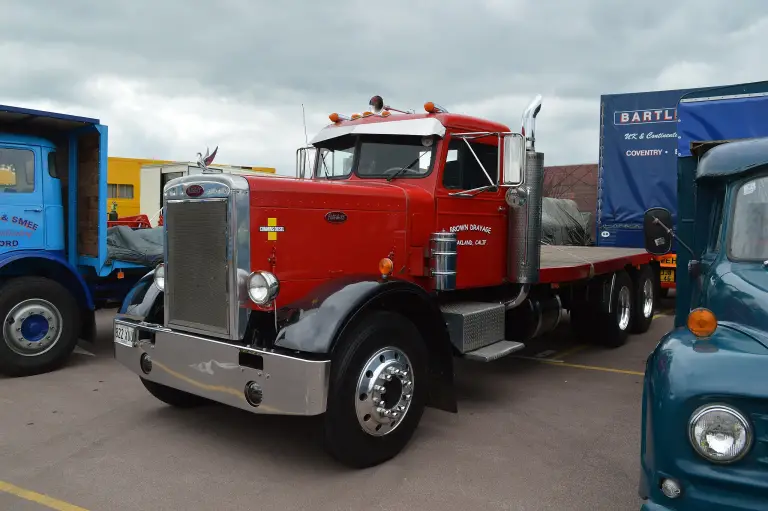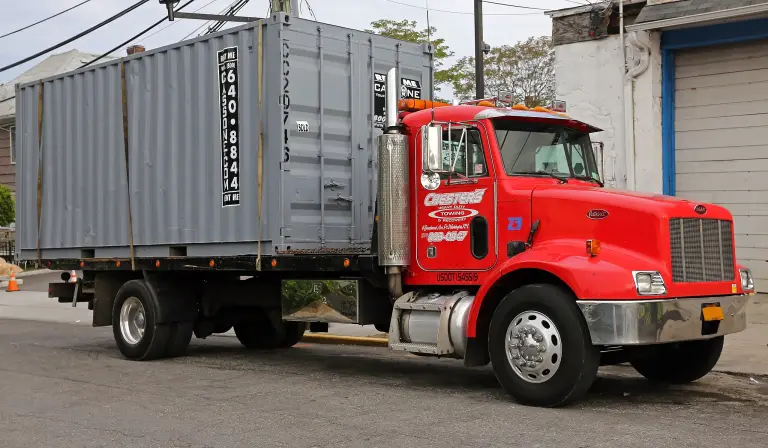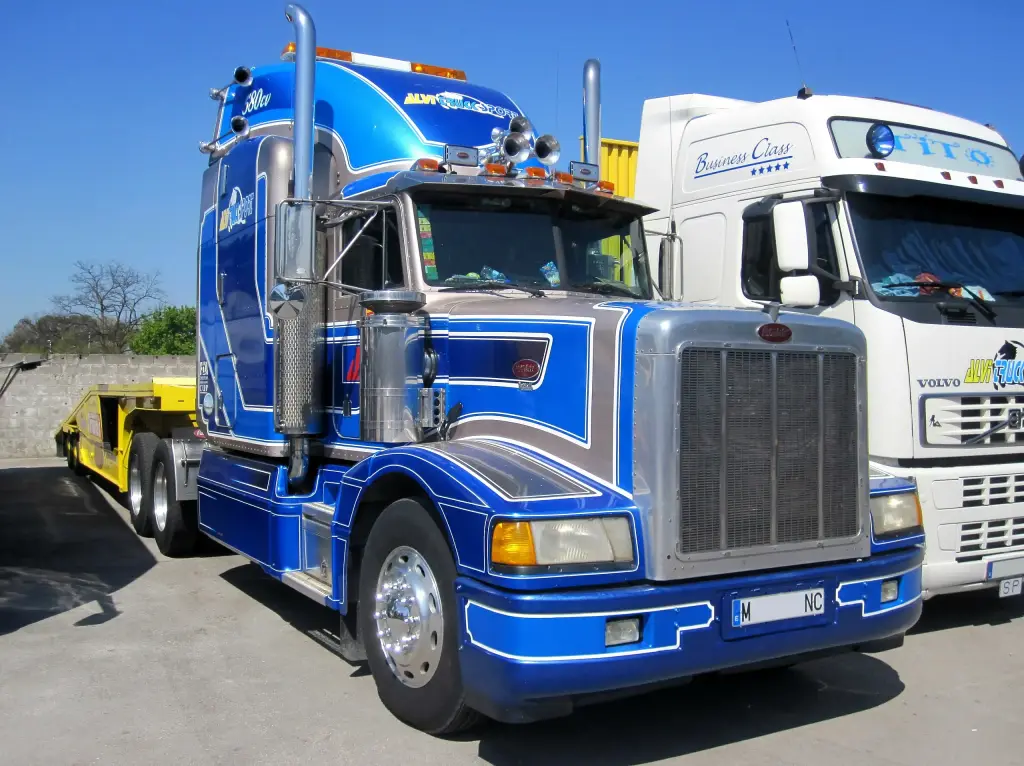
The Peterbilt 377 of 1986 was the company’s first aerodynamic conventional, more conservative in shape than the Kenworth T600 but pointed in the same direction. It had a hood angled further than the 348/349, a set-back front axle as standard and a wraparound bumper that was later joined by composite-lens headlamps.
Peterbilt 377 at a glance
| Maker | Peterbilt Motors Company (PACCAR) |
|---|---|
| Production | 1986–2000 |
| Class | on-highway, Class 8 |
| Layout | conventional cab |
| Hood | sloped, angled further than the 348/349 |
| Front axle | set-back as standard |
| Bumper | wraparound, integrated with the front fenders |
| Headlamps | composite lens lamps later in production |
| BBC | 120 inches set-back, 122 inches set-forward |
| Replaced by | 120-inch 385, along with the 387 |
History of the Peterbilt 377
The 377 was introduced for 1987, in the same programme that produced the 379. Where the 379 replaced the 359 as the standard long-hood tractor, the 377 was the aerodynamic alternative: its bonnet was angled further than the 348/349, its front axle sat back as standard and a wraparound bumper was integrated into the front fenders. Composite-lens headlamps came later in production.
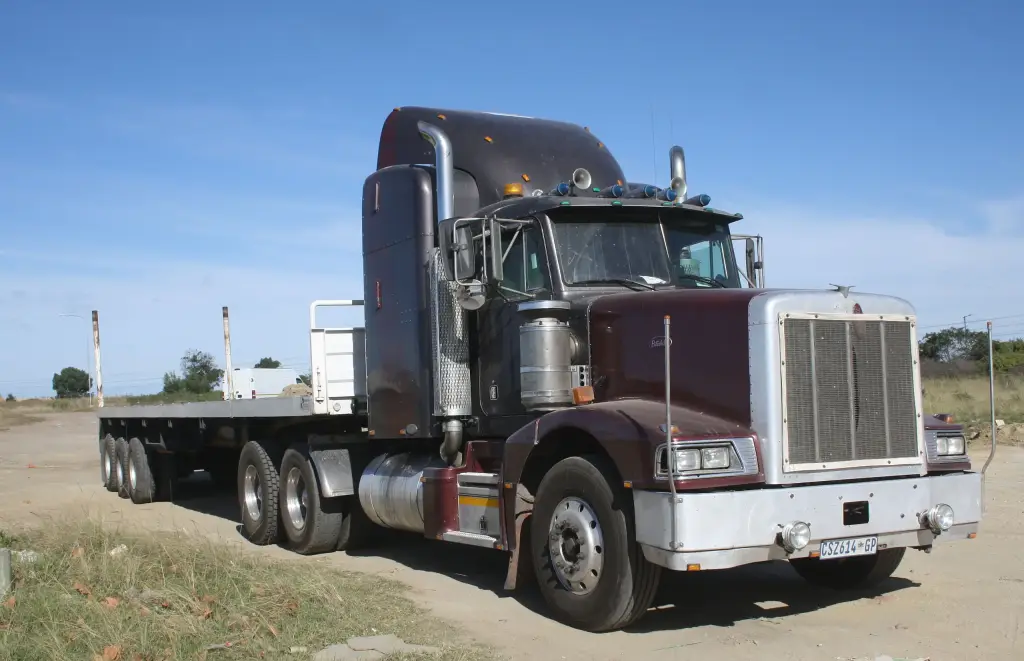
Peterbilt described the truck as more conservative than the Kenworth T600, the first of PACCAR’s aerodynamic tractors, but it followed the same logic of cutting fuel consumption by smoothing the airflow over the front of the truck. With the hood sloped and the axle set back, the driver also sat further back from the front of the vehicle than in the older conventionals.
The 377 ran until 2000. Its role was taken over by the 385, whose 120-inch version replaced it and the 375, and by the 387, which added a wide-body cab and a more thoroughly aerodynamic shape. Surviving 377s are now regarded as the transition point between the square Peterbilt and the rounded one.
Design and features
- First aerodynamic conventional: the 377 brought the sloped-hood idea into the Peterbilt range.
- Sloped bonnet: angled further than the 348/349 for better airflow.
- Set-back front axle: standard, improving weight distribution and the look of the truck.
- Wraparound bumper: integrated into the front fenders, later with composite-lens headlamps.
Peterbilt 377 versions
- 377 (1986–2000): the standard aerodynamic conventional.
- Set-back and set-forward versions: 120 and 122 inches.
- 375: the daycab version for lighter loads.
The daycab sister is the Peterbilt 375, and the replacement is the 385. The long-hood truck introduced with it is the 379; more in the Peterbilt collection.
Video: Inside Peterbilt 377
Video by Brett on YouTube.
Sources
- Peterbilt, English Wikipedia: 1987 launch, T600 comparison, hood angle, set-back axle, bumper
- List of Peterbilt vehicles, English Wikipedia: production years, BBC, composite headlamps, replacement