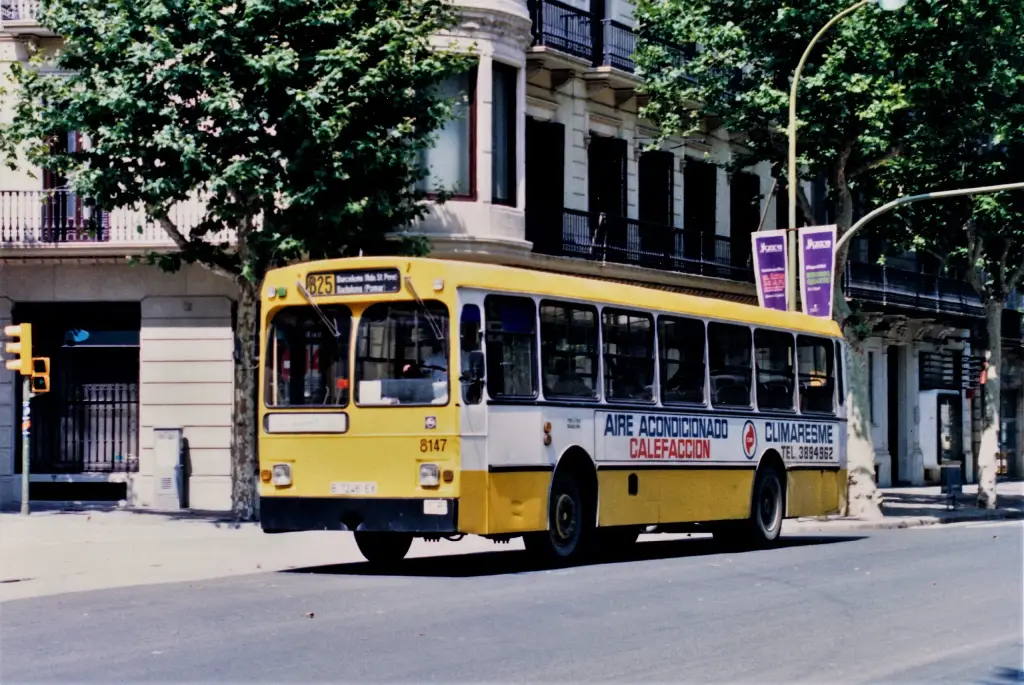
The Pegaso 6025 was the short version of the 6050 urban bus. ENASA presented both at the fourteenth Barcelona motor show, held from 22 April to 2 May 1972, as a modern replacement for the long-serving 6035.
Pegaso 6025 at a glance
| Maker | ENASA, Barcelona |
|---|---|
| Marque | Pegaso |
| Type | urban bus, short version of the 6050 |
| Shown | Barcelona motor show, 22 April to 2 May 1972 |
| Layout of the 6050 | rear engine, low floor, integral body |
| Purpose | one-man operation without a conductor |
| Related model | Pegaso 6050, built 1972–1980 |
| Owner | ENASA until 1990, then Iveco |
The 6025 has no Wikipedia article of its own; it is described in the Spanish article on the Pegaso 6050, and this page uses only what that article says.
History of the Pegaso 6025
At the start of the 1970s Spain’s municipal transport companies needed to renew their fleets and cut running costs. ENASA answered with a bus designed for one-man operation, so that the conductor could be dropped: with no need for a rear door, the engine could move to the back of the vehicle and the floor could be lowered.
The prototype of that bus, the 6050, was presented at the fourteenth Barcelona motor show in 1972 together with its short version, the 6025. Series production did not begin until 1974, when the first order of 200 buses for the Madrid municipal operator EMT went into build.
The 6050 family never replaced the older 6035 as ENASA had hoped. Over the same period the company built 1,402 examples of the 6035 against 1,004 of the 6050, and overheating of the rear-mounted engine, caused by poor cooling and repeated failures of the ventilation belts, is the likely reason. The short 6025 shared that engineering and the same fate, and the integral Pegaso bus line moved on to the 6038 and then the 6420.
Design and features
- Short body: the 6025 was the compact member of the 6050 family.
- Rear engine: a layout made possible by one-man operation, with no rear door.
- Lower floor: the rear engine allowed a floor height that made boarding easier.
- Shared debut: shown alongside the 6050 prototype in Barcelona in 1972.
Pegaso 6025 versions
- 6025: the short urban bus described here.
- 6050: the standard-length version, produced from 1974 to 1980.
The bus it was meant to replace is in Pegaso 6035, and the integral range that followed in Pegaso 6038 and Pegaso 6420; the whole marque is under Pegaso.
Sources
- Pegaso 6050, Spanish Wikipedia: 6025 short version, 1972 Barcelona show, production
- Pegaso, Spanish Wikipedia: bus ranges and company history