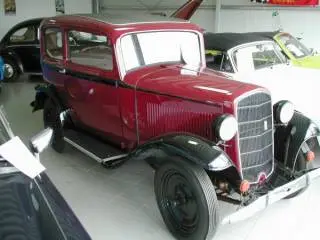
The Opel 1,2 Liter was a small car built by Opel from 1931 to 1935 and replaced by the broadly similar Opel P4, which stayed in production until December 1937. Both were developed in America after General Motors took control of Opel, and between 1932 and 1936 the model was the company’s best seller.
Opel P4 at a glance
| Maker | Adam Opel AG, Rüsselsheim |
|---|---|
| Production | July 1931 – December 1937 |
| Model | Opel 1,2 Liter, then Opel P4 |
| Engine | 1,193 cc four-cylinder side valve |
| Power | 22 PS, then 23 PS from 1933 |
| Top speed | 85 km/h, 82 km/h with Regent body |
| Gearbox | three-speed without synchromesh, four-speed option from 1933 |
| Brakes | cable operated, on the driveshaft |
| Price 1931 | 2,000 Marks for the open two-seater |
| Bodies 1931 | two-seater, two- and four-seater cabriolets, two-door Limousine |
| Also built | 1,0 Liter of 1933, 5,600 cars |
| Best seller | Opel’s top model from 1932 to 1936 |
Based on one source, the English Wikipedia article on the Opel 1,2 Liter, which also covers the P4 that followed it. No free photograph was available, so the entry keeps its earlier picture.
History of the Opel P4
Developed in America
The 1,2 Liter went into production in July 1931, six months after the 1.8 Liter, and the two cars even shared their cylinder dimensions, though the larger engine had two more cylinders. General Motors had bought control of Opel in 1928, and the 1,2 Liter was developed in America with efficient, inexpensive production built into the process from the start. Its wheelbase was a little short for the class, but the aggressive pricing more than made up for it. The car also introduced a new naming convention: instead of two figures for tax and actual horsepower, as with the Opel 4/20 before it, the model was simply named for its engine size in litres.
The engine and the bodies
The 1,193 cc side-valve engine claimed 22 PS, raised marginally to 23 PS in 1933. The published top speed was 85 km/h, or 82 km/h for the slightly heavier Regent-bodied version. Power went to the rear wheels through a three-speed gearbox without synchromesh, with a four-speed option from 1933, and the brakes were cable operated and acted on the driveshaft. The entry-level car was an open two-seater at 2,000 Marks in 1931, cut to 1,890 Marks in 1932 as prices fell. There were two- and four-seater cabriolets with a foldaway roof cover and a two-door four-seater Limousine at 2,700 Marks, which by 1935, after a general upgrade in 1934, was down to 1,850 Marks thanks to the model’s popularity.
The P4 and the smaller 1,0 Liter
In 1935 the 1,2 Liter was replaced by the P4, broadly similar but with a new engine, and that car continued until December 1937. For a single year, 1933, Opel also offered the 1,0 Liter, a simplified version with a 995 cc engine of 18 PS and a top speed of 78 km/h. Production began in November 1932 but only one car was sold before the end of that year; by the time it ended in November 1933, 5,600 had been built. Ending it was attributed to the economic recovery, which lifted the German market from 41,118 cars in 1932 to 130,938 in 1934, and to the abolition of the annual car tax for new cars bought after 1933 — a tax based on engine size, which had been the small car’s chief selling point.
The range also grew upwards. In 1932 the 1,2 Liter Regent took the two-door Limousine body of the larger 1.8 and fitted it to a slightly extended version of the small platform. Four-door Limousines arrived in 1933 on both 1,2 Liter models with a six-light body and a 2,445 mm wheelbase, though the car was still short for four doors and the doors were narrow. In 1934 the range was cut to three bodies: a Limousine, a Special-Limousine and a Cabrio-Limousine with a roll-back soft top. Versions were also assembled in Batavia in the Dutch East Indies, where General Motors Java built a seven-seat taxibus on the same engine from 1932 and an ambulance from 1933.
Design and features
- American development: designed for cheap volume production after General Motors took over Opel.
- Cheap to buy: from 2,000 Marks in 1931, and 1,890 Marks a year later.
- Best seller: Opel’s most popular model for five years running.
- New naming: the car that replaced horsepower figures with engine size in litres.
Opel P4 versions
- Open two-seater (1931): the cheapest body at 2,000 Marks.
- Two- and four-seater cabriolets: with a foldaway roof cover.
- Limousine: two doors at 2,700 Marks, later 1,850.
- Regent (1932): the larger 1.8 body on the small platform.
- 1,0 Liter (1933): a 995 cc version of 18 PS, 5,600 built.
- P4 (1935): the revised model built until December 1937.
The 1,2 Liter replaced the Laubfrosch and was followed by the Kadett, while its bigger brother was the Opel 1.8 Liter. More cars are in the Opel collection.
Sources
- Opel 1,2 Liter, English Wikipedia: engine, bodies, prices, the 1,0 Liter, production