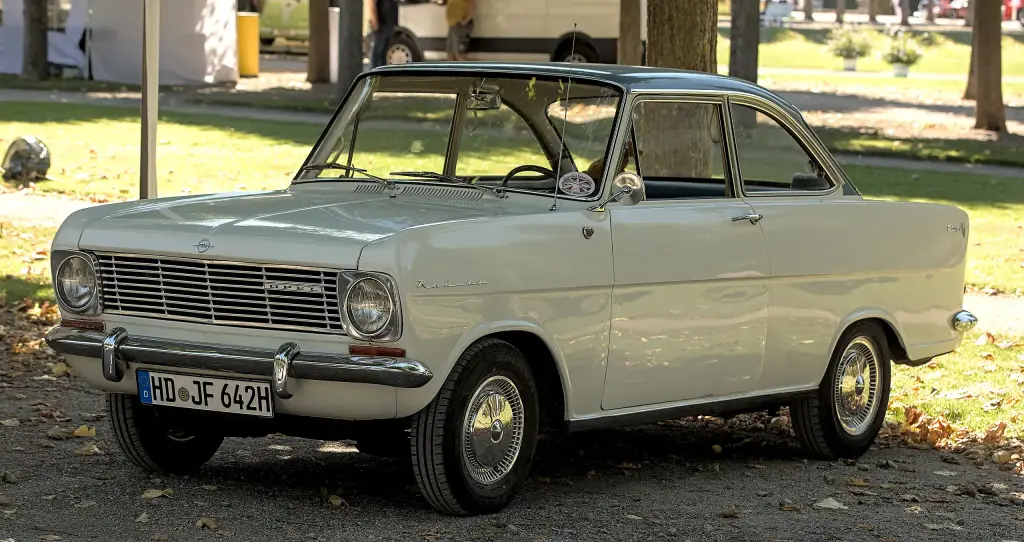
The Opel Kadett was Opel’s small family car from 1936 to 1940 and then from 1962 to 1991, when it was succeeded by the Astra. As each generation grew, the Corsa took over as Opel’s entry-level model.
Opel Kadett at a glance
| Maker | Adam Opel AG, Rüsselsheim |
|---|---|
| Production | 1936–1940 and 1962–1991 |
| Cabriolet | until 1993 |
| Successor | Opel Astra |
| First Kadett | Kadett I, presented December 1936 |
| Engine 1937 | 1,074 cc side valve, 23 PS at 3,400 rpm |
| Wheelbase | 234 cm |
| Bodies | two-door Limousine, four-door and Cabrio-Limousine |
| Price 1937 | 2,100 Reichsmark |
| Built to 1940 | 106,608 |
Based on one source, the English Wikipedia article on the Opel Kadett, which describes the 1936–1940 generation in detail.
History of the Opel Kadett
The first Kadett
The first car to carry the Kadett name was presented to the public in December 1936 by Opel’s commercial-technical director Heinrich Nordhoff, who later became known for building up Volkswagen. Following the Opel Olympia, the Kadett adopted a chassis-less unibody construction, which pointed to a car designed for high-volume, low-cost production. Production was interrupted in 1940 by the Second World War.
The 11234 and the Spezial
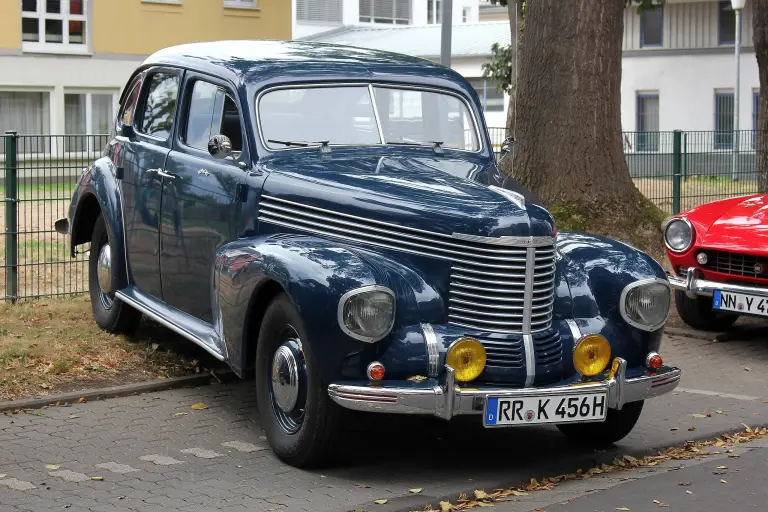
For 1937 the Kadett was offered as a small two-door Limousine or, at the same 2,100 Reichsmark, as a soft-top Cabrio-Limousine. Its body resembled the larger Olympia and followed the streamlined fashion of the time. The 1,074 cc side-valve engine came from the 1935 Opel P4 with the same 23 PS, and the 234 cm wheelbase sat between the little P4 and the larger Olympia; the series name 11234 combined the engine’s 11 decilitres with the wheelbase in centimetres. The brakes were hydraulic, and the suspension used synchronous springing of the Dubonnet type, licensed by General Motors in France and developed further in North America. The soft ride was criticised when the system was applied to a small, light car. By the end of 1937, 33,402 first-generation Kadetts had been built.
From December 1937 a modified grille marked an upgrade, and Opel sold two versions: the basic Kadett KJ38 and the better-equipped Kadett K38, also called the Spezial, with a chrome stripe below the window line and a richer interior. The cheaper KJ38 lost the synchronous springing and went back to a rigid axle like the old P4. Only the Spezial could be ordered as a cabriolet or a four-door, at 2,150 and 2,350 Reichsmark against 2,100 for the two-door Spezial. The KJ38 was meant to replace the P4 but cost more and gained a reputation as a car for poor people, while the Spezial was Germany’s best-selling small car in 1938 and 1939. By May 1941 Opel had built 17,871 KJ38s and 56,335 K38 Spezials, and 106,608 Kadetts in all had left the Rüsselsheim line when production stopped in May 1940.
The Soviet copy
After the war the Soviet Union asked for the tooling of the Rüsselsheim plant as part of reparations, to replace production lost at the KIM plant during the siege of Moscow. Soviet planners wanted a four-door saloon with an all-metal body and a four-stroke engine, and rejected both the rear-engined KdF-Wagen and the two-stroke DKW F8. The closest car to the KIM was the four-door Kadett K38, and on 26 August 1945 Order No. 9905 prescribed that the four-door Kadett be built in Moscow “without any changes to the design”.
Design and features
- Unibody construction: the Kadett followed the Olympia in doing without a separate chassis.
- 1,074 cc engine: the side-valve unit from the P4, with 23 PS.
- Two levels of trim: the basic KJ38 and the better-equipped K38 Spezial.
- A Soviet afterlife: the four-door K38 was chosen as the model for post-war production in Moscow.
Opel Kadett versions
- Kadett 11234 (1937): two-door Limousine and Cabrio-Limousine at 2,100 Reichsmark.
- Kadett KJ38 (1938): the basic car with rigid-axle suspension.
- Kadett K38 Spezial (1938): chrome trim, better interior, four-door option.
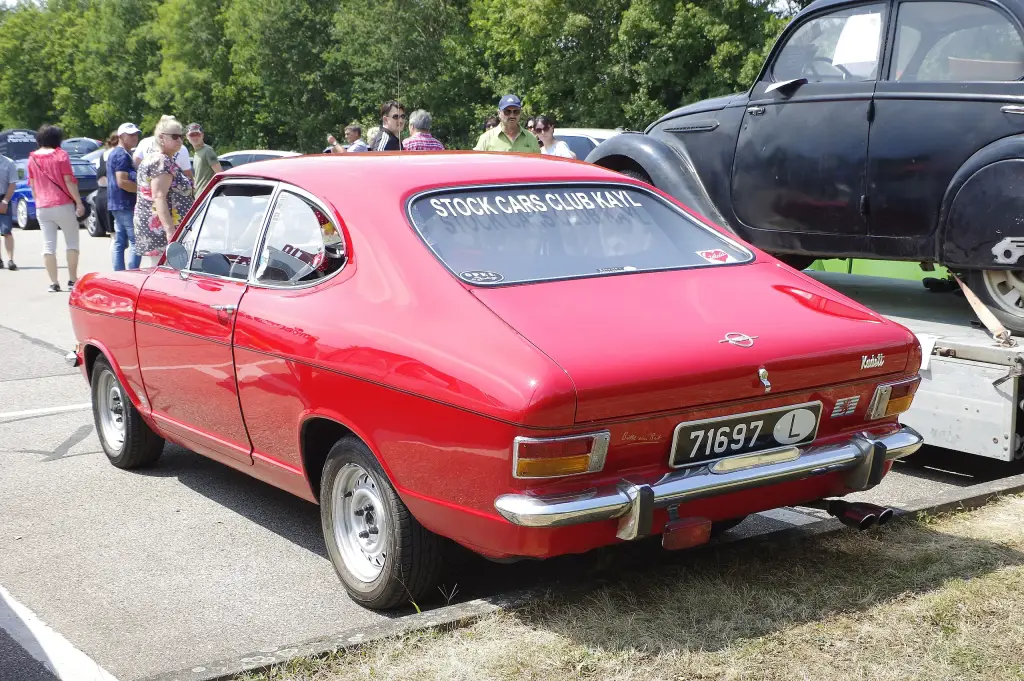
- Later Kadett generations (1962–1991): the line that ended with the Astra.
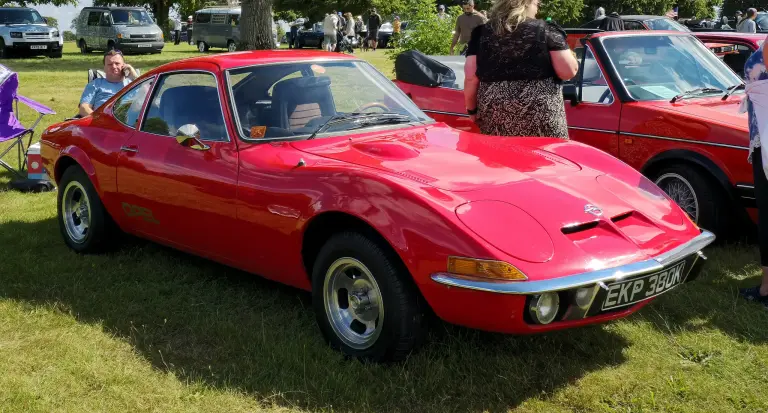
The Kadett was replaced by the Astra, and its mechanical parts went into the first Opel GT. More cars are in the Opel collection.
Video: Rainer Günzler testet den Opel Kadett-B 1968
Video by Stephan Krauss on YouTube.
Sources
- Opel Kadett, English Wikipedia: first generation, versions, prices, production, Soviet history