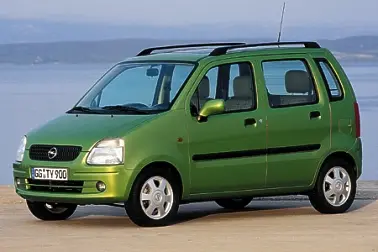
The Opel Agila was Opel’s city car from 2000 to 2014. Both generations were rebadged Suzukis — the Wagon R+ first, the Splash second — and the car was replaced in March 2015 by the Opel Karl.
Opel Agila at a glance
| Maker | Opel, a General Motors brand |
|---|---|
| Production | 2000–2014 |
| First generation (H00) | 2000–2007 |
| Second generation (H08) | 2008–2014 |
| Based on | Suzuki Wagon R+, then Suzuki Splash |
| Built at | Gliwice, Poland (first); Esztergom, Hungary (second) |
| Engines, first generation | 1.0 three-cylinder 973 cc, 1.2 four-cylinder 1,199 cc |
| Engines, second generation | 1.0 65 PS, 1.2 86 PS, 1.2 CDTi 75 PS |
| Facelift | August 2003 |
| Replaced by | Opel Karl, March 2015 |
Based on one source, the English Wikipedia article on the Opel Agila. No free photograph of the Agila was available on Wikimedia Commons, so the entry keeps its earlier picture.
History of the Opel Agila
A rebadged Suzuki
The first-generation Agila was a rebadged Suzuki Wagon R+, a car produced in Japan and later sold there as the Solio. Opel fitted its own 1.0 and 1.2 litre petrol engines, both smaller than the 1.3 litre used in the European Wagon R+. The 1.0 was the Z10XE three-cylinder of 973 cc and the 1.2 the Z12XE four of 1,199 cc, both with cam chains; in the event these Opel engines proved less reliable than the cam-belt Suzuki unit. Sales started in August 2000, and the Agila was built at Opel’s plant in Gliwice, Poland, while the European Wagon R+ came from the Magyar Suzuki works at Esztergom in Hungary.
The first-generation Agila was classed as a city car. A facelift arrived in August 2003, bringing a 1.25-litre diesel and updated petrol engines with Opel’s TwinPort technology and slightly larger capacity; the revised 1.2 four did not arrive until January 2004.
The second generation
The second-generation Agila was announced on 15 May 2007 and shown at the Frankfurt Motor Show that year as a rebadged Suzuki Splash. It was 200 mm longer than its predecessor, which put it in the same size class as small MPVs and superminis, and it was now classed as a mini MPV. Sales began in April 2008. The petrol engines were a three-cylinder 1.0 of 65 PS and a four-cylinder 1.2 of 86 PS, with a 1.2 CDTi common-rail diesel of 75 PS. Two trim levels were offered, Base/Essentia and Edition/Enjoy. European production of the Agila and the Splash was at the Magyar Suzuki plant in Esztergom, and the model was replaced in March 2015 by the Opel Karl, sold in Britain as the Vauxhall Viva.
Design and features
- Suzuki underneath: the Wagon R+ in the first generation, the Splash in the second.
- Opel engines: 1.0 three-cylinder and 1.2 four-cylinder petrol units with cam chains.
- Built in Europe: Gliwice in Poland for the first generation, Esztergom in Hungary for the second.
- From city car to mini MPV: the second generation grew by 200 mm and moved up a class.
Opel Agila versions
- Agila 1.0 (2000): three-cylinder Z10XE of 973 cc.
- Agila 1.2 (2000): four-cylinder Z12XE of 1,199 cc.
- 2003 facelift: TwinPort petrol engines and a 1.25-litre diesel.
- Agila B (2008): 1.0, 1.2 and 1.2 CDTi, in Essentia and Enjoy trim.
The Agila was the smallest car in the Opel range below the Corsa, and its role as a small MPV was shared with the larger Meriva. More cars are in the Opel collection.
Video: opel agila 1.0 litre (3piston engine) 0-165 km/h
Video by Ondra L. on YouTube.
Sources
- Opel Agila, English Wikipedia: generations, engines, plants, trim levels