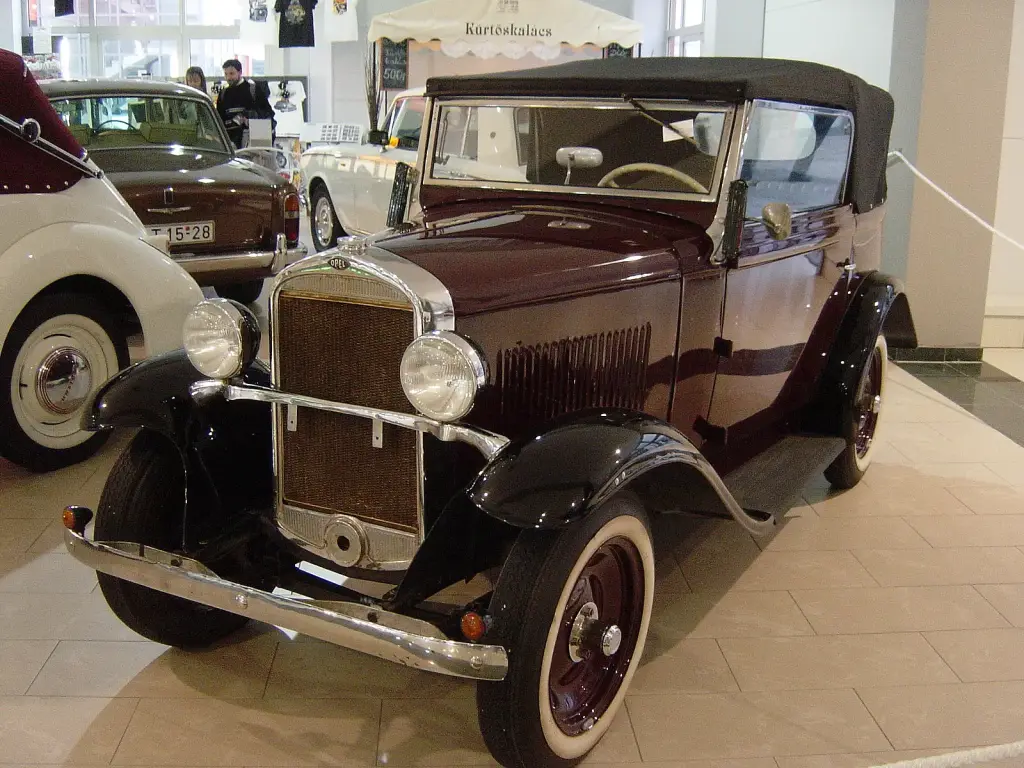
The Opel 1.8 Liter was the first new Opel launched after General Motors bought an 80 per cent share of the company, and the first Opel designed and developed by GM in North America. It went into production in January 1931 and stayed on the line until November 1933, with 32,285 cars built.
Opel 1.8 Liter at a glance
| Maker | Adam Opel AG, Rüsselsheim |
|---|---|
| Production | January 1931 – November 1933 |
| Series | 18B (1931), 18C (1932), 18N (1933) |
| Engine | 1,790 cc straight-six, side valves, Solex 30FV carburettor |
| Power | 32 PS (24 kW) at 3,200 rpm, slightly more from 1933 |
| Top speed | 85 km/h, 90 km/h from 1933 |
| Gearbox | three-speed, four-speed from 1933, no synchromesh |
| Bodies | two-seater cabriolet, four-door Limousine, Sonnen-Coupé, Touring, Roadster |
| Price | from 3,175 Marks for the two-seater cabriolet |
| Built | 32,285 |
Based on one source, the English Wikipedia article on the Opel 1.8 Liter.
History of the Opel 1.8 Liter
A General Motors design
General Motors took its 80 per cent share of Opel in 1929, and the 1.8 Liter was the first new model to appear afterwards. It was also the first Opel to be designed and developed by GM in North America, which made it a different kind of car from the Opel 4/12 PS and the other small models that had built the company.
Bodies for a depressed market
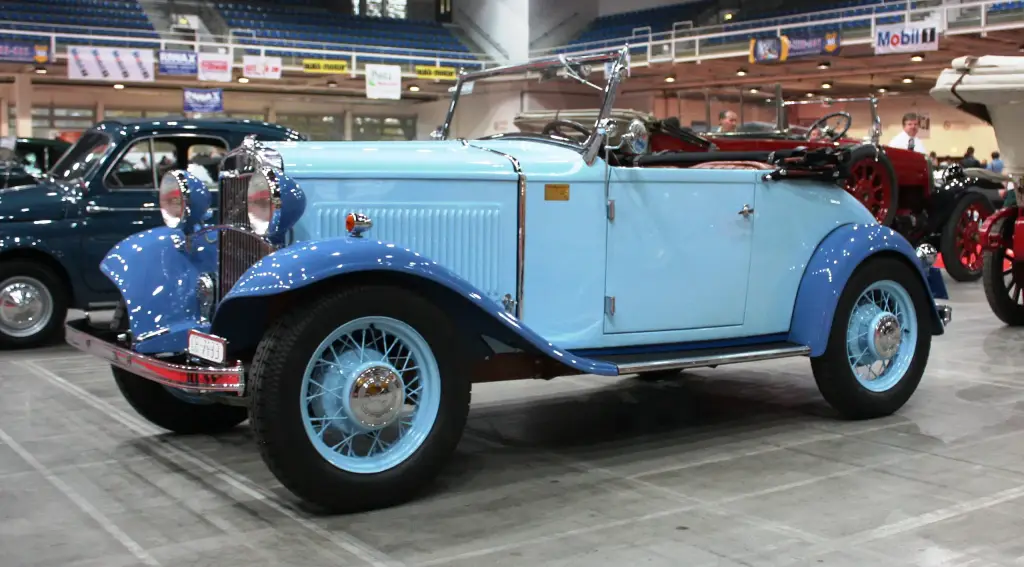
Production began in January 1931 with the Series 18B. There were three bodies at first: a two-seater cabriolet with fixed side windows and a fold-out Dickey seat at the back, priced aggressively at 3,175 Marks; a four-door Limousine; and a two-door Sonnen-Coupé. The Sonnen-Coupé had a black imitation leather roof that looked like a folding hood, a style the French called a faux-cabriolet, and it also had an opening steel panel sunroof. A two-door Torpedo “Touring” body, a Roadster and a two-door Limousine followed.
A runaway first year
In its first year the 1.8 Liter was a striking success: 15,739 cars were produced in 1931, when the whole German passenger car market accounted for only 56,039 cars. Towards the end of 1931 came the Series 18C for the 1932 model year. It was little changed, though the range of bodies was broadened, the two-piece bumper gave way to a single-piece one, and prices on most versions fell by a few hundred marks as deflation took hold in Germany.
Regent bodies and the end
In July 1932 Opel added an all-steel “Regent” Limousine with a sloping, streamlined rear, a luggage locker, and a spare wheel on the rear panel with the fuel filler reached through the middle of the wheel. Over the following months Regent-body versions of the other models appeared, with the exception of the torpedo Touring body. In 1933 a four-door Series 18N six-light limousine joined the range, and the engine gained a little compression and power, together with a four-speed gearbox without synchromesh. That gearbox was carried over to the Opel »6« 2-litre the following year. Production ended in November 1933.
Design and features
- Six cylinders in a small car: a 1,790 cc side-valve engine fed by a Solex 30FV carburettor, good for 32 PS and 85 km/h.
- Cheap entry model: the two-seater cabriolet with a Dickey seat cost 3,175 Marks.
- American engineering: the first Opel designed and developed by General Motors in North America.
- Regent body: an early streamlined all-steel saloon with a sloping tail and a luggage locker.
Opel 1.8 Liter versions
- Series 18B (1931): the original range with three body styles.
- Series 18C (1932): broader body choice, single-piece bumpers, lower prices.
- Regent Limousine (1932): all-steel streamlined saloon, two-door first, four-door later.
- Series 18N (1933): four-door six-light limousine.
- Sonnen-Coupé: imitation leather roof and a steel sliding sunroof.
The 1.8 Liter was followed down the range by the smaller Opel P4, and its six-cylinder layout was taken further in the Opel Super 6. More cars are in the Opel collection.
Sources
- Opel 1.8 Liter, English Wikipedia: engine, bodies, prices, production figures