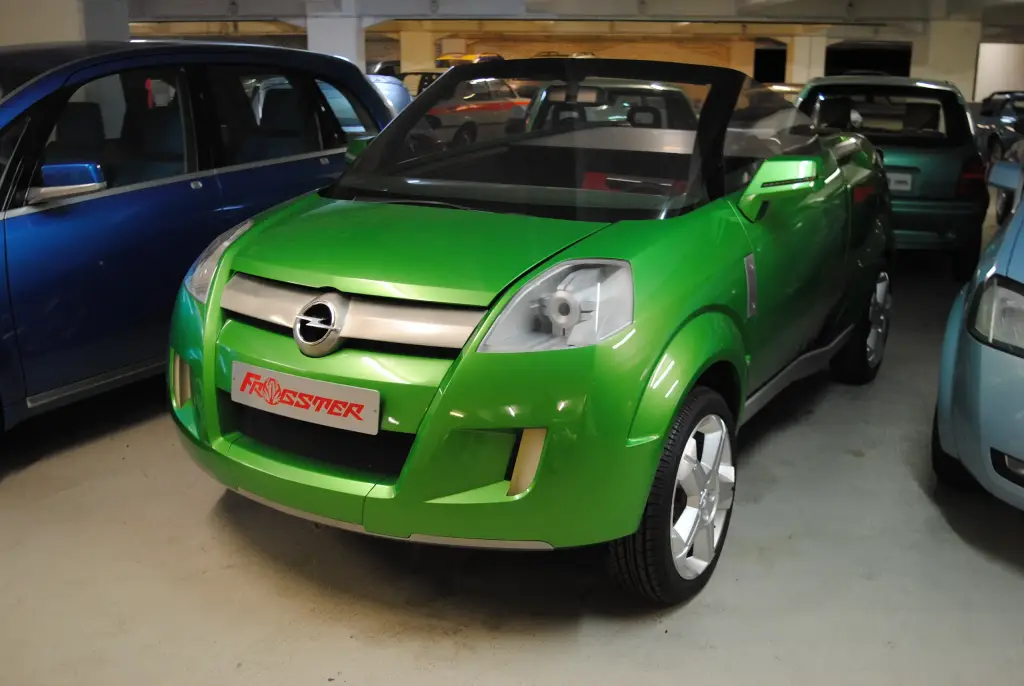
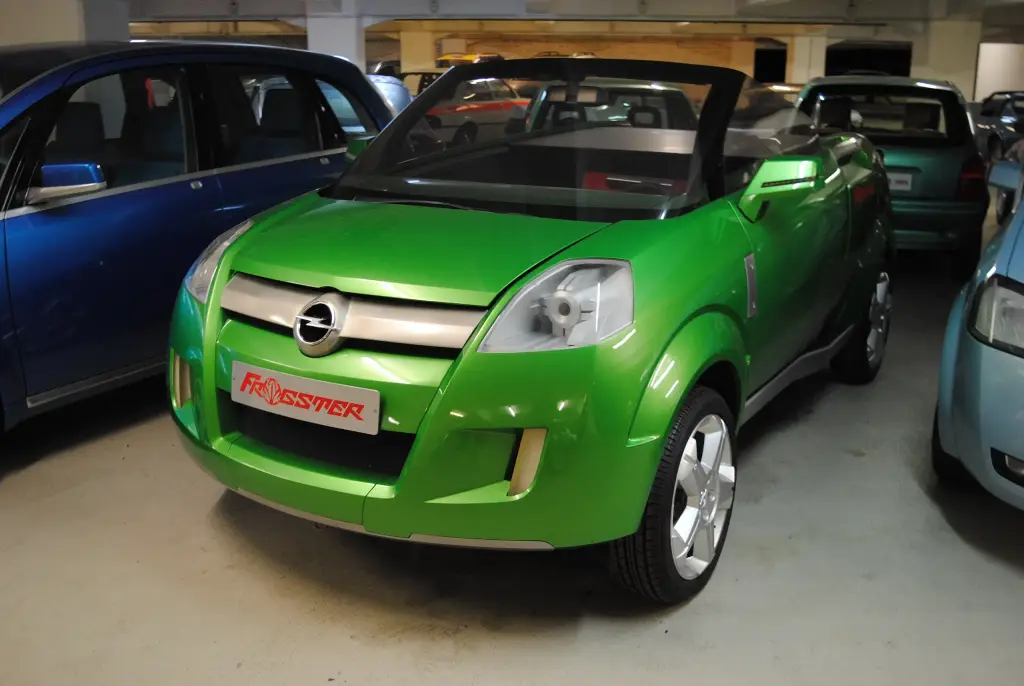
The Opel Frogster was a concept car built by Opel and shown at the Frankfurt Motor Show in September 2001. From a roadster it could become a convertible or a small pickup, and the transformation was controlled from a tablet mounted between the two front seats. It was aimed at younger buyers and never went into production.
Opel Frogster at a glance
| Maker | Adam Opel AG |
|---|---|
| Type | concept car |
| Shown | Frankfurt Motor Show, September 2001 |
| Bodies | roadster, convertible and pickup in one car |
| Control | personal digital assistant between the front seats |
| Roof | electrically powered |
| Console | digital, controlling most of the car’s functions |
| Target buyers | younger customers |
| Production | never planned |
Based on one source, the English Wikipedia article on the Opel Frogster. The article is short, so this page is shorter than usual.
History of the Opel Frogster
A car with three bodies
The Frogster was built around a simple idea: one small car that could be whatever its owner needed. In roadster form it was an open two-seater; with the electrically powered roof raised it became a convertible; and with the rear opened out it turned into a small pickup. Such a conversion had not been offered by any production car at the time, and the Frogster carried other technology that was new to the market as well.
The digital console
The centre of the idea was a personal digital assistant mounted between the two front seats. From this screen the driver could control most of the car’s functions and, more unusually, order the body to change its shape. A digital console in that position was itself a novelty in 2001, when most cars still had rows of buttons and a radio.
Named after a tree frog
The name came from an early Opel of the 1920s, the Laubfrosch, which young people nicknamed the tree frog because of its bright green paint. Opel’s designers were working on the concept at a time when the new Opel Speedster was generating excitement, and designer Stefan Arndt recalled the moment the name appeared: “Everyone knows how excited we all are about the Speedster. When we were working on this concept car, someone suddenly called out: ‘Let’s paint it green and call it the Frogster.’ We all agreed it was perfect.” The car was presented in that green, and there were never any plans to put it into production.
Design and features
- Three bodies in one: roadster, convertible and pickup from the same car.
- Powered roof: an electric roof that no production car had yet used.
- Digital console: a PDA between the seats controlling the car’s functions.
- Aim at young buyers: a small, cheap-to-run shape with a playful character.
Opel Frogster versions
- Roadster: the car with the roof down and the rear closed.
- Convertible: the roof raised and the cabin enclosed.
- Pickup: the rear opened for light loads.
The Frogster took its name from the Opel Laubfrosch of the 1920s and shared its spirit with the Speedster, which was new at the time. More cars are in the Opel collection.
Sources
- Opel Frogster, English Wikipedia: concept, technology, name