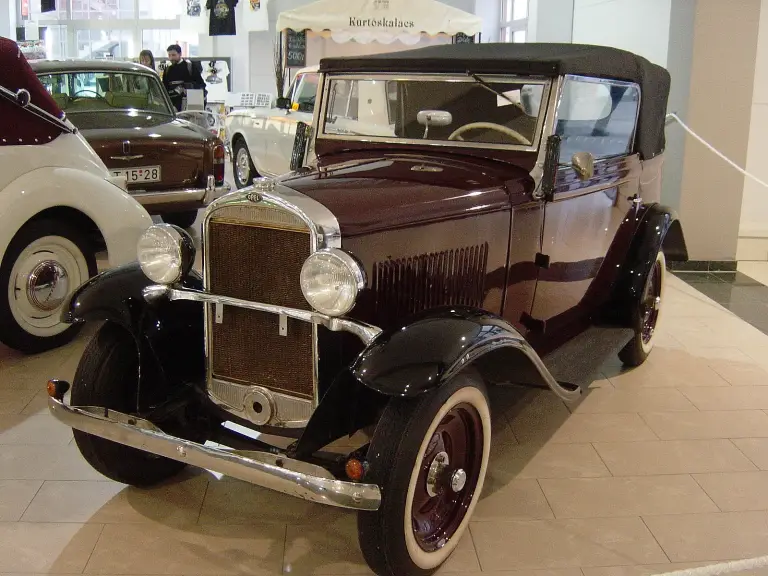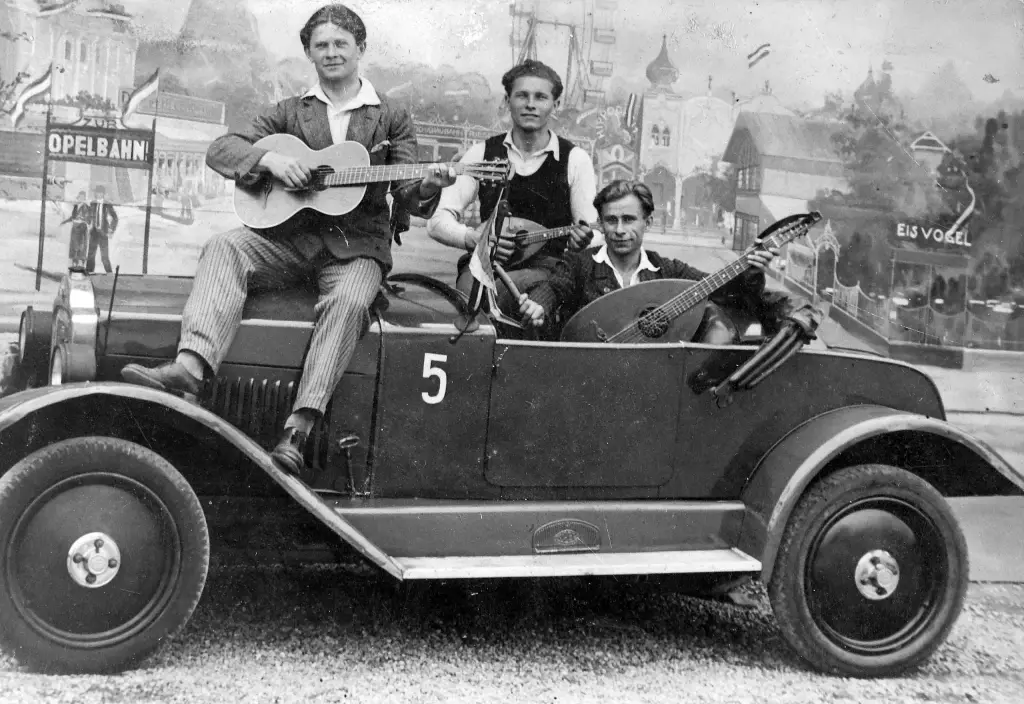
The Opel 4 PS, universally known as the Laubfrosch or tree frog, was a small two-seater introduced by Opel early in 1924 and built until June 1931. It was the first German car assembled on a Ford-inspired production line, and 119,484 were made.
Opel Laubfrosch at a glance
| Maker | Adam Opel AG, Rüsselsheim |
|---|---|
| Introduced | early 1924 |
| Production | May 1924 – June 1931 |
| Built | 119,484 |
| Bodies | from a single two-door cabriolet to saloons and a van |
| Engine 1924 | four-cylinder side valve, 12 PS at 2,200 rpm |
| Top speed | 66 km/h, later 77 km/h |
| Gearbox | three-speed |
| Price 1924 | 4,500 Mark |
| Colour | green at first, then steel grey and reddish brown |
Based on one source, the English Wikipedia article on the Opel Laubfrosch.
History of the Opel Laubfrosch
A German Model T
The Laubfrosch was introduced as the Opel 4/12 PS and built at Rüsselsheim. It was the first German car to be assembled on a production line inspired by Ford’s, and it was aimed squarely at the lower end of the German market with volume production in mind. The price of 4,500 Mark was competitive, performance was good for a small cheap car, and the car sold well from the start.
The official name came from the engine’s rating of four tax horsepower, while the second figure in 4/12 was the claimed actual output. The nickname may come from the fact that all the early cars were painted green, a lucky colour in Germany, which also distinguished the Opel from the similarly shaped Citroën 5 CV that usually appeared in yellow.
From 4/12 to 4/14
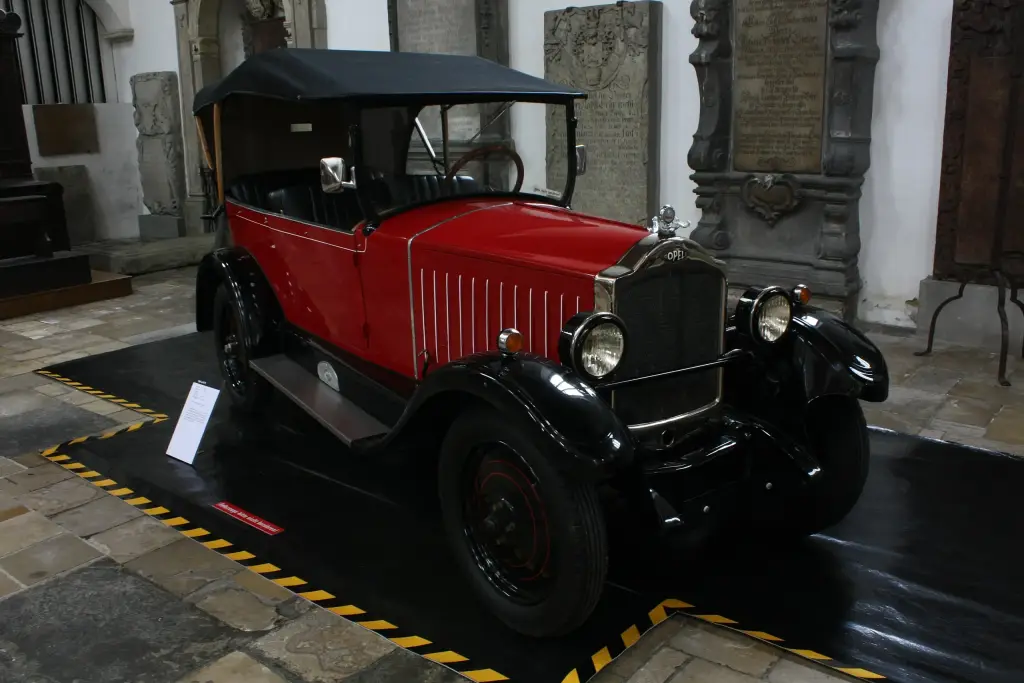
Series production began in May 1924 with a single body, a simple two-door cabriolet, always green. The engine was a water-cooled four-cylinder side-valve unit with thermosyphon cooling, 12 PS at 2,200 rpm and a top speed of 66 km/h, driving the rear wheels through a three-speed gearbox. The fuel tank sat under the bonnet with the engine. The footbrake worked mechanically on the driveshaft and a cable handbrake on the rear wheels; in 1925 this was reversed.
In the autumn of 1924 came the 4/14 PS, with the bore increased by 2 mm for 1,018 cc and 14 PS at 2,500 rpm, a wheelbase longer by 355 mm to 2,510 mm, and a wider choice of bodies. Three-seater bodies appeared with the third seat behind the front two, along with an enclosed Limousine and an open body, and from 1925 two- and four-seater bodies and a small delivery van. The cars were no longer only green: three-seater limousines came in steel grey with a black roof and the vans in reddish brown.
4/16 and 4/20
In November 1926 Opel announced more power: the 1,018 cc engine now gave 16 PS at 2,800 rpm and the top speed rose to 70 km/h. For the first time the footbrake acted on all four wheels, the suspension was reworked, and the steering wheel moved from the right to the left, following a general European trend; the fuel filler moved under the bonnet. In the autumn of 1927 the gear ratios changed and the car received a flamboyant Packard-style radiator. At the end of 1928 power rose to 20 PS at 3,500 rpm and the top speed to 77 km/h, with another carburettor change; three-seaters disappeared from the list, a new 2+2 cabriolet arrived in 1930, and the delivery van was good for 75 km/h.
The name 4 PS became obsolete when Germany switched from tax horsepower to taxing by cubic capacity in 1928, and by 1931 the car was sometimes simply called the Opel 1.1. Production ended in June 1931, when the Opel 1.2 litre took its place.
Design and features
- First German production line: Ford-inspired assembly at Rüsselsheim.
- Volume car: 119,484 built in seven years, at a competitive 4,500 Mark.
- Green tree frog: an all-green launch and a lucky colour gave the car its nickname.
- Steady development: from 12 to 20 PS, and from a single cabriolet to saloons and a van.
Opel Laubfrosch versions
- Opel 4/12 PS (1924): the original green two-door cabriolet.
- Opel 4/14 PS (1924): longer wheelbase, 1,018 cc, three-seater bodies and a van.
- Opel 4/16 PS (1927): 70 km/h, four-wheel brakes, left-hand steering.
- Opel 4/20 PS (1929): 77 km/h and a 2+2 cabriolet from 1930.
- Lieferwagen: the small delivery van of 1925.
The Laubfrosch was replaced by the Opel 1,2 litre, and its name inspired the Frogster concept car of 2001. More cars are in the Opel collection.
Sources
- Opel Laubfrosch, English Wikipedia: chronology, engines, bodies, production