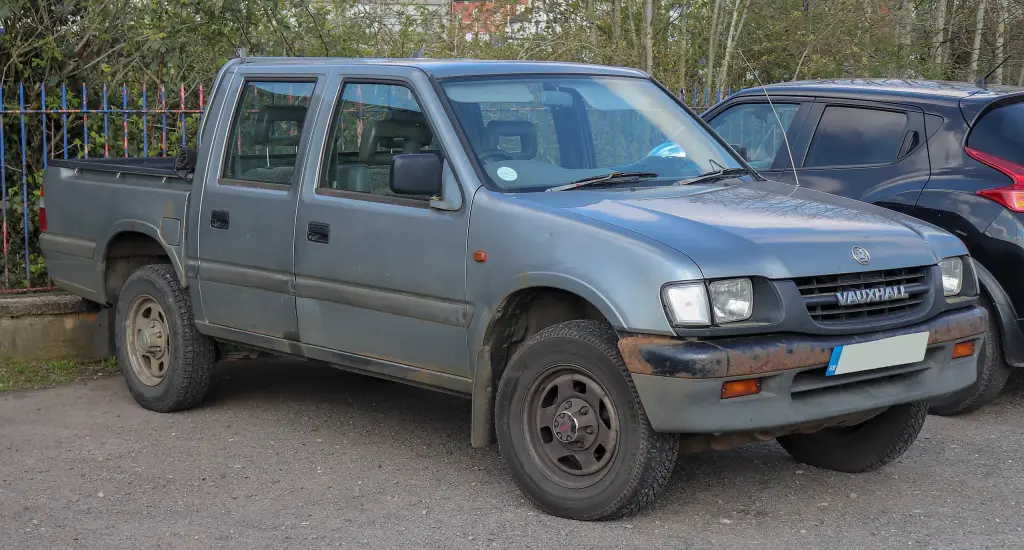
The Opel Campo was Opel’s compact pickup, the European version of the Isuzu Faster that Isuzu built from 1972 to 2002. In other markets the same truck was sold through General Motors as the Chevrolet LUV and the Bedford KB.
Opel Campo at a glance
| Maker | Opel, a General Motors brand |
|---|---|
| Based on | Isuzu Faster |
| Model family | Isuzu Faster/KB, three generations |
| Faster production | 1972–2002 |
| Chassis | ladder frame, leaf-spring live rear axle |
| Front suspension | independent A-arms |
| Wheelbases | 2,600 mm and 2,995 mm |
| Four-wheel drive | from 1978, KB40 chassis |
| Other badges | Chevrolet LUV, Bedford KB, Holden Rodeo |
| Successor | Isuzu D-Max (outside Japan and North America) |
Based on one source, the English Wikipedia article on the Isuzu Faster, the truck on which the Opel Campo was based.
History of the Opel Campo
A Japanese truck with many badges
The Isuzu Faster appeared in 1972 as the KB20, with the longer KB25 on a 2,995 mm wheelbase alongside the 2,600 mm standard model. It replaced the Isuzu Wasp and was derived from the Isuzu Florian, sharing doors and front-end parts with that car. Most export cars were sold as the Isuzu KB, but the truck also went through General Motors channels: as the Chevrolet LUV, short for light utility vehicle, and in Europe as the Bedford KB. Opel’s version of the same family carried the Campo name.
Built like a truck
The pickup used a traditional ladder-frame chassis with leaf springs and a live axle at the rear, and independent A-arm suspension at the front. The standard cargo bay was 1,855 mm long, and the long-wheelbase version carried a 2,290 mm bed. In 1978 a four-wheel-drive version arrived on the KB40 chassis, sold in Japan as the Faster Rodeo, and a double cab was added on the longer chassis. The usual engine in most markets was a carburetted 1.6-litre overhead-cam four of 94 PS, with a 2.0-litre diesel of 62 PS alongside it; top speeds were 145 km/h and 115 km/h.
The American career
In North America the truck was sold by Chevrolet dealers as the LUV from March 1972, with a 1.8-litre four of 75 hp. To get around the 25 per cent tariff on light trucks, the cars were imported as cab chassis with no cargo bed and completed in the United States. Front disc brakes and an optional three-speed automatic came for 1976, power rose to 80 hp for 1977, and a longer cargo bay helped sales to 71,145 in 1978. Four-wheel drive arrived for 1979 and earned the LUV a Motor Trend Truck of the Year award; sales peaked at 100,192. The second generation, from 1980, was sold mostly as the Isuzu KB or Pick Up and introduced single cab, double cab and Space Cab bodies, with the same chassis underneath.
Design and features
- Ladder frame: a proper truck chassis with leaf springs and a live rear axle.
- Four-wheel drive: added in 1978 on the KB40 chassis and sold as the Faster Rodeo in Japan.
- Three cab styles: single cab, double cab and Space Cab from the second generation.
- GM badge network: Chevrolet LUV, Bedford KB and Holden Rodeo were the same truck in other markets.
Opel Campo versions
- KB20 and KB25: short and long wheelbase versions of the first generation.
- KB40: the four-wheel-drive chassis of 1978.
- Chevrolet LUV: the North American version with a 1.8-litre engine.
- Bedford KB: the European commercial-vehicle version.
- Second generation (1980): new body, same chassis, three cab styles.
The Campo was the smallest commercial vehicle in the Opel range, well below the Vivaro van. More cars are in the Opel collection.
Video: Opel Campo teszt – 1999
Video by Attila Tűhegyi on YouTube.
Sources
- Isuzu Faster, English Wikipedia: chassis, engines, generations, GM badges