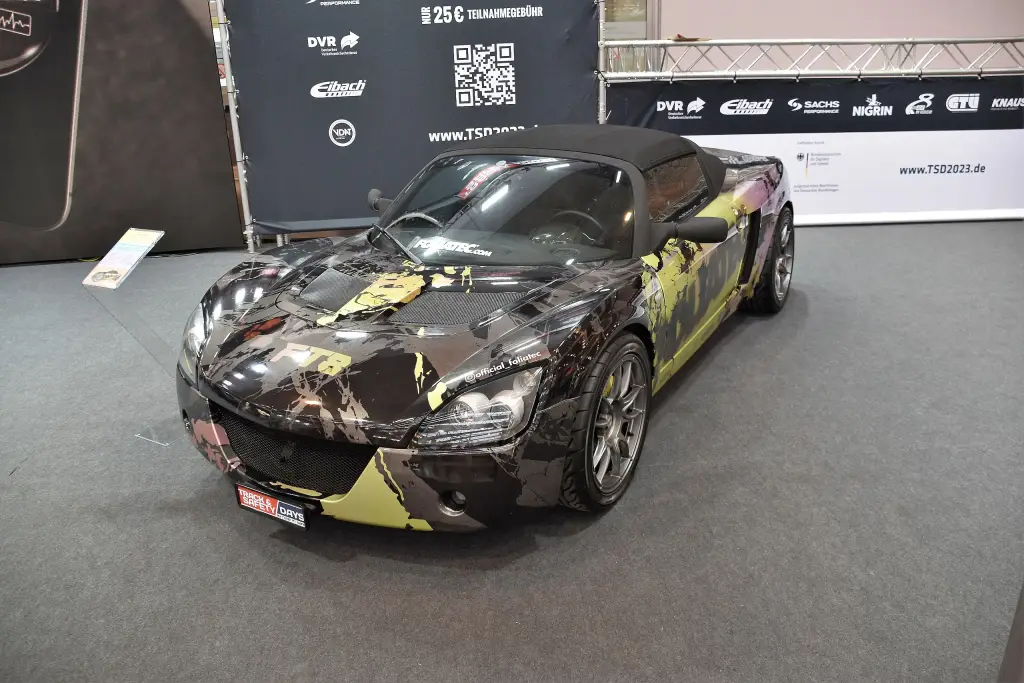
The Opel Speedster was a mid-engined, targa-topped two-seater built by Lotus at Hethel in England from July 2000 to July 2005. It shared much with the Lotus Elise, and in Britain it was sold as the Vauxhall VX220. Only 7,207 were made.
Opel Speedster at a glance
| Maker | Opel, built by Lotus |
|---|---|
| Production | July 2000 – July 2005 |
| Built at | Hethel, Norfolk, England |
| Body | mid-engined two-seat targa |
| Chassis | Lotus Elise Series 2, 30 mm longer wheelbase |
| Frame | aluminium, 72 kg |
| Bodywork | fibreglass |
| Weight | 875 kg |
| Engine | 2.2-litre Z22SE, 145 hp |
| Turbo version | 2.0-litre, 200 hp, 930 kg |
| Top speed, turbo | 242 km/h, 0–100 km/h in 4.7 s |
| Built in total | 7,207 |
Based on one source, the English Wikipedia article on the Opel Speedster.
History of the Opel Speedster
A deal with Lotus
Changes to European crash safety regulations for the 2000 model year meant Lotus had to replace the original Elise. In October 1999 Lotus and General Motors agreed a deal that gave Lotus the funds to develop a new Elise, and as part of it Lotus agreed to develop and build the Opel Speedster and the Vauxhall VX220 on a variation of its new Series 2 Elise chassis, with a 30 mm longer wheelbase and lower door sills than the Lotus. The first Speedster concept was shown at the Geneva Motor Show in 1999, and production began in March 2001, after a full launch in July 2000.
Light by design
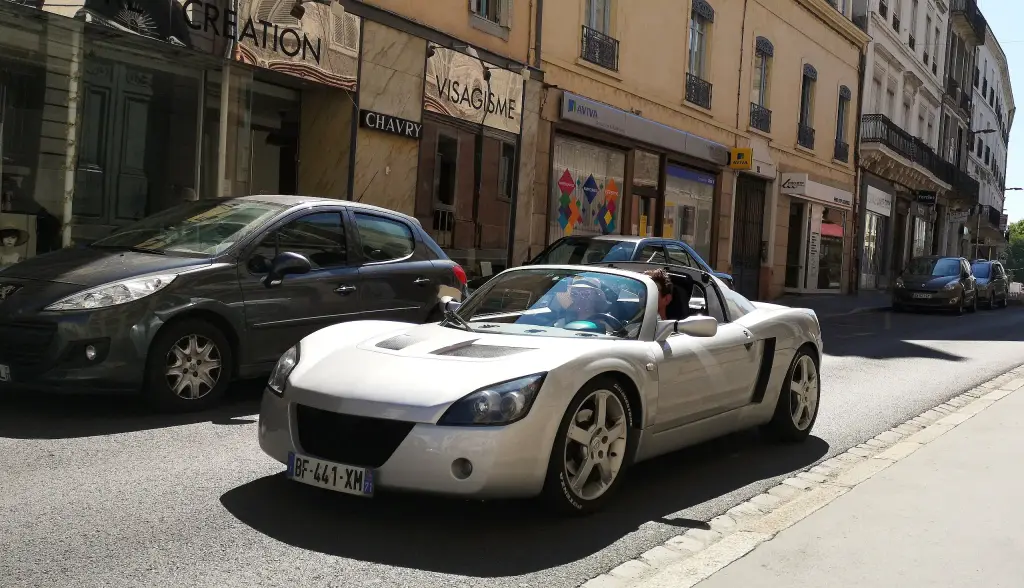
Where the new Elise used a 1.8-litre Toyota engine, the Speedster was designed around the 2.2-litre GM Ecotec unit from the Opel Astra, an all-aluminium engine of 145 hp. The chassis was an aluminium frame weighing only 72 kg, the bodywork was entirely fibreglass, and the complete car weighed 875 kg — about 100 kg less than the similarly sized Toyota MR2, and considerably more powerful than the Series 2 Elise at launch. Lotus expanded Hethel to a capacity of 10,000 cars to build the new models, with around 3,500 places set aside for the Speedster.
The turbo and the end
Answering calls for more power, Opel added a two-litre turbocharged Ecotec of 200 hp, at a slightly higher 930 kg; the turbo car reached 242 km/h and 100 km/h in 4.7 seconds. In 2004 a limited run of sixty track-focused cars was built for Britain as the Vauxhall VXR220, with larger brakes, upgraded tyres, lowered suspension, 220 hp, performance seats, Speedline wheels and Calypso Red paint as the only colour. A single Daewoo-badged car was shown in South Korea in 2005 for marketing, but it was otherwise sold as an Opel Speedster. Production ended on 22 July 2005 with no direct successor, and the Opel GT of 2007 eventually filled the gap — without a right-hand-drive version for Britain.
Design and features
- Elise chassis: a Series 2 Lotus structure, 30 mm longer in the wheelbase.
- 875 kg: an aluminium frame of 72 kg and fibreglass bodywork.
- Ecotec power: the 2.2 of 145 hp, or the 2.0 turbo of 200 hp.
- VXR220: sixty British cars with 220 hp and track-focused equipment.
Opel Speedster versions
- Speedster 2.2 (2000): 145 hp, 875 kg.
- Speedster Turbo: 2.0-litre with 200 hp and 930 kg.
- Vauxhall VX220: the British version.
- Vauxhall VXR220 (2004): sixty cars with 220 hp.
- ECO Speedster (2002): a gullwing-door concept with a 1.3 diesel.
The Speedster was replaced in spirit by the second-generation Opel GT, and its name inspired the Frogster concept. More cars are in the Opel collection.
Sources
- Opel Speedster, English Wikipedia: development, chassis, engines, production