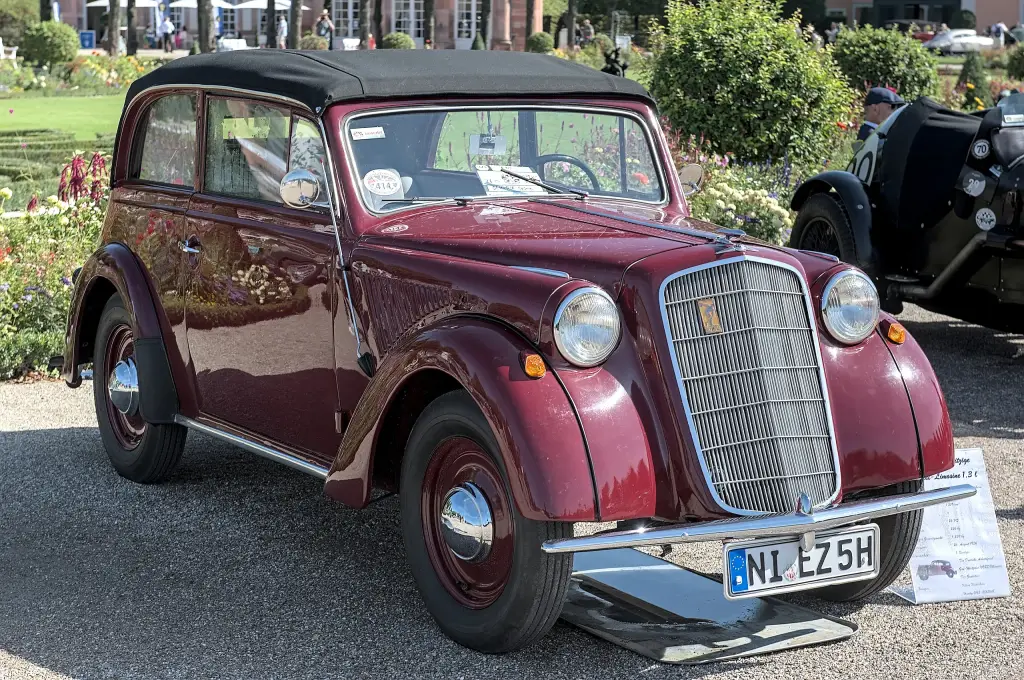
The Opel Olympia was Opel’s compact car from 1935 to 1940 and again from 1947 to 1953. It was one of the world’s first mass-produced cars with a unitary body — a full monocoque on the closed saloon — and Opel built more than 168,000 of them before the war.
Opel Olympia at a glance
| Maker | Adam Opel AG, Rüsselsheim |
|---|---|
| Production | 1935–1940 and 1947–1953 |
| Shown | Berlin Motor Show, February 1935 |
| Body | all-metal unitary construction |
| Engine 1935 | 1,286 cc four-cylinder side valve, 24 PS |
| Top speed 1935 | 100 km/h |
| Engine 1937 (OL38) | 1,488 cc overhead valve, 37 PS |
| Top speed 1937 | 112 km/h |
| Price 1935 | 2,500 Reichsmark |
| Built to 1940 | over 168,000 |
| Post-war | from December 1947, 25,952 by the end of 1949 |
Based on one source, the English Wikipedia article on the Opel Olympia.
History of the Opel Olympia
Weight saved by dropping the chassis
The Olympia was first shown at the Berlin Motor Show in February 1935, and production began later that year. It was named in anticipation of the 1936 Berlin Olympic Games. The 1935 car was Germany’s first mass-produced car with an advanced all-metal unitary body, a full monocoque on the closed-roof saloons, after the 1934 Citroën Traction Avant. The new construction cut the weight by up to 180 kg compared with its predecessor, and it required new materials and methods: wood framing was almost eliminated, sheet steel was spot-welded and the production line was rearranged.
At 2,500 Reichsmark the Olympia offered a genuine four-seater with a 1.3-litre four-cylinder side-valve engine of 24 PS and a top speed of 100 km/h. Drive went to the rear wheels through a three-speed gearbox, with a four-speed available from 1937. There was independent front suspension and a live rear axle on semi-elliptic springs. It came as a two-door saloon, the LZ, and a two-door soft-top, the CL, and from 1938 it was also assembled at Tanjung Priok near Jakarta in the Dutch East Indies, where it was sold as the Opel 1.3.
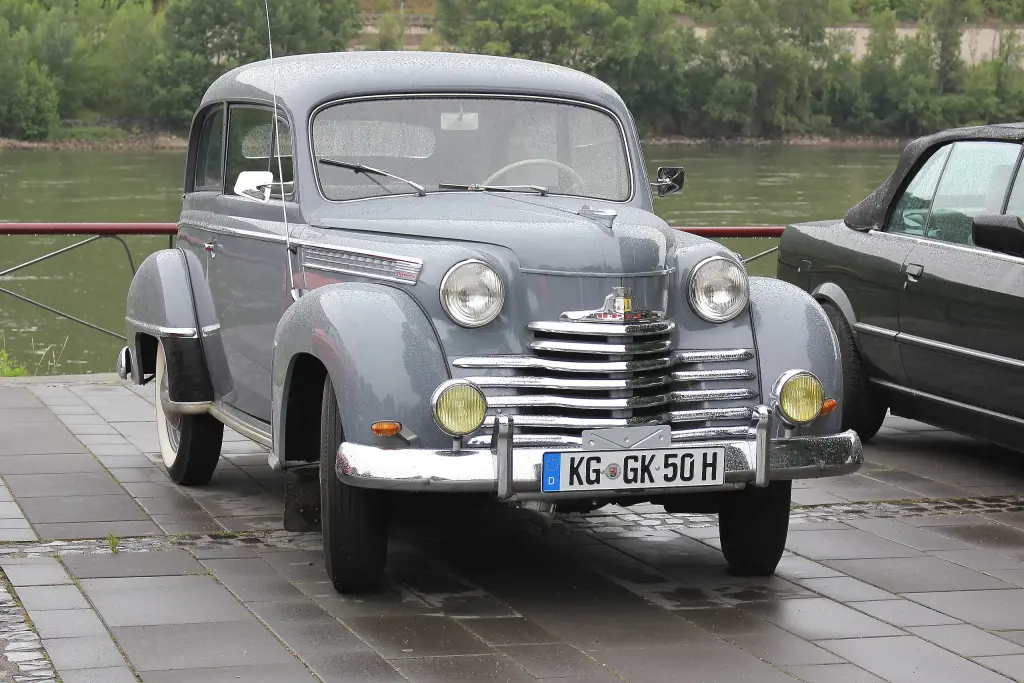
The OL38
In 1937 the Olympia received a new engine and a revised body. The larger 1,488 cc unit introduced overhead valves and gave about 50 per cent more power, 37 PS, for a top speed of 112 km/h; it stayed in production until 1960 with only minor changes, and its architecture was used for the 2.5-litre six of the Super 6 and the Kapitän. The body grew by 7 cm in width and 9 cm in length on a 6 cm longer wheelbase, and gained a four-door six-light saloon, the LV, at 2,950 Reichsmark, alongside the 2,675 Reichsmark LZ and the 2,750 Reichsmark CL cabriolet. Production stopped late in 1940, and the Rüsselsheim plant was badly damaged by Allied bombing during the war.
Opel’s first post-war car
Production of the Olympia was announced in November 1947 and restarted the following month, making it Opel’s first post-war car. Opel had been building the six-cylinder Blitz since July 1946, and it would have made sense to restart the Kapitän first since it used the same engine, but the occupation regulations forbade civilian sales of cars over 1.5 litres. Visually the car was unchanged, but the fragile Dubonnet front suspension was replaced by a conventional control-arm and coil-spring layout. Only the two-door saloon was built, and 25,952 were made by the end of 1949.
In January 1950 the Olympia received a modernised body on the same pre-war basis, with a column-shifted three-speed gearbox replacing the floor-mounted four-speed. The saloon cost 6,400 DM, a cabrio-coach 6,600 and a two-door kombi estate 7,350, the last built by Karosserie Miesen. In February 1951 came 15-inch instead of 16-inch wheels and a boot that enclosed the spare wheel. In just over three years about 160,000 were made before the Olympia Rekord replaced it in March 1953.
Design and features
- Unitary body: a monocoque saloon that saved up to 180 kg and changed how Opel built cars.
- Two engines: the 1.3-litre side-valve of 24 PS, then the 1.5-litre overhead-valve of 37 PS.
- Post-war pioneer: the first Opel back in production after the war, in December 1947.
- Olympia Rekord: the 1953 successor whose name lived on as the Rekord.
Opel Olympia versions
- Olympia LZ (1935): two-door saloon at 2,500 Reichsmark.
- Olympia CL: the two-door soft-top cabriolet.
- Olympia OL38 (1937): 1.5-litre engine and a larger body.
- Olympia LV: four-door six-light saloon.
- Olympia 1950: modernised body, column gear change and a kombi estate.
- Olympia Rekord (1953): the pontoon-bodied successor.
The Olympia led to the Rekord, and its 1.5-litre engine grew into the six used in the Kapitän. More cars are in the Opel collection.
Sources
- Opel Olympia, English Wikipedia: unitary body, engines, versions, prices, post-war production