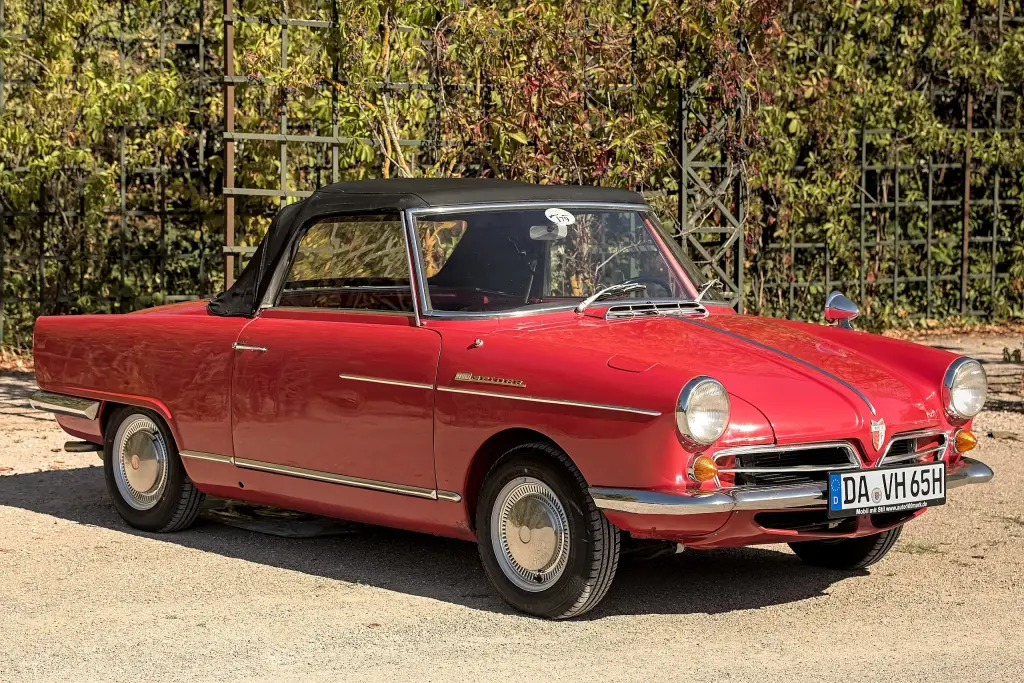
The NSU Spider was the first series-production car in the Western world powered by a Wankel rotary engine. Built from 1963 to 1967 with a Bertone-designed cabriolet body, it was a technical showcase for NSU — and the beginning of the company’s financial troubles.
NSU Wankel Spider at a glance
| Maker | NSU Motorenwerke AG |
|---|---|
| Production | 1963–1967, sold 1964–1967 |
| Built | 2,375 |
| Body | two-door cabriolet by Bertone |
| Based on | NSU Sport Prinz coupé |
| Engine | single-rotor Wankel, KKM 502, 498 cc chamber |
| Displacement equivalent | 996 cc |
| Power | 50 PS (37 kW) at 5,500 rpm, later 54 PS at 6,000 rpm |
| Torque | 79 N·m at 3,500 rpm |
| Compression | 8.5:1, 91 RON petrol |
| Brakes | front discs as standard |
| Price | USD 2,979 |
Based on one source: the English Wikipedia article on the NSU Spider.
History of the NSU Wankel Spider
The Spider appeared in 1963 with a two-door cabriolet body based on the NSU Sport Prinz coupé of 1959. Besides the folding roof, it could be told from the closed car by a grille at the front. Like every NSU car of the time it had its engine at the rear, but to improve weight distribution the radiator and the 35-litre fuel tank were placed ahead of the driver, which left only a small front luggage locker; a second luggage area sat at the back above the engine. The water-cooled single-rotor engine and standard front disc brakes set the car apart from others of its type.
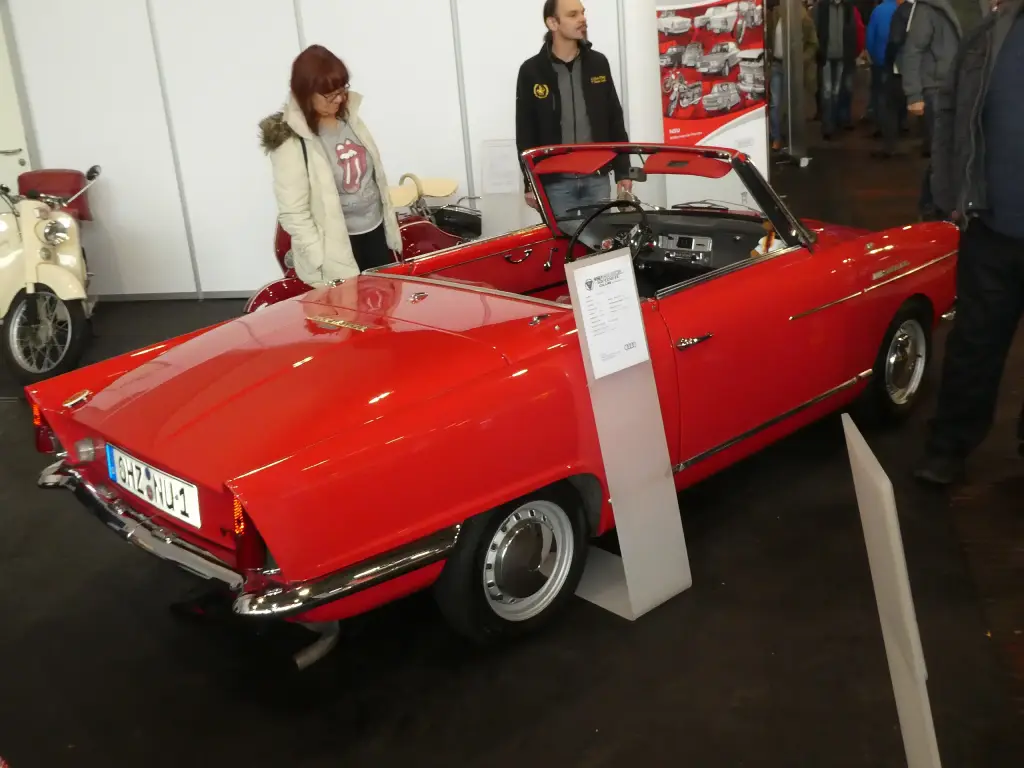
The engine was a KKM 502 single-rotor Wankel with one spark plug. Its chamber volume was 498 cc and its equivalent displacement 996 cc, from a generating radius of 100 mm, a rotor width of 67 mm, an eccentricity of 14 mm and an equidistant of 2 mm. Compression was 8.5:1 and the fuel required 91 RON petrol. Rated power was 50 PS at 5,500 rpm at first and 54 PS at 6,000 rpm in later cars, with maximum torque of 79 N·m at 3,500 rpm. Compared with piston engines of the period the unit was compact, light and free-revving; ignoring the manufacturer’s recommendations, it was possible to rev it briefly past 7,000 rpm in the lower gears and reach 100 km/h in 14.5 seconds, against 15.7 seconds when the recommendations were followed.
The engine had teething troubles. It was later found that the properties of the critical materials NSU selected for production rotary engines were unsuited to the stresses they had to bear, and rotary-engined cars earned a reputation for unreliability: engines needed frequent rebuilding to replace worn apex seals. The warranty costs of fitting the engine to NSU’s second Wankel model destroyed the company’s financial viability and forced the merger with Audi in 1969.
Large sales were never expected. The Spider was relatively expensive at USD 2,979, and 2,375 were built between 1964 and 1967. The model was withdrawn in 1967, when NSU presented its second rotary-engined production saloon, the Ro 80, which went on to account for 37,398 cars in ten years. The Spider also had a small place in racing history: in 1966 Al Auger of Richmond, California, became the first person to race a Wankel-powered production car in a sanctioned event, fitting only a mandatory roll bar and racing tyres to his Spider and finishing second overall in SCCA Class H Modified in both 1966 and 1967 — a class in which, because the SCCA had no technical information on the Wankel engine, it raced against lighter, more powerful 850 cc pure racing cars.
Design and features
- First Western production Wankel car: a single-rotor KKM 502 engine of 498 cc chamber volume.
- Compact and smooth: light and free-revving compared with piston engines of the time.
- Bertone cabriolet body: based on the Sport Prinz coupé, with a folding roof and a front grille.
- Balanced packaging: radiator and 35-litre tank ahead of the driver, luggage lockers front and rear.
- Front disc brakes: standard equipment, unusual in a small car of 1963.
NSU Wankel Spider versions
- Early cars (1963–1964): 50 PS at 5,500 rpm.
- Later cars: 54 PS at 6,000 rpm.
- Racing Spider (1966–1967): Al Auger’s SCCA Class H Modified car, with roll bar and racing tyres.
The Spider’s body came from the NSU Prinz family, and its rotary engine led to the larger NSU Ro 80. More NSU models are in the NSU collection.
Sources
- NSU Spider, English Wikipedia: body, engine data, production, reliability, racing