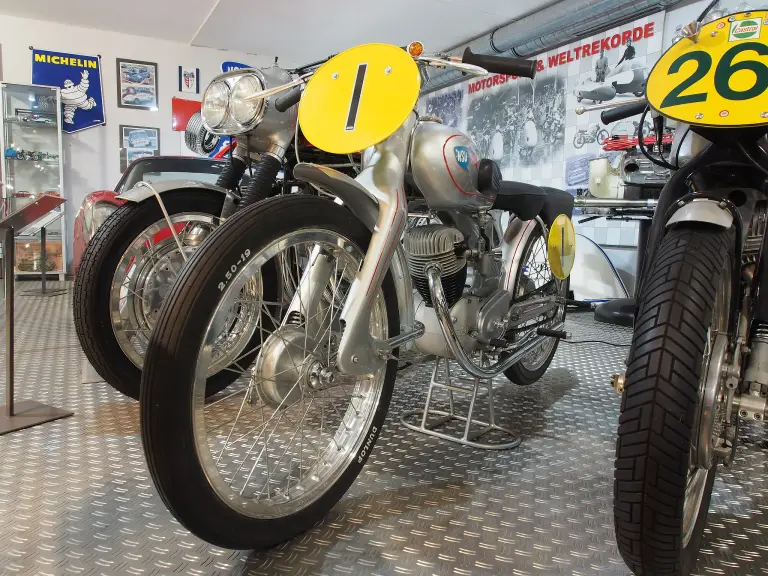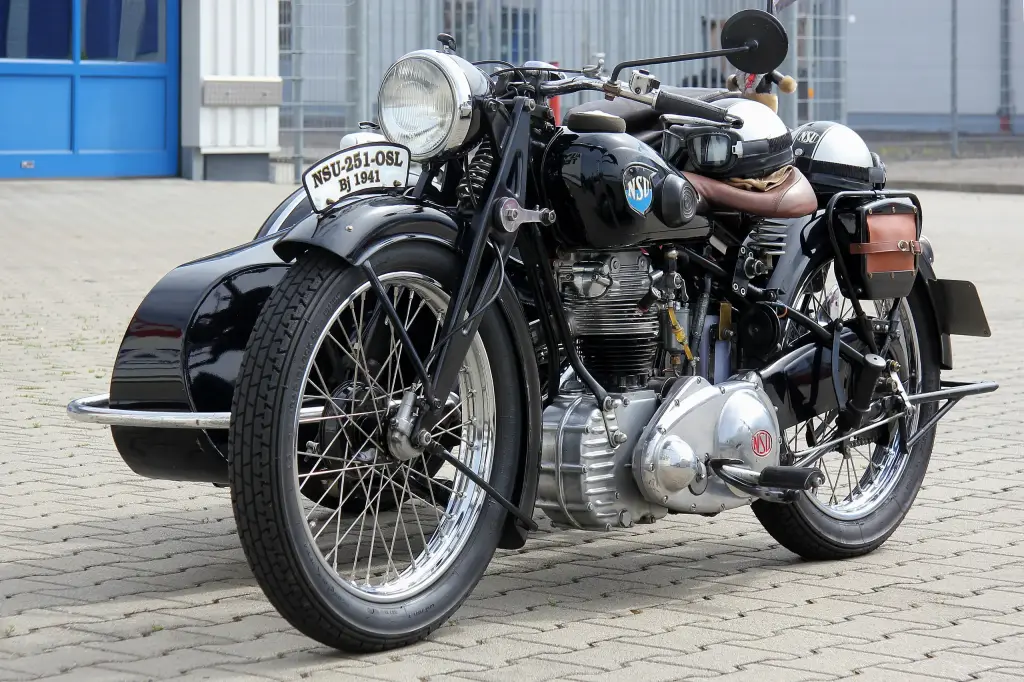
OSL stood for overhead valve, Sport and Luxus, and the letters named a whole family of NSU singles. The range began in 1933 with the 201 OSL and 251 OSL and soon spread to capacities of about 350, 500 and 600 cm³, making NSU one of the strongest names in German motorcycling before the war.
NSU OSL at a glance
| Maker | NSU Motorenwerke, Neckarsulm |
|---|---|
| Introduction | 1933 |
| Meaning of OSL | overhead valve, Sport, Luxus |
| First models | 201 OSL (200 cm³) and 251 OSL (250 cm³) |
| Later models | about 350, 500 and 600 cm³ |
| 601 OSL | built until 1941 |
| Smaller models | production ended in 1939 and 1940 |
| Engine | single-cylinder four-stroke, air-cooled, dry-sump lubrication |
| Gearbox | three speeds, four with foot change from 1935 |
| Frame | open steel tube, parallelogram front fork, rigid rear |
| 251 OSL after the war | 1947–1952, 32,465 built |
| Price in 1950 | 1,395 DM |
Based on one source: the German Wikipedia article on the NSU OSL models, which covers the whole range including the 251 OSL.
History of the NSU OSL
The OSL series followed the O and OS models from 1933. The O stood for overhead valve, the S for Sport and the L for Luxus; the first digit of the type number gave the capacity and the last the number of cylinders, so the 251 OSL was a 250 cm³ single. The first models were the 201 OSL of 200 cm³ and the 251 OSL of 250 cm³, and the range was soon extended to machines of roughly 350, 500 and 600 cm³. The 601 OSL stayed in production until 1941, while the smaller models ended in 1939 and 1940.
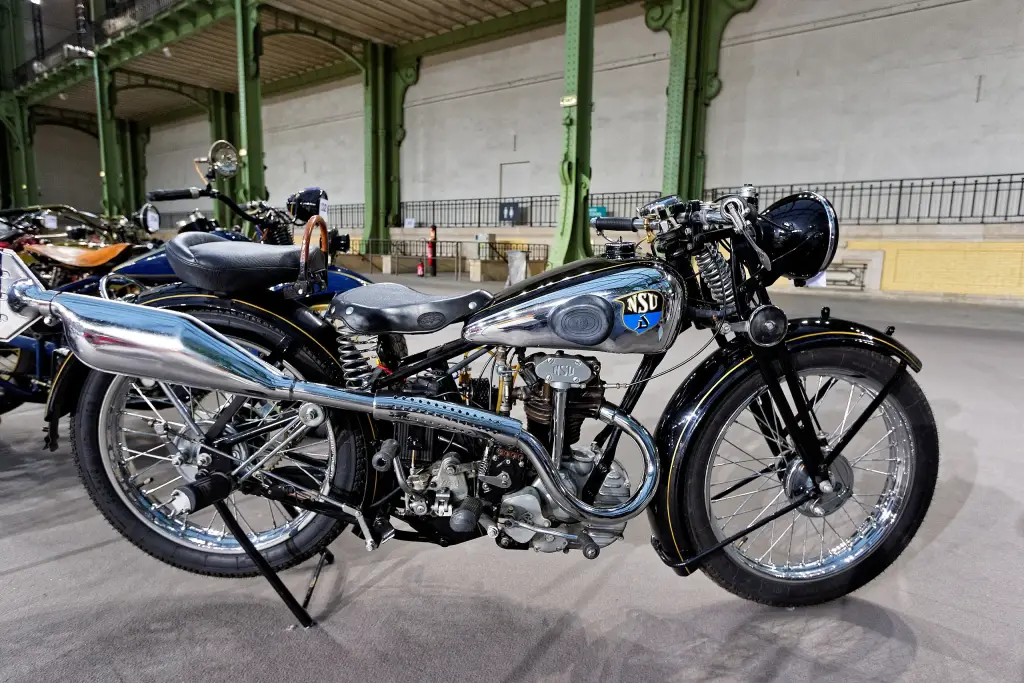
The engines looked like the single-cylinder racing units of the 351 SS, 501 SS and 601 SS, but used a low-mounted camshaft that worked the inclined overhead valves through enclosed pushrods. The enclosure gave the impression of a shaft-driven overhead camshaft. From 1936 the valves had hairpin springs, both open and enclosed; the cylinder stood upright, and from 1938 it had a detachable light-alloy head, though the 201 OSL kept a cast-iron one. The crankcase was aluminium. All OSL engines had dry-sump lubrication with a gear pump, and the oil tank sat in the air stream at the front on engines below 250 cm³ and under the saddle on the larger ones. A kickstarter was the only means of starting. Larger engines had a double-port exhaust, while the 201 and 251 OSL had a single pipe on the right; a raised exhaust was optional. All engines were air-cooled and mounted across the frame.
A chain running in oil took the drive from the engine to a gearbox mounted separately, on the left in the direction of travel. The small models had three gears at first, and from 1935 all versions had four with foot change. Following the style of the English designer William Moore, who moved from Norton to NSU in 1929, the lever was on the right with first gear at the top. A roller chain drove the rear wheel, with upper and lower guards until 1938 and a closed chain case afterwards.
All OSL models used an open steel-tube frame. The front wheel ran in a parallelogram fork with coil springs and plate friction dampers: a pressed-steel fork on the 201 and 251 OSL, a tubular one on the larger models. The rear wheel was unsprung, though from 1935 it had a quick-detachable axle, and the 601 OSL had interchangeable wheels including the sidecar wheel. Both brakes were mechanically operated drums.
From 1938 to 1941 NSU built the 601 OSL Wh in camouflage for the Wehrmacht, with few changes beyond a sprung saddle on double tension springs, a blackout cap on the headlamp and an Amal carburettor. It was not ideal in rough country but well suited to despatch riders, solo or with a sidecar, and 4,962 were delivered. After the war the 251 OSL and the 125 ZDB were the models with which NSU restarted motorcycle production in 1947. The 251 OSL began with a black-painted tank, gained a chromed one in 1950 along with revised handlebar fittings and 3.25 × 19 tyres instead of 3.00 × 19, and had its last changes in 1951. Of the post-war machines 32,465 were built up to 1952 and sold until 1954; from 1950 it cost 1,395 DM, about half a worker’s gross annual wage, against 1,990 DM for a BMW R 25/2 with 1.5 PS more, a telescopic fork and rear suspension.
Design and features
- Overhead valves with enclosed pushrods: the valve gear looked like a shaft-driven camshaft.
- Wide range: 200, 250, 350, 500 and 600 cm³ singles on one basic design.
- Right-foot gear change: first gear at the top, following English practice.
- Quick-detachable axles: from 1935, with interchangeable wheels on the 601 OSL.
- Wehrmacht version: the 601 OSL Wh, 4,962 delivered between 1938 and 1941.
NSU OSL versions
- 201 OSL: 200 cm³, single exhaust, cast-iron head throughout, pressed-steel fork.
- 251 OSL: 250 cm³, the model that returned after the war and was built until 1952.
- 350, 500 and 600 OSL: larger singles with double-port exhausts and tubular forks.
- 601 OSL (to 1941): the biggest of the range, with interchangeable wheels.
- 601 OSL Wh (1938–1941): Wehrmacht version in camouflage, 4,962 built.
The OSL engine line continued after the war in the NSU Konsul, and the 250 cc class was later taken over by the NSU Max. More NSU motorcycles are in the NSU collection.
Sources
- NSU OSL-Modelle, German Wikipedia: range, engines, gearbox, frames, Wehrmacht version, post-war 251 OSL