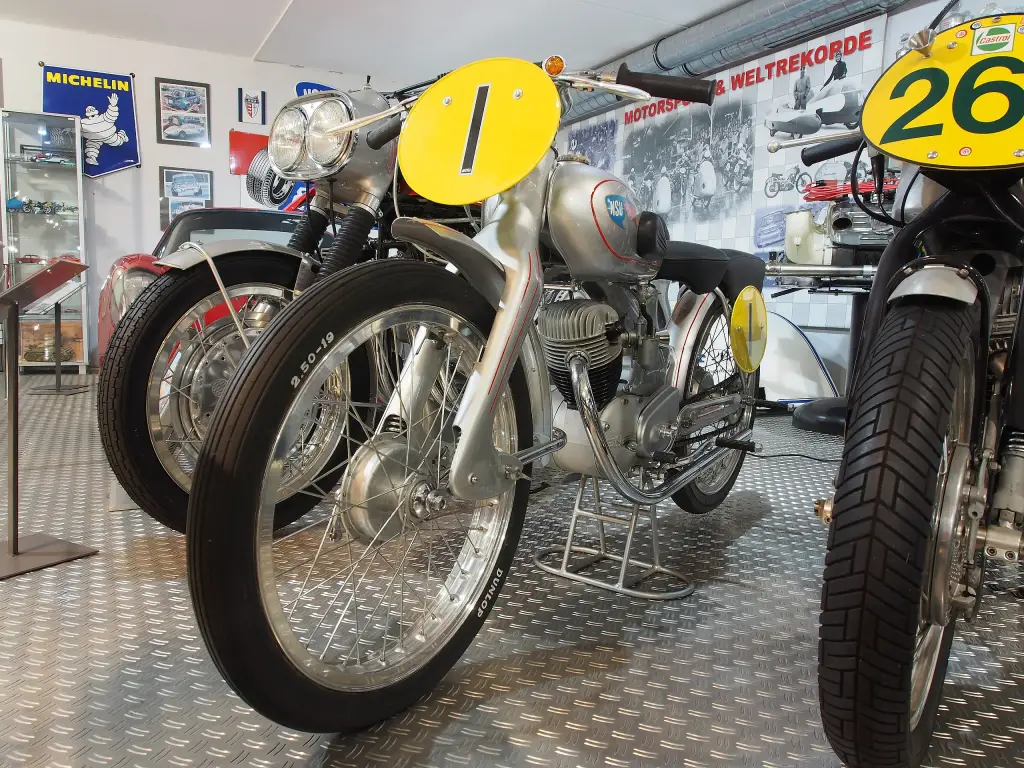
The NSU Fox was the first motorcycle NSU designed from scratch after the Second World War. Shown at the Hanover trade fair in 1948 and built from 1949 to 1954, it used a 98 cc four-stroke engine, a pressed-steel frame and a cantilever rear swingarm — a combination that made it light, cheap to run and unusually economical.
NSU Fox at a glance
| Maker | NSU Werke AG, Neckarsulm |
|---|---|
| Model | FOX 101 OSB |
| Production | 1949–1954 |
| Designer | Albert Roder, NSU chief engineer |
| First shown | Hanover industrial fair, 1948 |
| Engine, 1949 | 98 cc four-stroke, about 6 PS (4.4 kW) |
| Engine, 1951 | 123 cc two-stroke added (type 125 ZB) |
| Frame | pressed sheet-steel central frame |
| Rear suspension | cantilever swingarm with central spring under the saddle |
| Gearbox | three speeds, four from 1950; the two-stroke had four from the start |
| Carburettor | Bing slide type, AJ 1/14/9 (later AJ 1/14/19) |
| Fuel consumption | 1.9 l/100 km by the standard of the day, 2–2.5 l/100 km in practice |
| Successor | NSU Superfox, from 1955 |
Based on one source: the German Wikipedia article on the NSU Fox.
History of the NSU Fox
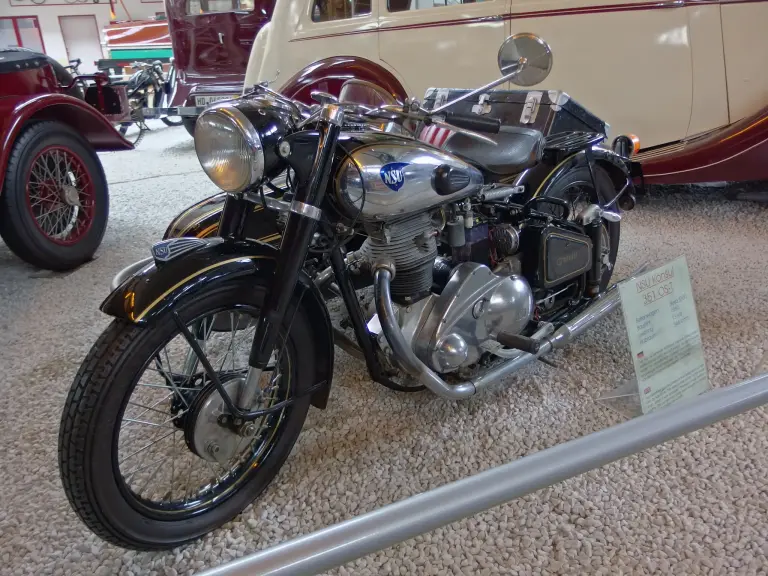
The Fox was a design by Albert Roder, NSU’s chief engineer, and it introduced a series of features new to the company. The engine sat in a pressed sheet-steel central frame that was open at the front; the rear wheel hung on a cantilever swingarm supported by a diagonal central spring below the saddle. At the front a rigid pressed-steel fork carried a leading-link short swingarm with compression springs, and the two levers were tied together by a hoop behind the wheel for stiffness. Adjustable friction dampers were fitted front and rear, though by the standards of the time they were weak.
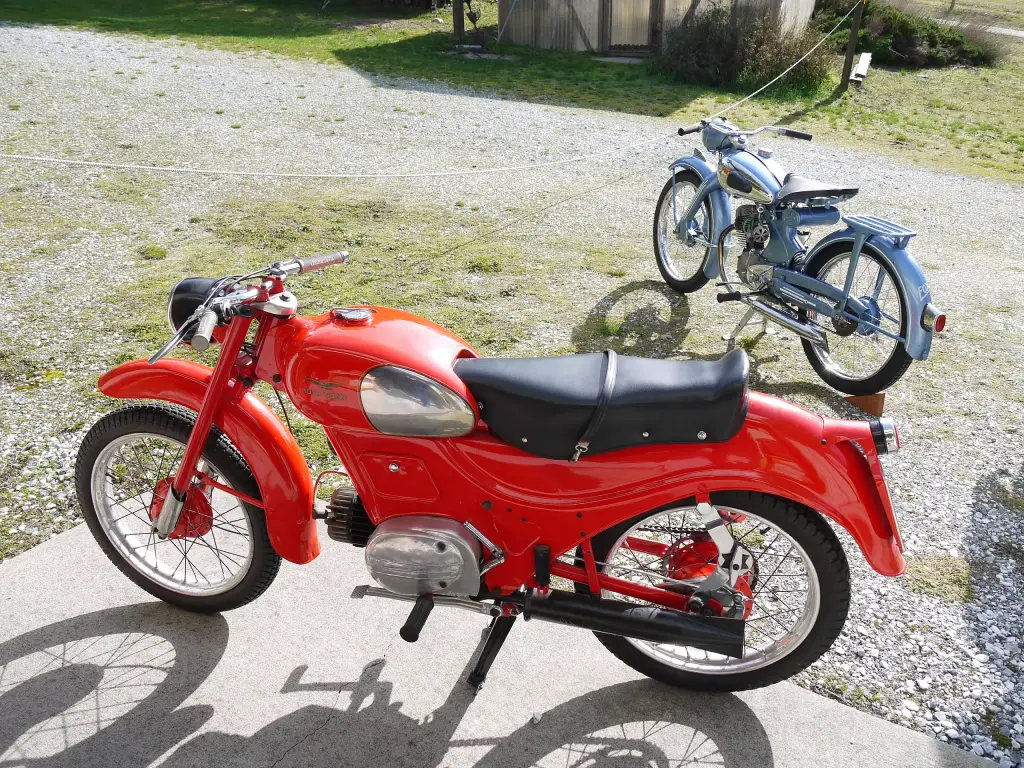
The four-stroke engine had a cast-iron cylinder and a light-alloy cylinder head with overhead valves, operated from a camshaft low on the right-hand side through tappets, pushrods and rockers. Crank, clutch and gearbox shared one aluminium housing and were lubricated only by oil thrown around by the crankshaft — there was no oil pump. The crankshaft itself was carried on one side only, with a single flywheel disc, which was unusual; the two-stroke engine that arrived in 1951 had a conventional shaft supported at both ends. A Bing slide carburettor fed the engine, and a roller chain on the left drove the rear wheel. The gearbox had three speeds at first and four from 1950, changed with a lever on the left; the two-stroke Fox had four speeds from the beginning.
The saddle sat on a long arm below the tank and was sprung in a post guide that stopped it moving sideways, with a small tool box underneath. Instead of a direct-current dynamo, the Fox used a flywheel magneto, usually by Noris and more rarely by Bosch, which supplied 6 V 25 W alternating current for the lights — headlamp working only with the engine running. A small 6 V battery, charged through a selenium rectifier or a resistor, fed only the horn and the parking light.
Economy was the Fox’s great selling point. Its official consumption was 1.9 litres per 100 km, and even in real use it needed only 2 to 2.5 litres. Its advertising slogan, coined by NSU’s advertising chief Arthur Westrup, was “Fixe Fahrer fahren FOX!” — “Smart riders ride a Fox!”
Design and features
- Pressed-steel frame: cheap to make, stiff and open at the front for easy access to the engine.
- Cantilever rear swingarm: a compact layout with the spring tucked under the saddle.
- Single-sided crankshaft: an unusual four-stroke detail, with just one flywheel disc.
- Very low consumption: 1.9 l/100 km by the official figure, about 2–2.5 l/100 km on the road.
- Simple maintenance: engine, clutch and gearbox in one housing, splash lubrication and no oil pump.
NSU Fox versions
- FOX four-stroke (1949–1954): 98 cc, three speeds at first and four from 1950.
- FOX two-stroke (from 1951): 123 cc type 125 ZB with a four-speed gearbox from the start.
- Sportfox (1950): a racing version built on the standard model, of which thirty were planned.
- Superfox (from 1955): the successor model that replaced the Fox.
The Fox was the starting point for the larger NSU Lux and for the 250 cc NSU Max. More NSU motorcycles are in the NSU collection.
Video: NSU FOX 98cc 1951 – last check before it`s hibernation
Video by AffensTyp on YouTube.
Sources
- NSU Fox, German Wikipedia: production, engines, frame, electrics, consumption