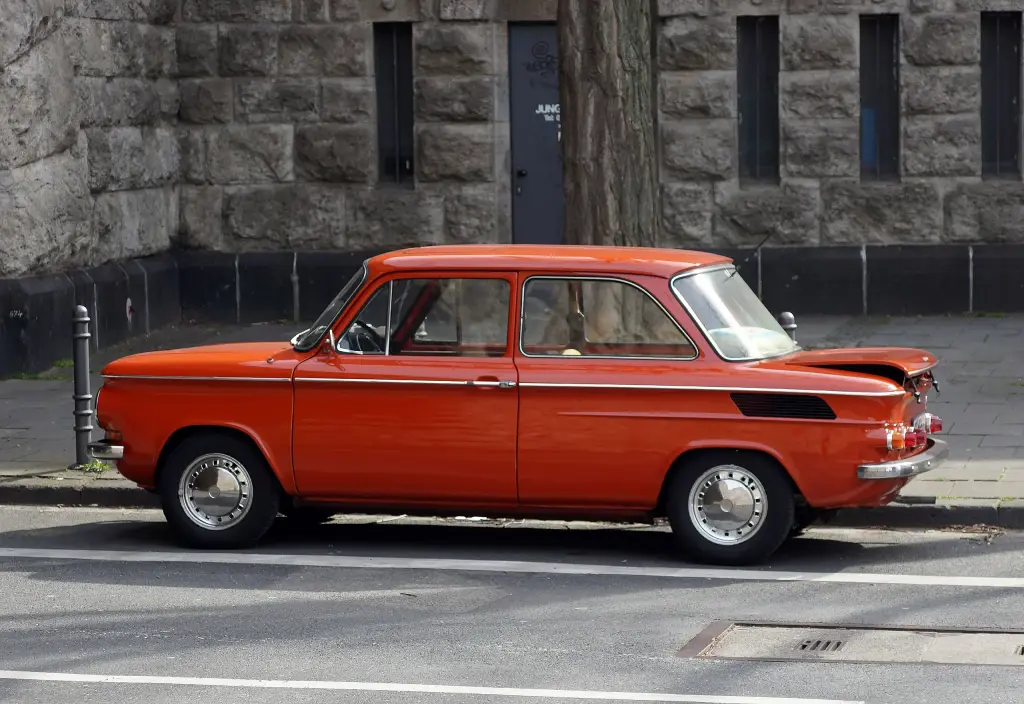
The NSU Prinz was the first car NSU built after the Second World War. Launched at the Frankfurt Motor Show in September 1957 and in volume production from March 1958, it was a small rear-engined saloon whose air-cooled two-cylinder engine came straight out of the company’s motorcycle tradition.
NSU Prinz at a glance
| Maker | NSU Motorenwerke AG, Neckarsulm |
|---|---|
| Production | 1958–1973 |
| First shown | Frankfurt Motor Show, September 1957 |
| Volume production | from March 1958, after 150 pre-production cars |
| Layout | rear engine, rear-wheel drive |
| Engine | air-cooled two-cylinder, 600 cc, 20 PS (14.7 kW) |
| Gearbox | “crash” type at first, four-speed all-synchromesh later |
| Slogan | “Fahre Prinz und Du bist König” |
| Sport Prinz | 2-seater coupé by Bertone, 20,831 built 1958–1968 |
| Prinz 4 | from September 1961 |
| Prinz 1000 | four-cylinder model from 1963 |
| Sporting versions | 1000 TT, 1200 TT and TTS |
Based on one source: the English Wikipedia article on the NSU Prinz, which covers the Prinz I to III, Sport Prinz, Prinz 4 and the 1000/TT line.
History of the NSU Prinz
NSU had been the biggest motorcycle producer in the world in the mid-1950s, but demand shifted first to microcars and then to affordable small cars as customers wanted weather protection. The answer was the Prinz, launched at Frankfurt in September 1957 with the slogan “Fahre Prinz und Du bist König” — “Drive a Prince and you are a king”. After a pilot run of 150 pre-production cars, volume production began in March 1958.
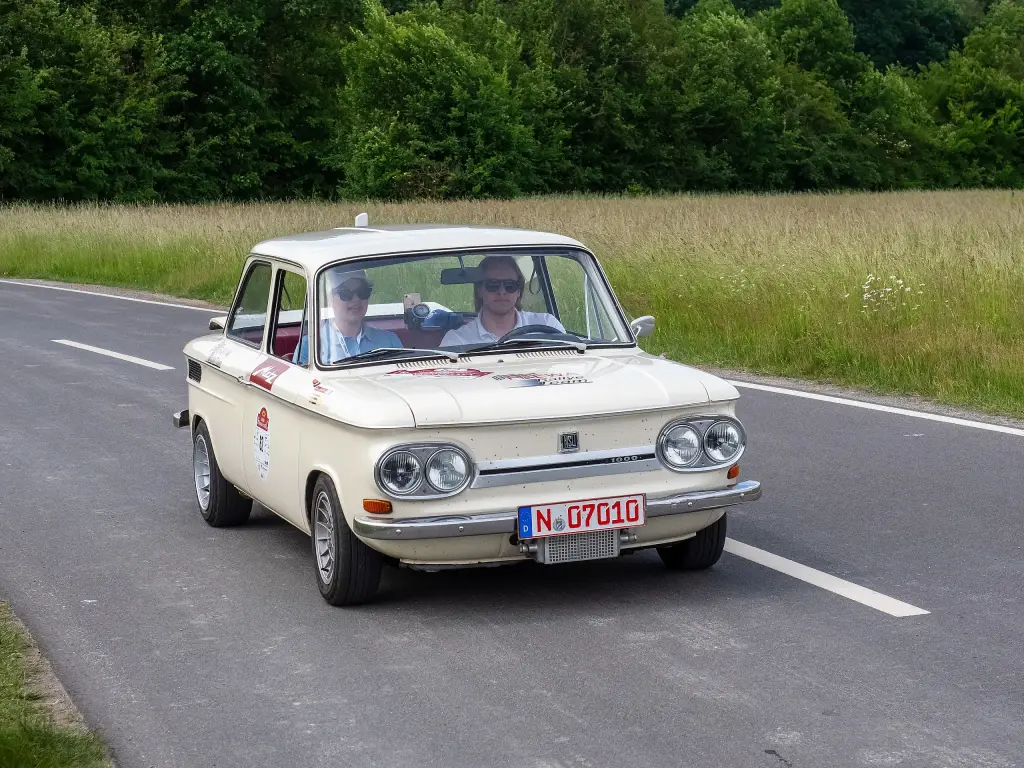
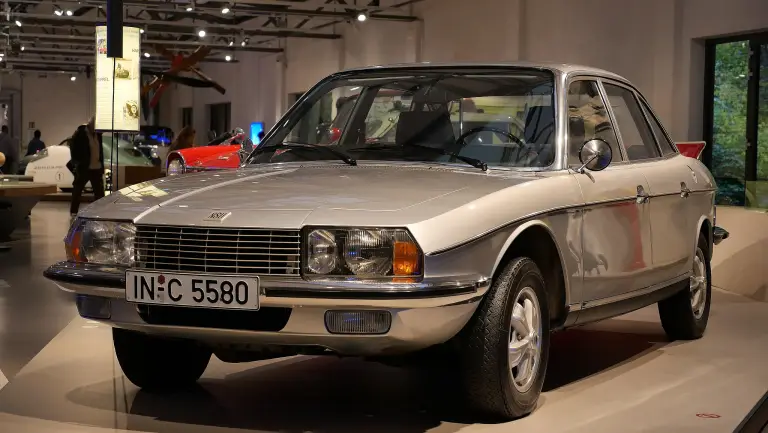
The Prinz I was a two-door saloon with an upright roofline and seating for four. The doors opened wide enough to reach the rear seats, though leg room there was very restricted for full-sized adults. Luggage went in a compartment at the front, shared with the spare wheel and the fuel filler, and there was a narrow but deep full-width space behind the rear seat. The noisy two-cylinder 600 cc air-cooled engine sat at the back and drove the rear wheels, at first through a “crash” gearbox and later through a four-speed all-synchromesh unit. Engine, gearbox and final drive ran in a single chamber lubricated by oil poured in through the rocker cover, and only two grease nipples on the steering kingpins needed attention. Contemporary reports praised the engine’s economy, flexibility and longevity.
The Prinz was exported to the United States but sold poorly and was dropped there after 1960. One famous owner was the Mercury astronaut John Glenn, who used a Prinz 1 as his daily driver: it was more economical than the Chevrolet the other astronauts drove, and with his long commute the saving went towards his children’s college fund.
The Prinz II arrived in 1959 with better trim and an all-synchromesh gearbox; an export version, the 30E, had a 30 PS engine. The Prinz III followed in October 1960 with a new stabiliser bar and the 30 hp motor. In parallel NSU built the Sport Prinz, a two-seater coupé designed by Franco Scaglione at Bertone in Turin: 20,831 were made between 1958 and 1968, the first 250 bodies at Bertone and the rest by Karosseriewerke Drauz in Heilbronn. It started with a 583 cc twin and claimed 160 km/h, and from late 1962 used a 598 cc engine. The Wankel-engined NSU Spider was later based on its platform.
The Prinz 4, one of the revelations of the Frankfurt show in September 1961, replaced the original car. Its body closely resembled the Chevrolet Corvair but was far smaller, and it kept the rear-mounted air-cooled twin with its eccentric rod-driven camshaft and a dynastart built into the crankcase that served as starter, generator and flywheel. A 1968 Autocar road test of a Super Prinz recorded 70 mph and 0–60 mph in 35.7 seconds; a Mini 850 managed 29.5 seconds, and at £597 the NSU cost slightly more than the £561 Mini, but the testers judged it competitively priced and adequately performed.
In 1963 the Prinz grew into the Prinz 1000 (type 67a), shown at Frankfurt with a larger body and an air-cooled overhead-camshaft four. A sporting 1000 TT with a 1.1-litre engine followed, and that in turn was developed into the 1200 TT and the TTS, all sharing the same body and lively, reliable alloy engines.
Design and features
- Motorcycle engineering: an air-cooled twin with an eccentric rod-driven camshaft and only two grease nipples to service.
- Dynastart: the combined starter and generator also acted as the flywheel on the Prinz 4.
- Compact package: front luggage compartment with the spare wheel and filler, plus a deep space behind the rear seat.
- Bertone bodywork: the Sport Prinz coupé was styled by Franco Scaglione.
- Room to grow: the same body later carried the four-cylinder 1000, TT and TTS engines.
NSU Prinz versions
- Prinz I (1958): 600 cc, 20 PS, crash gearbox.
- Prinz II (1959): better trim and an all-synchromesh gearbox; 30E export version with 30 PS.
- Prinz III (1960): stabiliser bar and a 30 hp engine.
- Sport Prinz (1958–1968): two-seater coupé by Bertone, 20,831 built.
- Prinz 4 (1961): new body resembling the Corvair, still with the rear-mounted twin.
- Prinz 1000, 1000 TT, 1200 TT and TTS (from 1963): four-cylinder air-cooled models with overhead camshafts.
The Prinz 1000 grew into the NSU 1200, the Sport Prinz platform carried the Wankel-engined NSU Spider, and the overhead-camshaft layout came from the NSU Max. More models are in the NSU collection.
Video: Tracktest NSU TT Prinz
Video by Motorvision Deutschland on YouTube.
Sources
- NSU Prinz, English Wikipedia: models, engines, Sport Prinz, Prinz 4 road test, 1000 and TT