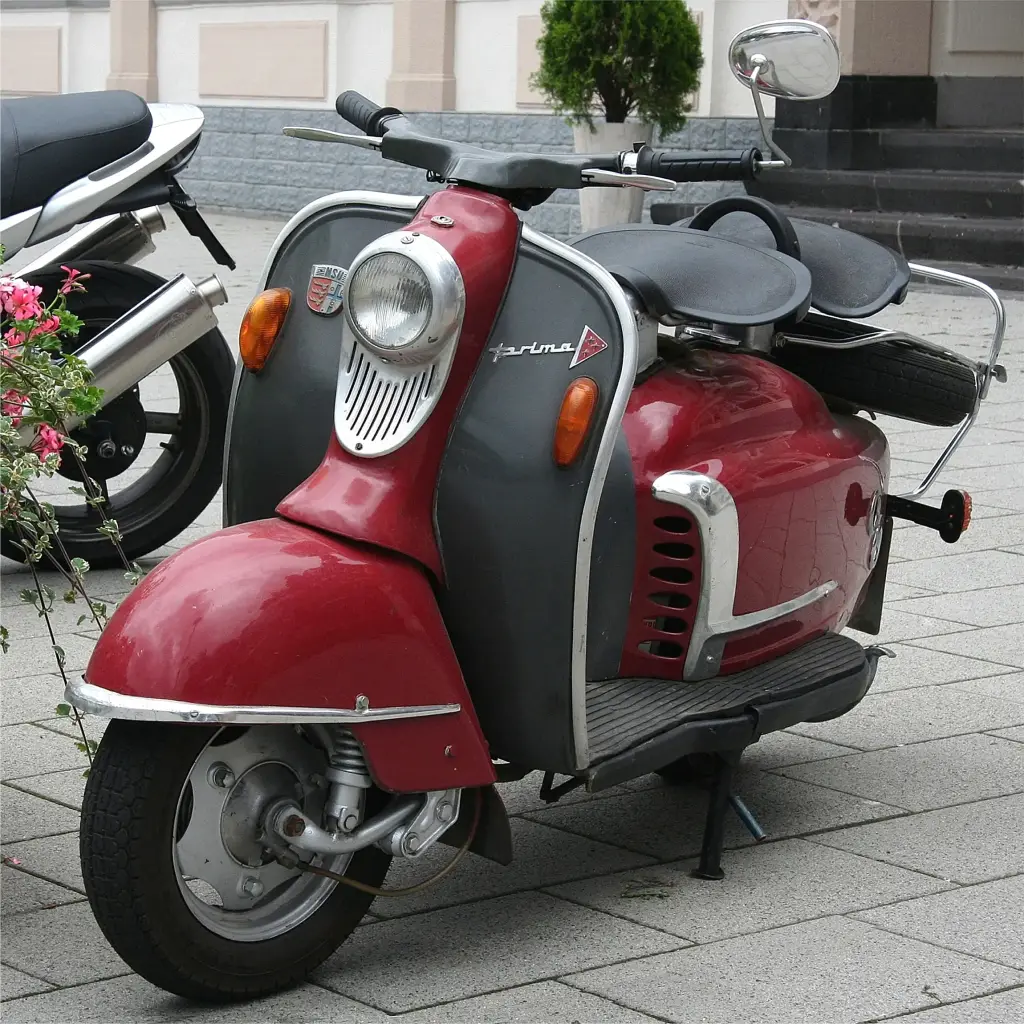
The NSU Prima took over from the Lambretta that NSU had built under Innocenti licence since 1950. Because it was NSU’s own design it could be sold abroad as well as in Germany, and between 1956 and 1964 NSU built 160,645 scooters under the Prima name.
NSU Prima at a glance
| Maker | NSU Werke, Neckarsulm |
|---|---|
| Production | 1956–1964 |
| Built | 160,645 |
| First model | Prima D, 1956 |
| Prima D engine | 146 cm³ two-stroke, 6.2 PS, 80 km/h |
| Prima V engine | 175 cm³, 9.5 PS |
| Prima III engine | 146 cm³, 7.4 PS |
| Frame, Prima V and III | central tube frame with pivoting engine unit |
| Final drive | shaft with bevel gears |
| Also built in | Yugoslavia by Pretis as NSU-Pretis |
| Planned successor | NSU Maxima, not produced |
Based on one source: the German Wikipedia article on the NSU Prima.
History of the NSU Prima
The Prima D arrived in 1956 and was sold alongside the Lambretta for about a year while the older scooter’s production ran out at 117,043 units. NSU warned customers in its house magazine in early 1956 that the Prima would first be delivered abroad and would reach Germany from April. Technically the Prima D was close to the last version of the Lambretta: a stiff steel-tube frame with an all-steel body on rubber pads, the free step-through typical of a scooter, a high front shield and two sprung saddles. The rear side panels came off easily with a twist grip, and the engine sat inside the bodywork ahead of the rear wheel. The rear wheel ran on a swingarm with a coil spring and hydraulic damper, the front on a leading-link short swingarm, and the wheels were interchangeable so that the standard spare could be fitted at either end.
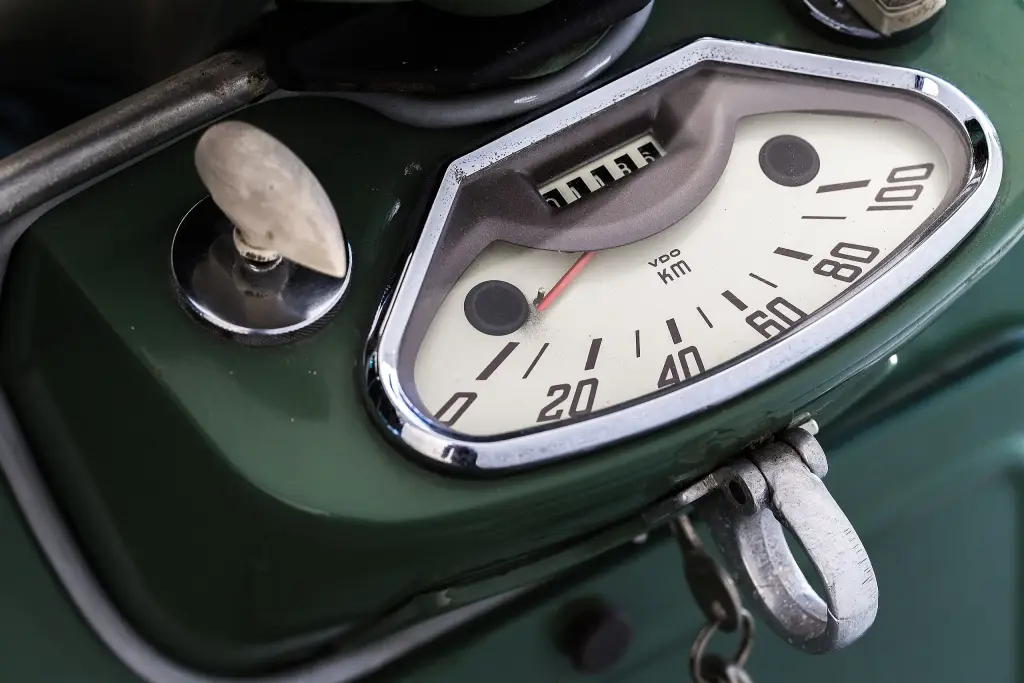
The differences from the Lambretta were mostly in the detail. Instead of a tubular handlebar the Prima had a pressed-steel profile bar with the cables hidden inside, a dashboard with speedometer and ignition and light switch, and knobs for the choke and the fuel tickler; there was no clock, but there was plenty of chrome and a combined headlamp and horn in a chrome surround. Its 146 cm³ fan-cooled two-stroke was fixed in the frame and produced 6.2 PS, driving through a three-speed gearbox changed by a twistgrip on the left, a multi-plate clutch, a shaft and bevel gears. Top speed was 80 km/h, and in first gear with two people aboard it could climb a 31.5 per cent gradient.
The Prima V of 1957, nicknamed the “five star”, was a new design with a central tube frame and a pivoting engine and gearbox unit; the front wheel moved to a leading-link swingarm. Its 175 cm³ engine gave 9.5 PS, and it had a four-speed gearbox with a foot rocker, while the shaft drive stayed. The dashboard now carried a speedometer, warning lights for ignition and fuel level and a clock, and headlamp flasher and a fog lamp on the front mudguard were standard. A dual seat could be ordered instead of the saddles, and the paint choices were Sahara beige, dolphin blue, tundra green or brick red.
At the same time NSU offered the Prima III, slightly cheaper, with a 7.4 PS 146 cm³ engine and without the fog lamp and flasher: at 1,648 DM it saved 147 DM against the Prima V. In November 1959 came the Prima III K and III KL, again with the 146 cm³ engine but with a kickstarter instead of an electric starter and without the dashboard and spare wheel. The III K cost 1,389 DM and the III KL 1,446 DM, the difference being less chrome; ivory was standard on the K and dolphin blue on the KL, and a dual seat was available for both.
Production ended in 1964. The tooling was no longer needed and was sold under a 1963 contract to the Yugoslav maker Pretis of Vogošća near Sarajevo, which built the Prima III and V as the NSU-Pretis for the Yugoslav market until 1964, when the factory needed the capacity for NSU cars. A successor, the NSU Maxima, was planned for 1960 with a modified 175 cm³ four-stroke engine from the NSU Maxi, chain drive, 10.5 PS and 95 km/h, but it never reached production.
Design and features
- Export rights: unlike the licence-built Lambretta, the Prima could be sold outside Germany.
- Hidden cables: a pressed-steel handlebar carried the wiring and Bowden cables inside.
- Interchangeable wheels: the standard spare wheel fitted front or rear.
- Pivoting power unit: from the Prima V, engine and gearbox swung with the rear suspension on a central tube frame.
- Shaft final drive: a shaft with bevel gears in place of a chain.
NSU Prima versions
- Prima D (1956–1960): 146 cm³, 6.2 PS, 80 km/h, three speeds, steel-tube frame.
- Prima V (1957–1964): 175 cm³, 9.5 PS, four speeds, central tube frame with pivoting engine unit.
- Prima III (1957–1964): 146 cm³, 7.4 PS, cheaper than the V at 1,648 DM.
- Prima III K and III KL (from November 1959): kickstarter, no dashboard or spare wheel, 1,389 and 1,446 DM.
- NSU-Pretis: Prima III and V built in Yugoslavia from 1963 to 1964.
The Prima replaced the licence-built NSU Lambretta, and its planned Maxima successor would have used an engine from the NSU Max family. More NSU models are in the NSU collection.
Video: NSU Prima
Video by Union Lido Mare | Camping 5 Stelle on YouTube.
Sources
- NSU Prima, German Wikipedia: models, engines, equipment, prices, Pretis production