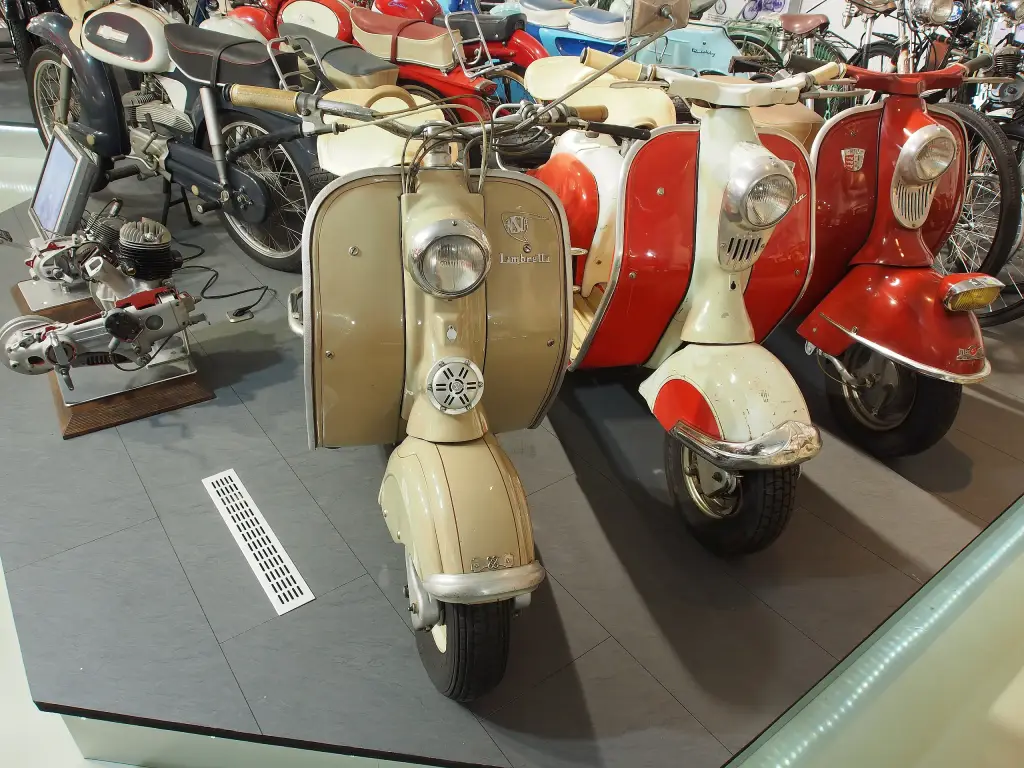
The NSU Lambretta was one of the first scooters of the West German boom of the early 1950s. NSU built it from 1950 under licence from Innocenti of Italy and showed it at the Frankfurt spring fair of the same year. The licence agreement forbade NSU to export the scooters and ran until 1956.
NSU Lambretta at a glance
| Maker | NSU Motorenwerke, Neckarsulm, under Innocenti licence |
|---|---|
| Production | 1950–1956 |
| First shown | Frankfurt spring fair, 1950 |
| Built | 117,043 |
| Engine | air-cooled single-cylinder two-stroke, fan on the left |
| Capacity, 1950–1954 | 123 cm³ (52 × 58 mm), 4.5 PS, 5.1 PS from March 1951 |
| Larger version | 146 cm³ (57 × 58 mm), 6.2 PS |
| Starting | kickstarter to 1953, electric starter afterwards |
| Gearbox | three speeds, Magura twistgrip |
| Frame | single-tube steel frame with deep step-through |
| Body | fully enclosed, mounted on rubber pads |
| Successor | NSU Prima |
Based on one source: the German Wikipedia article on the NSU Lambretta.
History of the NSU Lambretta
NSU signed the licence agreement with Innocenti, the Italian maker of the Lambretta, in time to present its version at the Frankfurt spring fair in 1950. The contract prohibited NSU from exporting the scooters, which kept the machine a German-market product throughout its life and ended in 1956, by which time 117,043 NSU Lambrettas had been built. Its successor was the NSU Prima, which at first looked and worked very much like it.
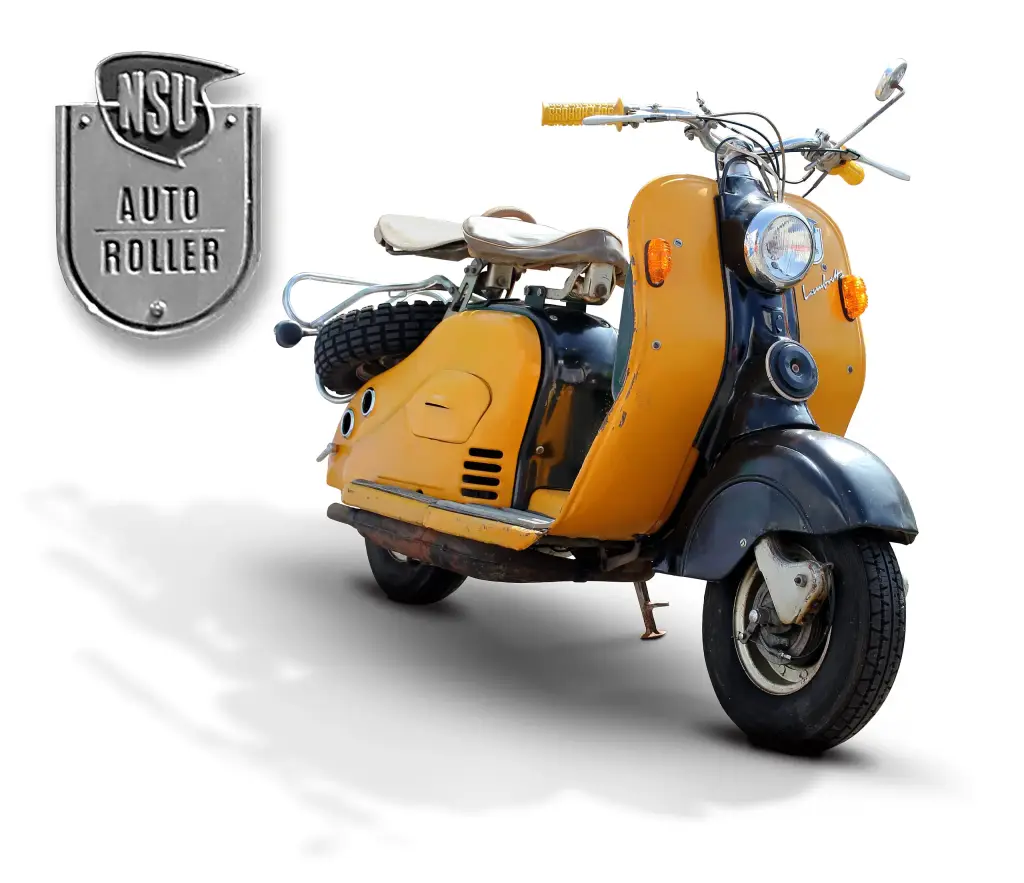
The engine was an air-cooled single-cylinder two-stroke with the cooling fan mounted on the left. In the 1950–1954 version it displaced 123 cm³ from a 52 mm bore and 58 mm stroke and produced 4.5 PS, raised to 5.1 PS from March 1951; a stronger 146 cm³ version with a 57 mm bore gave 6.2 PS. The first engines, up to 1953, were started with a kickstarter; later models had an electric starter, and their batteries sat in a lockable compartment in the legshield. A multi-plate clutch and a three-speed gearbox with Magura twistgrip change were bolted to the right of the engine. A gear train formed the primary drive, and a short shaft — called a cardan shaft in the advertising — with bevel gears took the drive to the rear wheel.
The scooter used a single-tube steel frame with a deep step-through, and unlike the earliest Innocenti Lambrettas it was fully enclosed. The body sat on rubber pads to keep noise out, and the fuel tank was built in between the rider’s and passenger’s seats. The side panels came off easily for access to the mechanical parts, and the right-hand panel had an extra flap by the cylinder and carburettor for reaching the fuel tap; the air flap and the fuel tickler were worked from the dashboard. The front wheel was carried on a short-arm swingarm with two levers and coil springs, the rear on a swingarm with two coil springs and a hydraulic damper. The wheels were interchangeable, and drum brakes front and rear were mechanically operated.
Equipment was generous for a scooter of the period. The NSU Lambretta, advertised as the “NSU-Autoroller”, had two sprung saddles as standard, the front one sliding lengthways to suit the rider’s height. There was a small dashboard with a tachometer and a clock, both lit, a lockable glovebox, a luggage hook, a steering lock and a spare wheel with a trim cover.
Design and features
- Licence-built body: fully enclosed, unlike the earliest Italian Lambrettas, and mounted on rubber pads.
- Two engines: 123 cm³ from 1950, later also a 146 cm³ version with 6.2 PS.
- Access flaps: removable side panels plus a flap by the cylinder for the fuel tap.
- Interchangeable wheels: front and rear wheels could be swapped.
- Full equipment: two sprung saddles, lit clock and tachometer, lockable glovebox and spare wheel.
NSU Lambretta versions
- 123 cm³ (1950–1954): 4.5 PS, 5.1 PS from March 1951.
- 146 cm³: the stronger version at 6.2 PS.
- Kickstart models (to 1953): replaced by electric-start models with a battery compartment in the legshield.
- Racing Lambretta: a works racer with much larger wheels and the tank behind the steering head, ridden by Romolo Ferri and Otto Daiker.
The NSU Lambretta was replaced by the NSU Prima, and the smaller NSU Quickly moped was the company’s other route into light two-wheelers. More NSU models are in the NSU collection.
Sources
- NSU Lambretta, German Wikipedia: licence, engines, chassis, equipment, racing, production