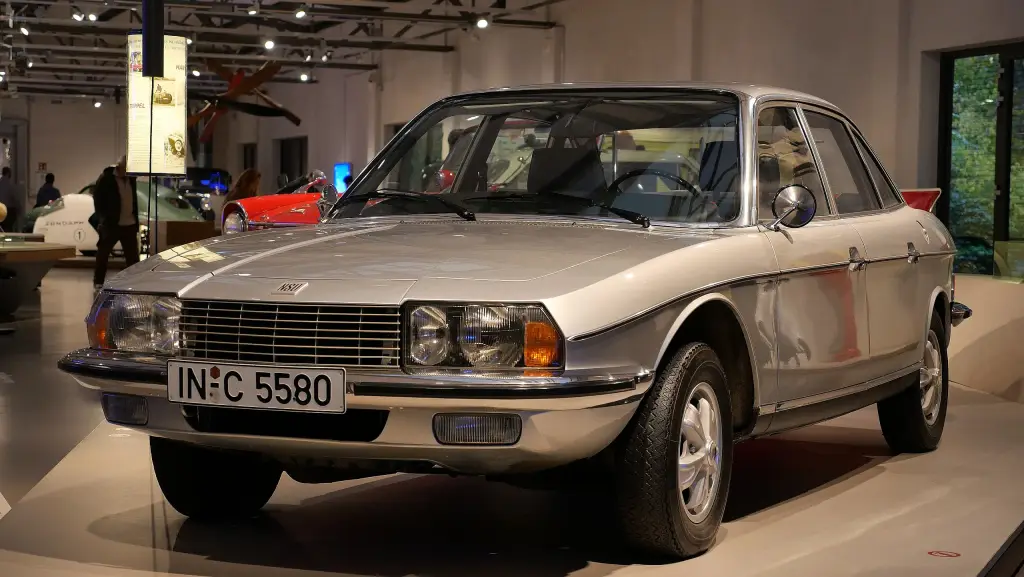
The NSU Ro 80 was the most advanced saloon NSU ever built, and the car that finished the company. Its twin-rotor Wankel engine, aerodynamic body by Claus Luthe and semi-automatic transmission made it Car of the Year for 1968, but its reliability problems helped push NSU into the arms of Volkswagen.
NSU Ro 80 at a glance
| Maker | NSU Motorenwerke, Neckarsulm |
|---|---|
| Production | October 1967 – April 1977 |
| Built | 37,398 |
| Engine | twin-rotor Wankel, 995 cc, 84 kW (113 bhp) |
| Layout | front engine, front-wheel drive |
| Gearbox | three-speed semi-automatic with vacuum-operated clutch |
| Brakes | ATE Dunlop discs all round, front inboard |
| Suspension | MacPherson struts front, semi-trailing arms rear |
| Steering | ZF power-assisted rack and pinion |
| Drag coefficient | 0.355 |
| Top speed | 180 km/h |
| Award | European Car of the Year 1968 |
Based on one source: the English Wikipedia article on the NSU Ro 80.
History of the NSU Ro 80
The Ro 80 was a four-door, front-engined executive saloon of unusual technical ambition. Under the bonnet sat a twin-rotor Wankel engine of 995 cc producing 84 kW (113 bhp), driving the front wheels through a semi-automatic transmission. There was no clutch pedal: touching the gear lever knob closed an electric switch that operated a vacuum system to disengage the clutch, after which the lever moved through a normal H-pattern gate. The gearbox was in effect a three-speed unit.
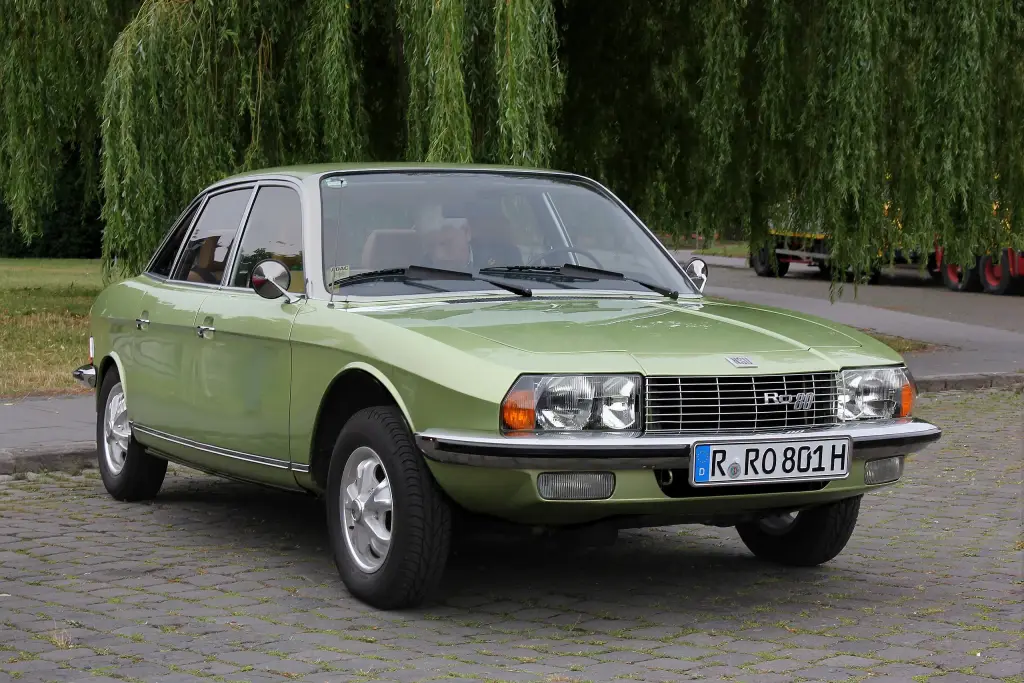
The running gear was equally advanced for 1967. All four wheels had ATE Dunlop disc brakes of a kind normally found only on expensive sports and luxury cars, with the front discs mounted inboard to reduce unsprung weight. The suspension was independent all round, with MacPherson struts at the front and semi-trailing arms at the rear, and the steering was power-assisted ZF rack and pinion. The styling by Claus Luthe, then head of design at NSU and later at BMW, was considered very modern and has appeared in many exhibitions of industrial design; the large glass area foreshadowed 1970s shapes such as Citroën’s. With a drag coefficient of 0.355, low for the period, the car reached 180 km/h. Inside there were cloth seats with a PVC headlining and a carpeted floor, leather being a rarely specified option.
The engine’s willingness to rev quickly and quietly to high speeds was also its weakness, because damage occurred precisely at those speeds: every Ro 80 had a rev counter, and cars built after 1971 added an acoustic warning when the engine was turning too fast. The car gained an early reputation for unreliability. The rotor tip seals were originally made in three pieces of the same material, and the centre section wore faster during cold starts, allowing the outer pieces to move and combustion gases to escape; some early cars needed a rebuilt engine before 50,000 km, with trouble from as little as 24,000 km. Redesigning the centrepiece in ferrotic material solved the problem completely. Fuel consumption of 13–16 l/100 km and poor understanding of the engine among dealers and mechanics did not help. By the 1970 model year most faults had been fixed, but a necessarily generous warranty and the damage to the car’s reputation had undermined NSU’s finances beyond repair.
The Ro 80 changed little over ten years. From September 1969 twin halogen headlamps replaced the rectangular units and air extractor vents appeared on the C-pillar; in August 1970 a slightly reshaped plastic grille replaced the metal one; and a minimal facelift in May 1975 brought larger rear lights, rubber inserts in the bumpers that added 15 mm to the length (4,795 mm) and a rear number plate moved above the bumper, with the boot lid lock moved to the lid’s rear lip.
Series production began in October 1967 and the last cars left the line in April 1977; 5,986 were built in 1968, 7,811 in 1969 and 7,200 in 1970, after which output fell to 3,000–4,000 a year. The fuel price rises after the 1973 oil crisis hurt a thirsty rotary saloon badly, and between 1974 and 1976 annual production was well below 2,000. In the end the success of the similarly sized Audi 100 settled the fate of both the Ro 80 and the NSU brand, as Volkswagen, which had acquired NSU in 1969 and merged it with Auto Union, concentrated on Audi.
Design and features
- Twin-rotor Wankel engine: 995 cc, 84 kW, smooth and free-revving.
- Semi-automatic transmission: no clutch pedal, a vacuum system disengaged the clutch when the lever was touched.
- Inboard front discs: four-wheel discs with reduced unsprung weight.
- Aerodynamic body: Claus Luthe styling with a drag coefficient of 0.355 and 180 km/h.
- Modern chassis: MacPherson struts, semi-trailing arms and power-assisted rack and pinion steering.
NSU Ro 80 versions
- Early cars (1967–1969): rectangular headlights and a metal grille.
- From September 1969: twin halogen headlamps and C-pillar air extractor vents.
- From August 1970: reshaped plastic grille.
- From 1971: acoustic over-rev warning added to the rev counter.
- 1975 facelift: larger rear lights, rubber bumper inserts, length 4,795 mm and a repositioned number plate.
The Ro 80 followed the NSU Spider, the first production car with a Wankel engine, and shared its engine thinking with the Prinz-derived range. More NSU models are in the NSU collection.
Video: Mit Stil: NSU RO 80 | Motor mobil
Video by DW Deutsch on YouTube.
Sources
- NSU Ro 80, English Wikipedia: engine, transmission, chassis, styling, reliability, production