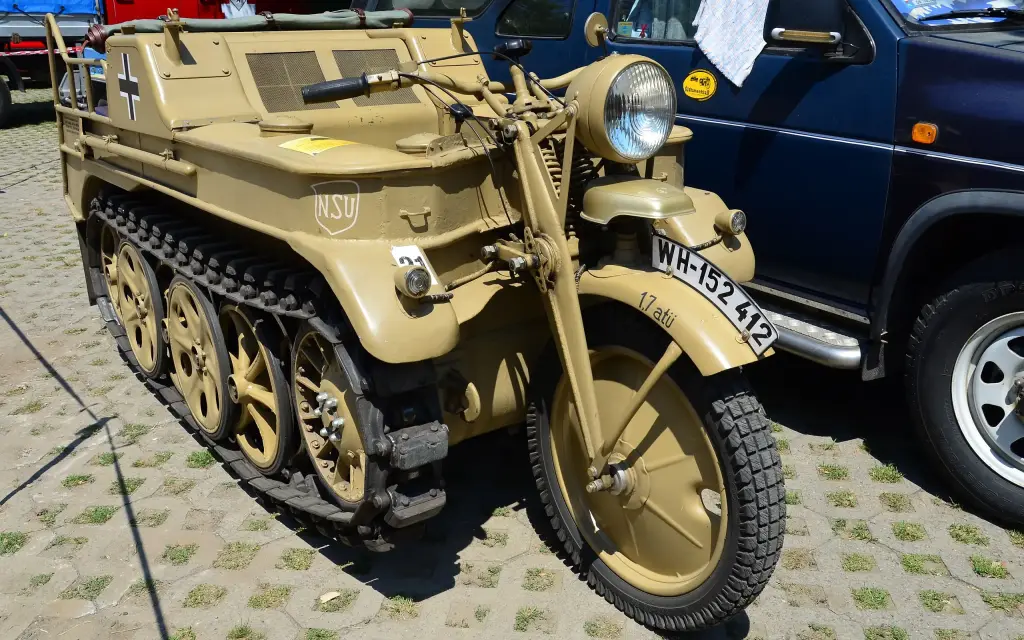
The Kettenkrad was a half-track motorcycle: a tracked chassis with a single steered front wheel. Designed by NSU in Neckarsulm as a light tractor for airborne troops, it became one of the most recognisable German military vehicles of the Second World War.
NSU Kettenkrad at a glance
| Official designation | Sd.Kfz. 2, Sonderkraftfahrzeug 2 |
|---|---|
| Full name | Kleines Kettenkraftrad HK 101 |
| Maker | NSU Werke AG, Neckarsulm |
| Patented | June 1939 |
| First used in action | Invasion of Crete, 1941 |
| Layout | tracked chassis with one steered front wheel |
| Designed for | airborne troops, delivered by Junkers Ju 52 |
| Road wheels | overlapping Schachtellaufwerk |
| Trailer | Sonderanhänger 1, carrying 350 kg |
| Gradient | up to 24 degrees in sand |
| Licence production | Stoewer of Stettin, about 10 per cent |
| Built to 1944 | 8,345 |
| Post-war | about 550 built for agriculture, until 1948 or 1949 |
Based on one source: the English Wikipedia article on the Sd.Kfz. 2.
History of the NSU Kettenkrad
The Kettenkrad was conceived as a light gun tractor for airborne troops. It had to fit inside the hold of a Junkers Ju 52 transport, though it was never dropped by parachute: it was the only gun tractor small enough to be carried that way. It was also the lightest mass-produced German military vehicle to use the complex Schachtellaufwerk system of overlapping and interleaved road wheels, which almost every German half-track of the war employed.
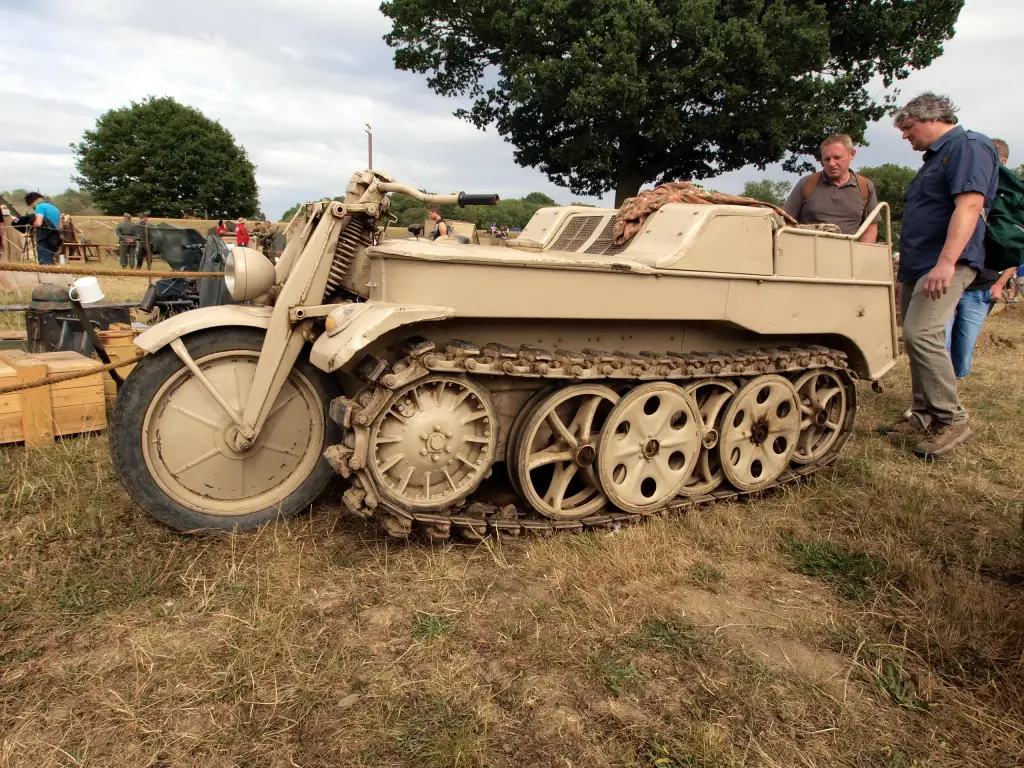
Steering worked through the handlebars. Up to a certain angle only the front wheel turned; beyond that the track brakes were engaged to tighten the turn. In extreme off-road conditions, where speed was low anyway, the vehicle could be driven without the front wheel fitted at all, and this was recommended. NSU patented the design in June 1939 and it was first used in action during the invasion of Crete in 1941. Later in the war Stoewer of Stettin built Kettenkräder under licence, accounting for about ten per cent of production.
Most saw service on the Eastern Front, where they laid communication cables, pulled heavy loads and carried soldiers through the deep Russian mud. Later they were used as runway tugs for aircraft, particularly the Messerschmitt Me 262 jet fighter and sometimes the Arado Ar 234 reconnaissance bomber: to save aviation fuel, German jets were towed to the runway rather than taxiing under their own power. The Kettenkrad was also used in North Africa and on the Western Front.
A special trailer, the Sonderanhänger 1, could be attached to increase cargo capacity; it carried 350 kg. Being tracked, the vehicle could climb gradients of up to 24 degrees in sand and more on hard ground.
Design and features
- Single steered front wheel: turns like a motorcycle until the track brakes take over for sharper corners.
- Air-transportable: the only gun tractor small enough to fit inside a Ju 52.
- Schachtellaufwerk: interleaved road wheels, the lightest German vehicle to use them.
- Trailer capacity: the Sd.Anh.1 added 350 kg of cargo.
- Climbing ability: 24 degrees in sand and more on hard ground.
NSU Kettenkrad versions
- Kettenkrad HK 101 (Sd.Kfz. 2): the standard production vehicle, built by NSU and Stoewer.
- Springer (Sd.Kfz. 304): a remotely controlled demolition vehicle derived from the Kettenkrad.
- Five-seat version: an enlarged project that reached only the prototype stage.
- Post-war agricultural version: about 550 built at NSU after 1945, production ending in 1948 or 1949.
The Kettenkrad came from the same works as NSU’s post-war motorcycles, among them the NSU Quick and the NSU Max. More vehicles are in the NSU collection.
Video: Kettenkrad AA 2013 mahl richtig Quälen Kettenkrad NSU
Video by Sepp Huber on YouTube.
Sources
- Sd.Kfz. 2, English Wikipedia: design, service, variants, production