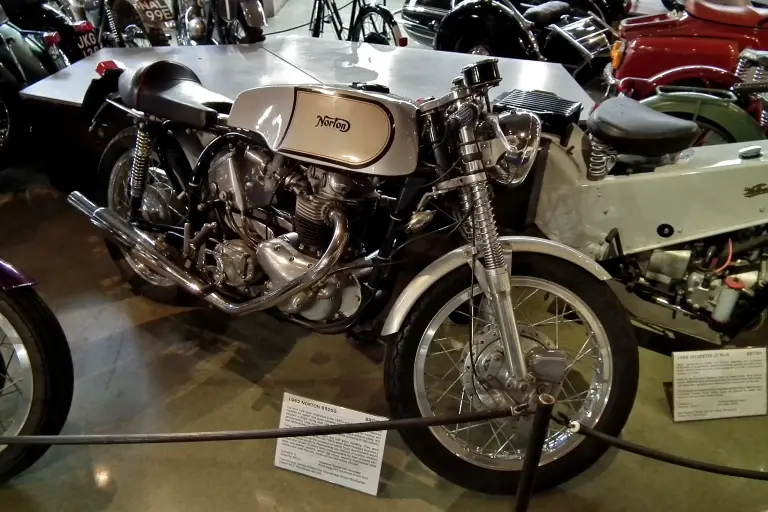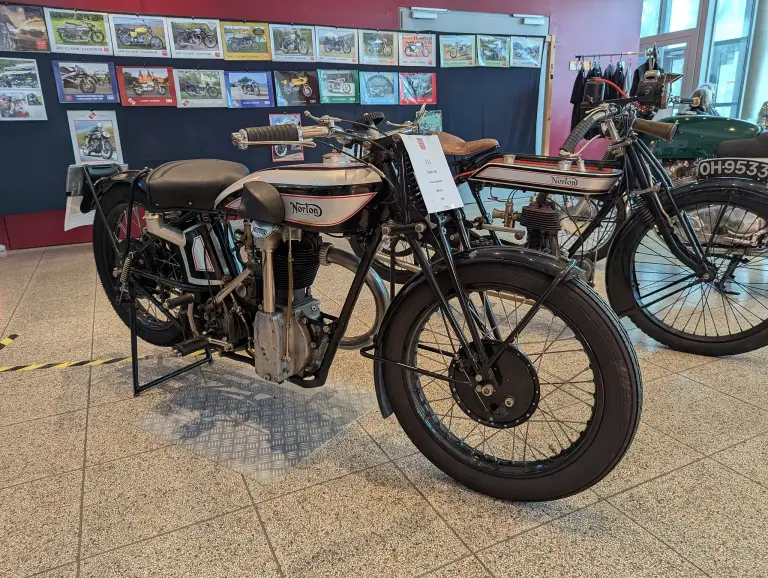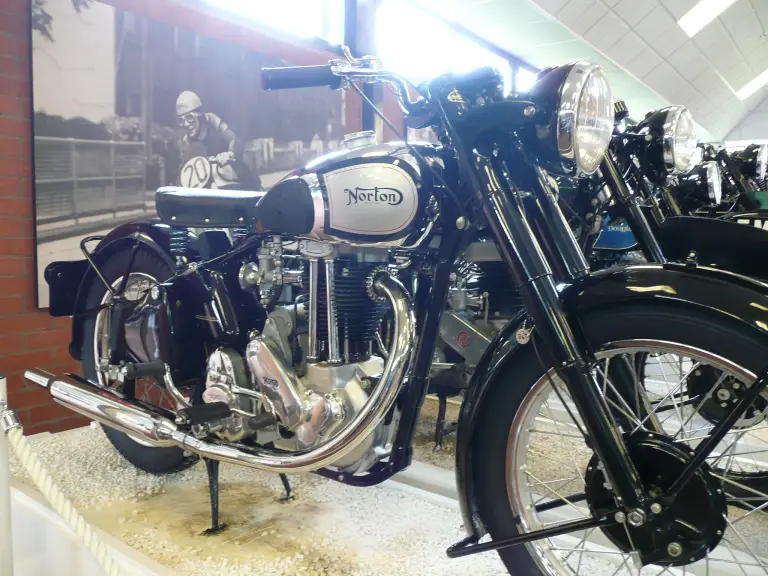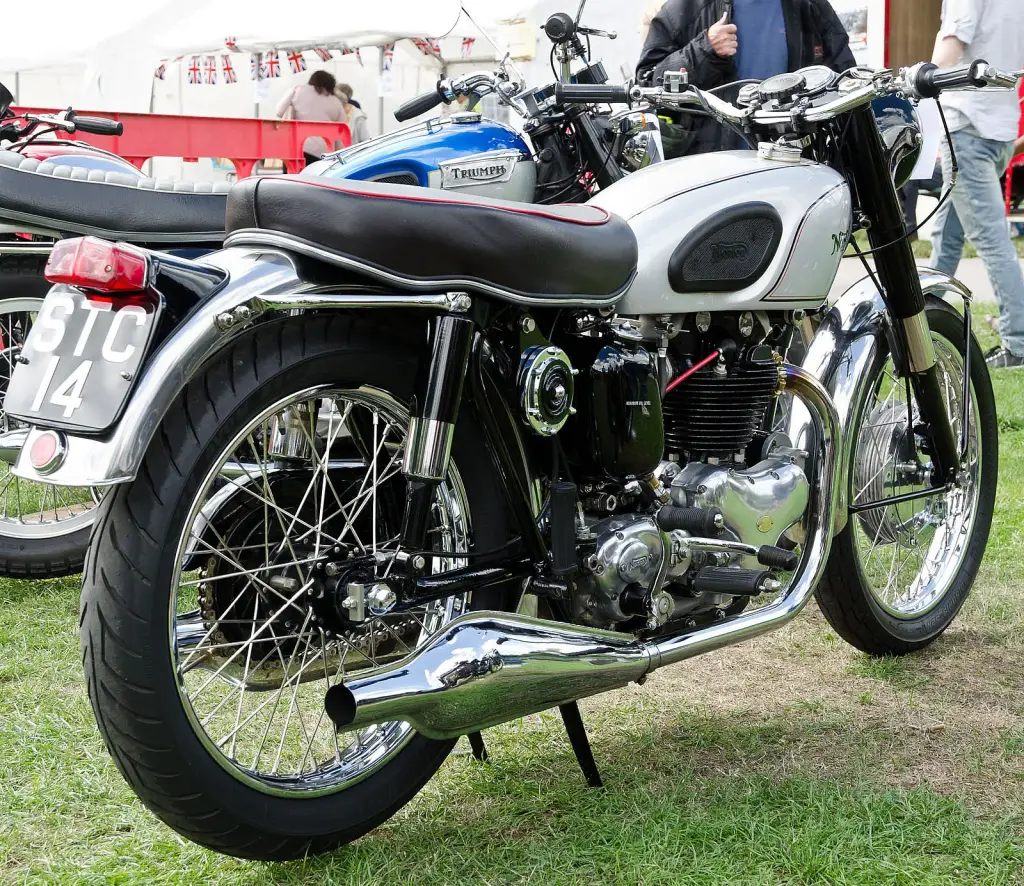
The Norton Model 7 Dominator is a 500 cc vertical twin motorcycle that the Norton Motorcycle Company made from 1949 until 1955. It was the first of the Norton Dominator series. Its engine was designed by Bert Hopwood and broke with Norton’s previous practice of building only single-cylinder machines.
Norton Model 7 Dominator at a glance
| Maker | Norton Motorcycle Company, Birmingham |
|---|---|
| Production | 1949-1955 |
| Type | 500 cc vertical twin |
| Engine | 497 cc overhead-valve twin, 360-degree crankshaft |
| Bore x stroke | 66.0 x 72.6 mm |
| Power | 29 bhp (22 kW) at 6,000 rpm |
| Carburettor | single Amal |
| Ignition | Lucas magneto at the rear of the engine |
| Gearbox | four-speed lay-down, chain primary drive |
| Frame | plunger, with telescopic Roadholder fork |
| Brakes | 7-inch drums front and rear |
| Launched | Earls Court Motorcycle Show, November 1948 |
Based on one source, the English Wikipedia article on the Norton Model 7 Dominator.
History of the Norton Model 7 Dominator
A British answer to the Speed Twin
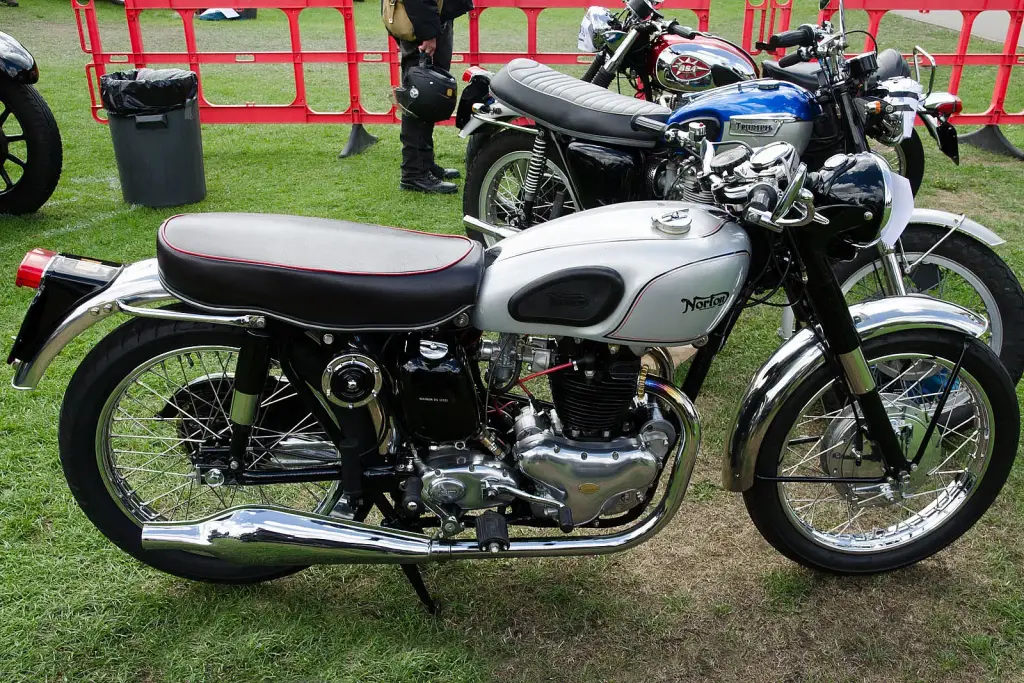
After the Second World War British manufacturers resumed civilian production, and the government launched an Export or Die campaign to aid economic recovery. Triumph’s 1938 Speed Twin had been well received, and other makers began to design their own 500 cc twins. Bert Hopwood had worked under Val Page at Ariel and Edward Turner at Triumph, where he helped design the Speed Twin, and Norton recruited him to design a new twin engine. The Model 7 Dominator, using Hopwood’s engine in adapted Norton ES2 cycle parts, was launched at the November 1948 Earls Court Motorcycle Show.
Engine and transmission
The engine has a 360-degree built-up crankshaft with central flywheels, which meant that a central main bearing could not be fitted. The outer main bearings were a ball bearing on the timing side and roller bearings on the drive side. Alloy connecting rods were split at the big end and used a bush for the big-end bearing; the crankshaft and conrods had been tested in an earlier Norton twin designed by J. E. Moore but never put into production. The camshaft sits in front of the engine, driven by a chain from a half-speed pinion. A Lucas magneto at the rear of the engine provides ignition, and a dynamo at the front powers the lights; both are chain-driven.
The cylinder block is cast iron with an integral pushrod tube, and the cylinder head is also cast iron with cast-in rocker boxes to eliminate oil leaks between head and rocker boxes. A shallow combustion chamber, a low included valve angle and flat-top pistons give a good swirl effect, and the head has widely splayed exhaust ports to aid cooling. A single Amal carburettor feeds the engine through an alloy manifold. The long-stroke engine measures 66.0 x 72.6 mm and produced 29 bhp (22 kW) at 6,000 rpm. An alloy version of the cylinder head was available to special order in 1952; it had been developed for Norton competition machines from 1950, including the Norton twins used in the 1950 ISDT. Primary drive is by chain to a wet clutch in a pressed-steel chaincase, and to fit the ES2 frame a new four-speed lay-down gearbox was used. Final drive is by chain.
Cycle parts and the Dominator family
The Model 7 has the same cycle parts as the single-cylinder ES2: Norton’s garden-gate plunger frame, a long Roadholder telescopic fork and 7-inch drum brakes front and rear. From 1952 the Model 7 engine was fitted in the swinging-arm Featherbed frame to create the lighter and better-handling Model 88, but Model 7 production continued because the Featherbed was thought unsuitable for sidecar use. In 1953 development engineer Bob Collier designed a new rear sub-frame giving the bike swinging-arm rear suspension, and in 1954 a larger 8-inch front brake was fitted.
Norton’s factory records show that the initial production of the Model 7 was for Australia. At the August 1950 Brisbane show a rigid-framed version was displayed on the stand of the Australian Norton dealer Andersons Agencies. Bob Collier of Norton’s experimental department had built a prototype rigid model for the 1950 racing season, promoted as being 2 inches lower and 10 lb lighter than the plunger version. It was known as the Model 77, the Model 77 Sport Twin, the Dominator Rigid or the Dominator Rigid Sport, and 237 rigid machines were sent to Australia between April 1950 and February 1952.
Design and features
- Hopwood’s first Norton twin: a 497 cc overhead-valve parallel twin with a 360-degree crankshaft and 29 bhp.
- Cast-iron construction: integral pushrod tube and cast-in rocker boxes, with an alloy head optional from 1952.
- ES2 cycle parts: the garden-gate plunger frame, Roadholder fork and 7-inch drum brakes.
- Police service: the Model 7 was used as a police motorcycle in Japan.
Norton Model 7 Dominator versions
- Model 7 (1949-1953): the original plunger-framed twin.
- Model 7 (1953-1955): with Bob Collier’s swinging-arm rear sub-frame.
- Alloy-head Model 7 (1952): a special-order cylinder head from Norton’s competition programme.
- Model 77 rigid (1950-1952): the Australian rigid-framed version, 237 built.
The Model 7 began the Norton Dominator line and used the cycle parts of the Norton ES2. More Norton motorcycles are in the Norton collection.
Video: 1950 Norton Model 7 starting sequence
Video on YouTube.
Sources
- Norton Model 7 Dominator, English Wikipedia: design, specifications, Australian models