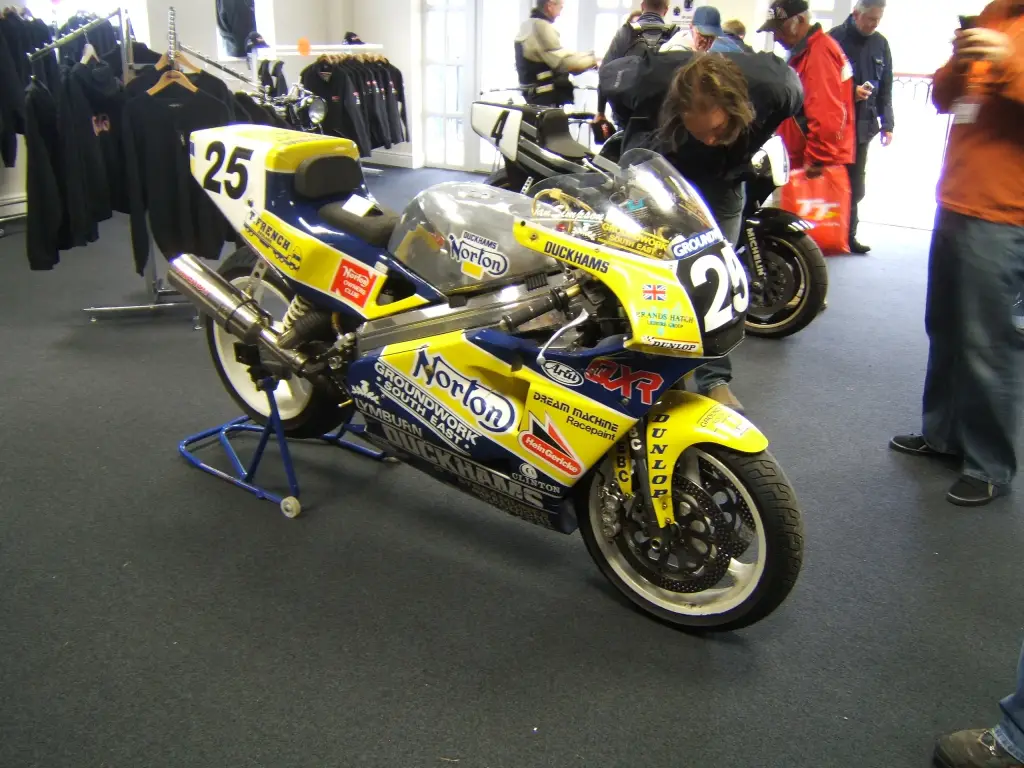
The Norton RCW588 is a works racing motorcycle produced for the 1988 to 1994 racing seasons. It used a twin-rotor Wankel engine, initially air-cooled in the form fitted to the road-going Norton Classic and water-cooled from 1989. The unusual rotary Norton became one of the most distinctive racing machines of its era.
Norton RCW588 at a glance
| Maker | Norton, Shenstone, Staffordshire |
|---|---|
| Racing seasons | 1988-1994 |
| Engine | twin-rotor Wankel, 588 cc |
| Cooling | air-cooled in 1988, water-cooled from 1989 |
| Power | 79 bhp in road tune; 130 bhp racing, 140 bhp with ram air |
| Frame | Spondon aluminium monoshock |
| Forks | Kayaba |
| Wheels | Dymag |
| Main sponsor | John Player & Sons |
| TT win | Steve Hislop, 1992 Senior TT |
| British Superbike | Ian Simpson, 1994 |
Based on one source, the English Wikipedia article on the Norton RCW588.
History of the Norton RCW588
A rotary racer from the service department
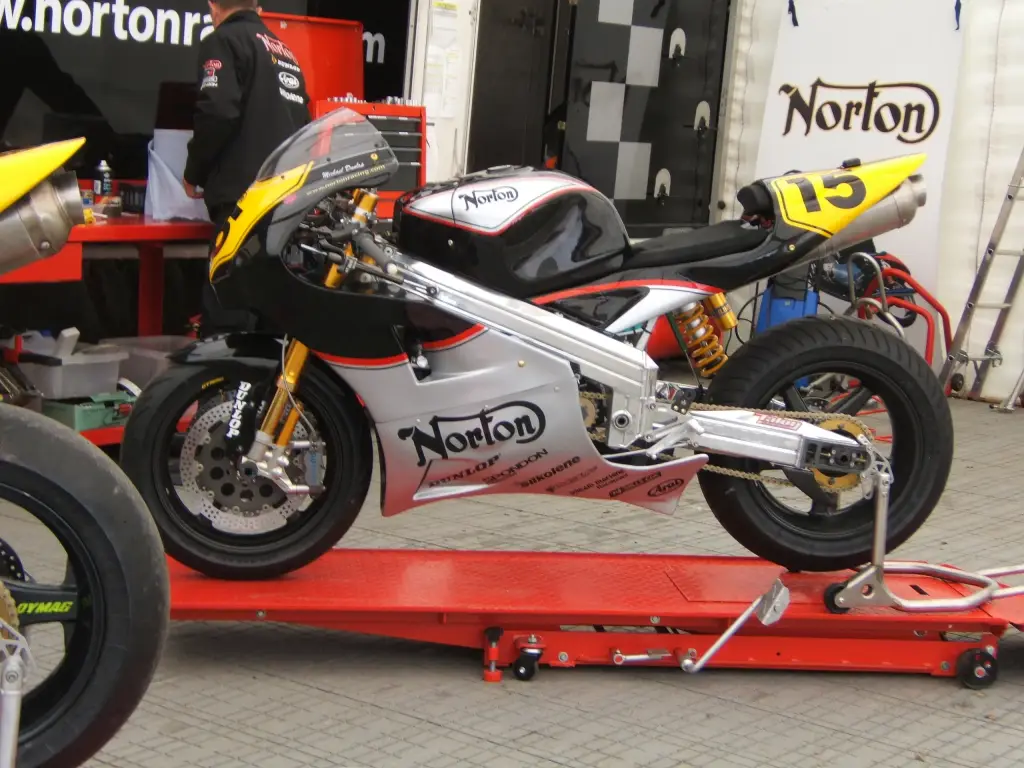
The RCW588 traces its origins to the motor of the Norton Classic, devised and developed by David Garside at BSA in the 1970s, but the racing engine was the creation of Brian Crighton. Crighton joined the Norton factory at Shenstone, Staffordshire, in 1984 from a background in electronic engineering to oversee the service department’s maintenance of the Norton Commander used by the police, and he was responsible for establishing Norton’s return to racing. Recognising that the engine could produce much more power, he first developed it in his own time without backing from Norton management, until the factory sanctioned the project in late 1987 and employee Malcolm Heath debuted the prototype at Darley Moor. Based on an ex-police engine, it was restricted to club-level racing because the ACU had not decided how to categorise the rotary engine.
The racing engine
One of the first changes for racing was to reduce the cooling-fin area, since racing machines moved much faster than the road-going types that police and RAC patrols had overheated in slow convoys. Ram air induction from fairing-mounted scoops was added; Motorcycle Sport confirmed in 1988 that Crighton had used it since 1972, some years before Honda, which later claimed it as one of its innovations. A longer induction length was also used. Power output was raised from the road-going 79 bhp to 130 bhp, or 140 bhp with maximum ram effect on a high-speed circuit.
The engine was basically similar to the road version but was fitted into a monoshock Spondon aluminium frame with Kayaba front forks and Dymag wheels. The induction system was simplified, abandoning the road arrangement in which cooling air was routed through the engine rotors before being fed into the carburettors; instead, exhaust-gas velocity was used with a venturi to create a low-pressure area that dragged air through the engine components and into the exhaust. Crighton noted that the usual way of modifying a road engine for racing is to replace the crankshaft, conrods, pistons and camshafts, but the rotary had none of these, and even raising the compression ratio was extremely difficult. Modifications were therefore made in the manner of a two-stroke, by changing the internal ports that control intake mixture and waste gases, together with improved carburation and exhaust extraction. The road-going SU constant-vacuum carburettors were replaced by Amal slide-operated units.
Racing results
The team started racing in late 1987 and ran the 1988 season on a limited budget with riders Trevor Nation and Simon Buckmaster and some sponsorship from Dunlop tyres, Duckham’s oils, Renold chains and Amal carburettors. From 1989 a six-man team included Nation and Buckmaster, and with major sponsorship from John Player & Sons the Norton Rotary achieved significant success with riders Steve Spray, Robert Dunlop and Ron Haslam, together with stand-in riders Andy McGladdery and Terry Rymer. The team won the British Formula One Championship with Steve Spray in 1989. The FIM accepted the 588 cc Wankel capacity in 1990, allowing the Norton to enter the 500 cc Grand Prix class.
Brian Crighton left Norton in September 1990 after Barry Symmons, formerly chief of the Honda Britain racing squad, was appointed race team manager in early 1990. Crighton stayed on as a consultant and then developed a shadow project called Roton with Spray, which competed in the Australian Grand Prix at Eastern Creek and finished 15th for one World Championship point. He also sought backing from the Australian businessman Chris Oldfield, who intended to manufacture the machines and run a team with Australian riders Grant Hodson and Wayne Clark.
Steve Hislop won the 1992 Senior TT, the first time Norton had won the class since 1961, and Ian Simpson won the 1994 British Superbike Championship on a Team Crighton Norton rotary with Duckhams sponsorship. The RCW588 also had successes at Cadwell Park, Mallory Park and Thruxton. A limited-production road-going version was developed, initially designated P55 and becoming known as the Norton F1. Brian Crighton later developed the Rotary Norton NRV588 concept for Stuart Garner, owner of Norton Motorcycles Ltd at Donington Hall, again using an aluminium twin-spar frame and swinging arm by Spondon Engineering, which became fully owned by Norton in 2013. He went on to develop his own CR700P, with engine chambers enlarged to 700 cc and a sealed, pressurised-gas cooling system circulating gas through an intercooler in the seat tail.
Design and features
- Rotary engine: a 588 cc twin-rotor Wankel, water-cooled from 1989 and accepted by the FIM for the 500 cc class in 1990.
- Big power: 130 bhp in racing tune and 140 bhp with ram air, against 79 bhp for the road engine.
- Ram air induction: fairing-mounted scoops and a venturi exhaust system, years before the Japanese factories adopted the idea.
- Race-winning: the 1992 Senior TT with Steve Hislop and the 1994 British Superbike title with Ian Simpson.
Norton RCW588 versions
- RC588 (1988): the air-cooled development racer based on an ex-police engine.
- RCW588 (1989-1994): the water-cooled works racer in Spondon frames.
- Norton F1 (P55): the limited-production road version of the rotary racer.
- NRV588: Brian Crighton’s later rotary concept for Norton at Donington Hall.
- CR700P: Crighton’s own 700 cc rotary with gas cooling.
The rotary racer followed Norton’s great racing singles such as the Norton Manx, and its road derivative joined the Norton Commando in the company’s road range. More Norton motorcycles are in the Norton collection.
Video: Norton NRV588 track test at Donington and dyno run for the Isle of Man TT
Video on YouTube.
Sources
- Norton RCW588, English Wikipedia: development, racing results, legacy