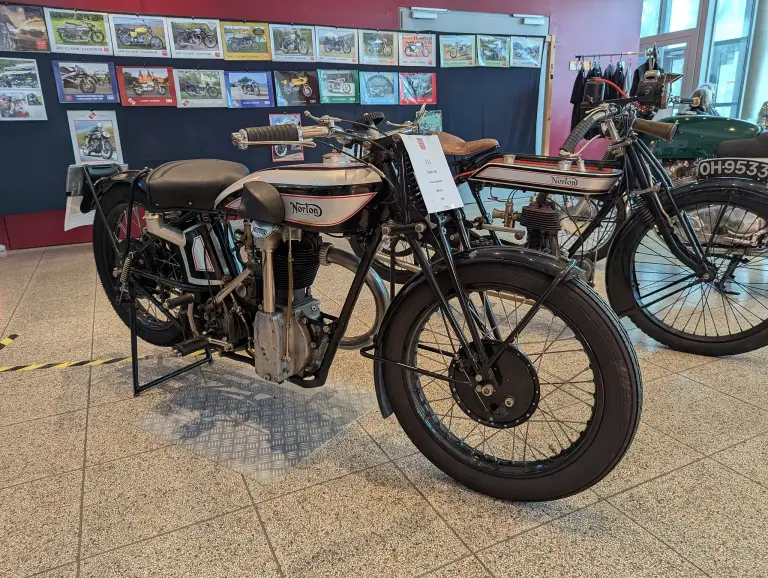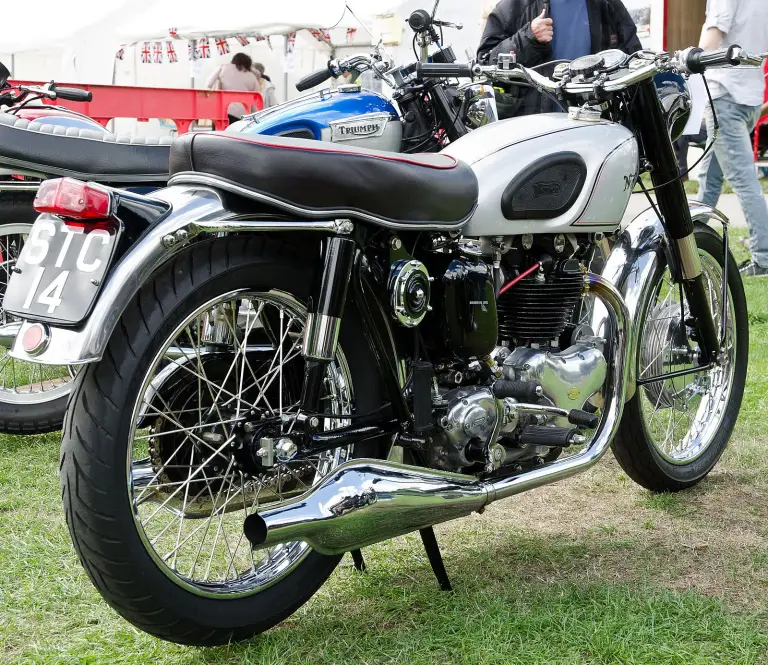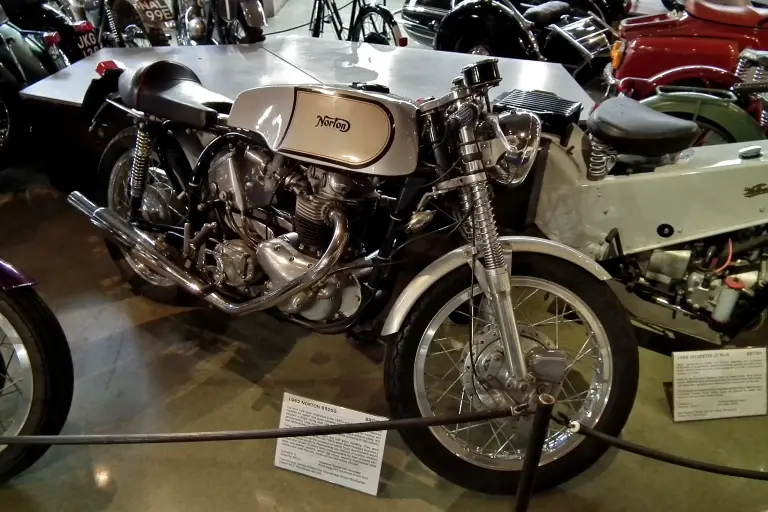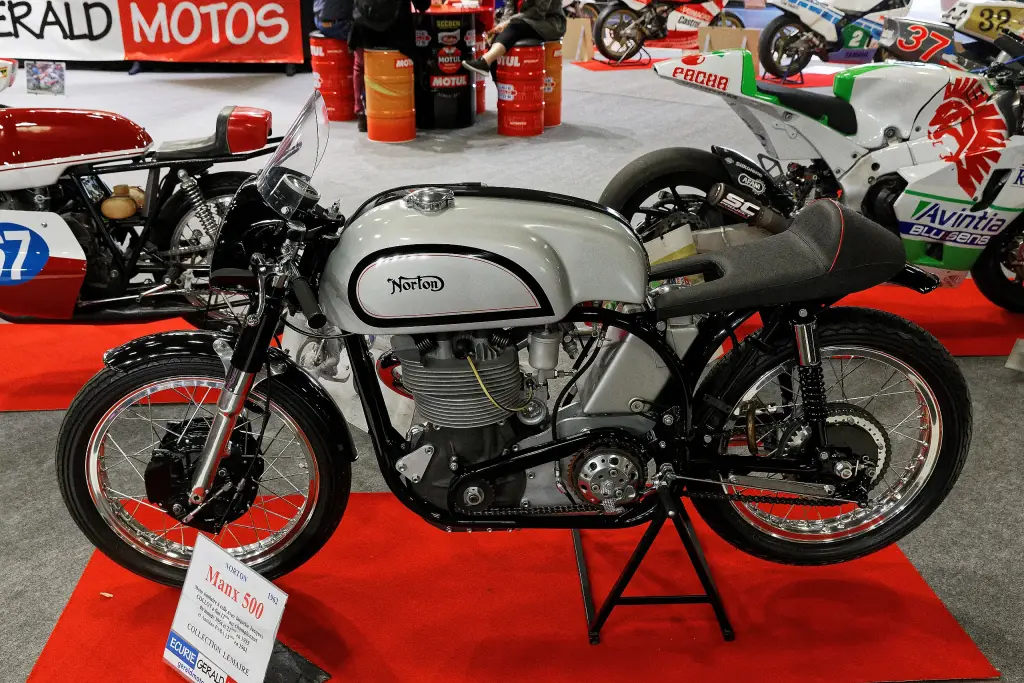
The Norton Manx, or Manx Norton, is a British racing motorcycle made from 1947 to 1962 by Norton Motors Ltd. It was an overhead-camshaft single available as a 350 cc or a 500 cc, and it became the machine that privateer racers bought, tuned and raced for decades.
Norton Manx at a glance
| Maker | Norton Motors Ltd, Bracebridge Street, Birmingham |
|---|---|
| Production | 1947-1962 |
| Type | racing motorcycle, overhead-cam single |
| Capacities | 350 cc and 500 cc |
| Frame | Featherbed from 1950 |
| Brakes | twin leading shoe from 1948 |
| Engine | redesigned short-stroke in 1953, 86.0 x 85.6 mm |
| Last 500 cc GP win | Godfrey Nash, 1969 Yugoslav Grand Prix |
| Bol d’Or wins | 1958-1971 |
| Last production | 42 machines between November 1962 and January 1963 |
Based on one source, the English Wikipedia article on the Norton Manx.
History of the Norton Manx
From the Manx Grand Prix
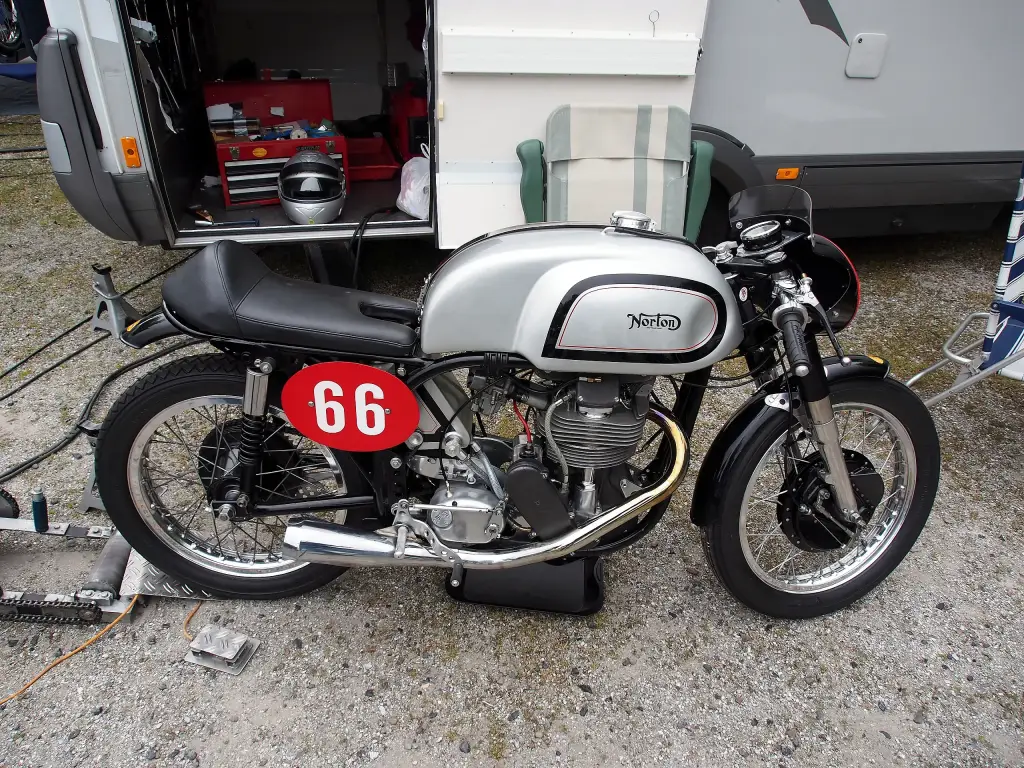
Norton’s first use of the name Manx was on the Manx Grand Prix model available from 1936 to 1940, a racing version of the International roadster with telescopic forks and plunger rear suspension, magnesium crankcases and cambox and no provision for lighting. Just after the Second World War the Grand Prix name was dropped, and Norton called its 1947 racing model the Manx. It was a lightly redesigned pre-war racing Norton International, an overhead-cam single sold as a 350 or a 500. The factory team under manager Joe Craig raced experimental versions, while a version was sold from Bracebridge Street to selected customers.
Featherbed and short stroke
The Manx re-emerged for the 1946 Manx Grand Prix. It gained new telescopic forks and in 1948 twin leading-shoe brakes. In 1950 the innovative Featherbed frame was developed, giving the Manx a significant advantage through a low centre of gravity and a short wheelbase that suited the TT course; the all-welded tubular frame was light and trim, without the usual forgings. In 1950 the Featherbed Manx recorded a double hat-trick of podium positions at the TT. The engine was redesigned in 1953 with a much shorter stroke of 86.0 x 85.6 mm to improve the rev range.
The major 1954 upgrade was to have been an engine with the cylinder mounted horizontally for a much lower centre of gravity, along the lines of the Moto Guzzi and Benelli racers. Instead, a decline in sales prompted several manufacturers to withdraw from Grand Prix racing in 1954, and Norton did the same. The Norton F Type Manx, as the horizontal-engine machine was to have been called, still exists and is displayed in the Sammy Miller Museum Collection. Joe Craig retired after more than 25 years of extracting ever more power and reliability from his single-cylinder cammy racers. The Manx had several wins at the Bol d’Or from 1958 to 1971.
Privateers, motocross and cars
Although Norton had pulled out of international Grand Prix racing in 1954, the Manx became the backbone of privateer racing. British racer Les Archer Jr worked with frame specialist Ron Hankins and tuner Ray Petty to develop a Manx for motocross, fitting the short-stroke engine into a Hankins frame with an aluminium tank and titanium axles; his Manx MX won the 1956 FIM 500 cc European Motocross Championship, though the 1962 version could not compete with the emerging two-strokes.
Manx Nortons also played a significant role in post-war car racing. At the end of 1950 the English national 500 cc regulations became the new Formula 3; the Manx produced significantly more power than the JAP Speedway engine and became the engine of choice, and many complete motorcycles were bought just to strip the engine, as Norton would not sell engines separately. Manx rolling chassis were often paired with Triumph twins to create Triton café racers.
1962 was the last full year of production. In July AMC announced the transfer of production from Bracebridge Street to Woolwich in London, and 42 Manx Nortons were built between November 1962 and January 1963. In 1966 Colin Seeley bought what remained of the spares and tools, later selling them to John Tickle in 1969. Tickle took over the Manx name and built complete racers called the Manx T5 and T3, but could not compete with the Japanese racers and sold the stock and rights to Unity Equipe in the late 1970s. When Godfrey Nash rode a Norton Manx to victory at the 1969 Yugoslavian Grand Prix at Opatija, it marked the last time a 500 cc Grand Prix race was won on a single-cylinder machine.
Design and features
- Overhead-cam single: the racing engine developed from the pre-war International, in 350 and 500 cc form.
- Featherbed frame: the 1950 frame that gave the Manx its low centre of gravity and precise steering.
- Privateer favourite: sold to selected customers and raced, tuned and rebuilt around the world.
- Versatility: the engine also won in motocross and Formula 3 car racing.
Norton Manx versions
- Manx Grand Prix (1936-1940): the pre-war racing version of the International, with magnesium castings and no lighting.
- Manx (1947): the post-war overhead-cam racer in 350 and 500 cc form.
- Featherbed Manx (1950): the definitive version with the McCandless frame and twin leading-shoe brakes.
- Short-stroke Manx (1953): the 86.0 x 85.6 mm engine with a wider rev range.
- Manx MX: Les Archer’s motocross version, European champion in 1956.
- Manx T5 and T3: John Tickle’s later 500 and 350 racers.
The Manx was the racing descendant of the Norton CS1, and its Featherbed frame and racing lessons fed into the Norton Commando. More Norton motorcycles are in the Norton collection.
Video: 1953 Norton Manx 30M vintage motorcycle test drive
Video on YouTube.
Sources
- Norton Manx, English Wikipedia: development, racing, end of production