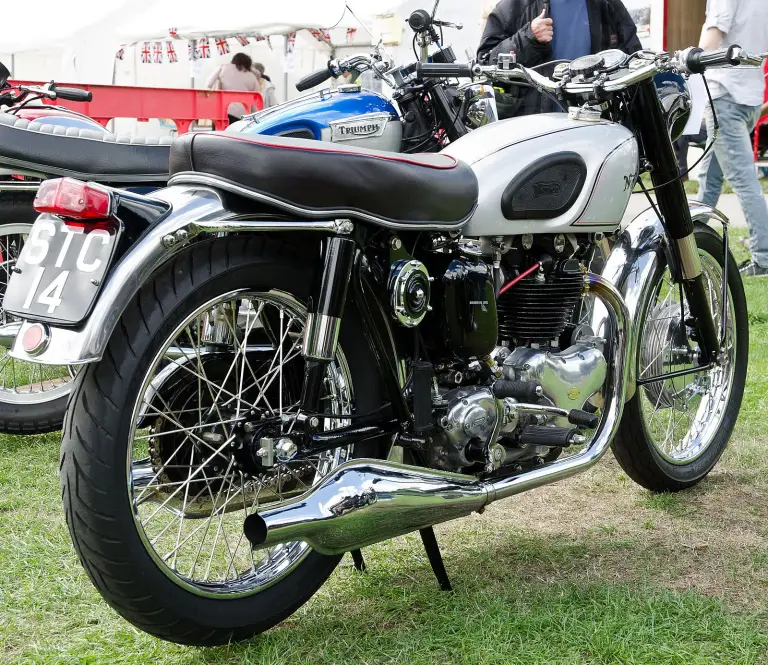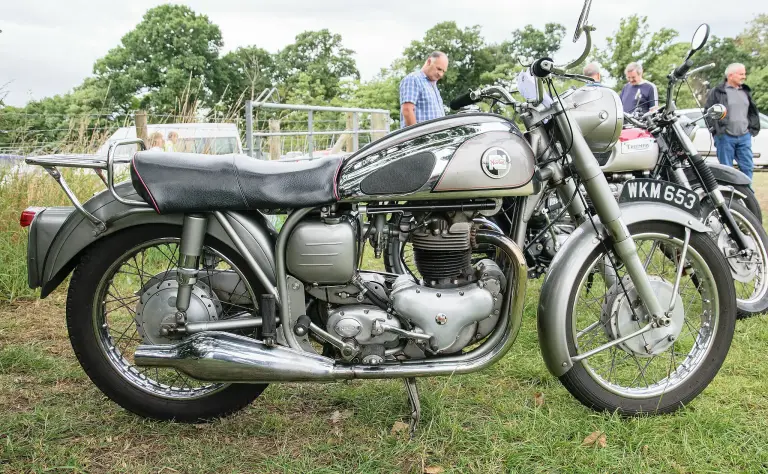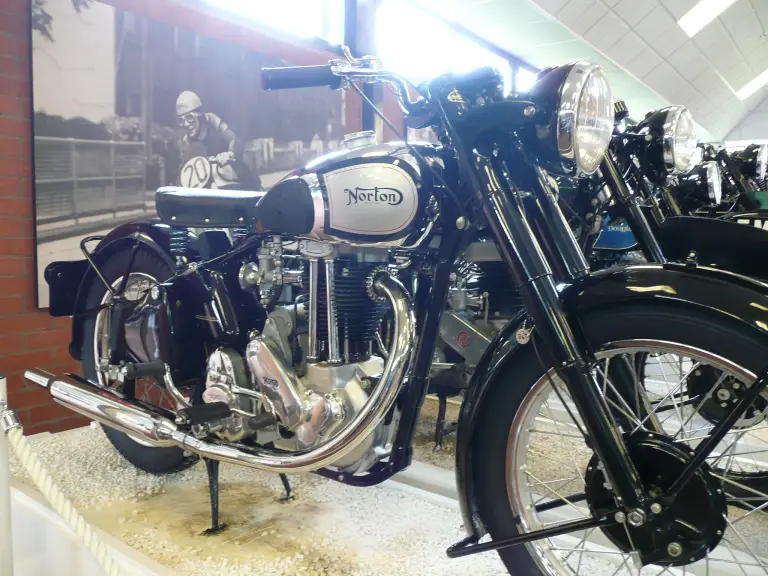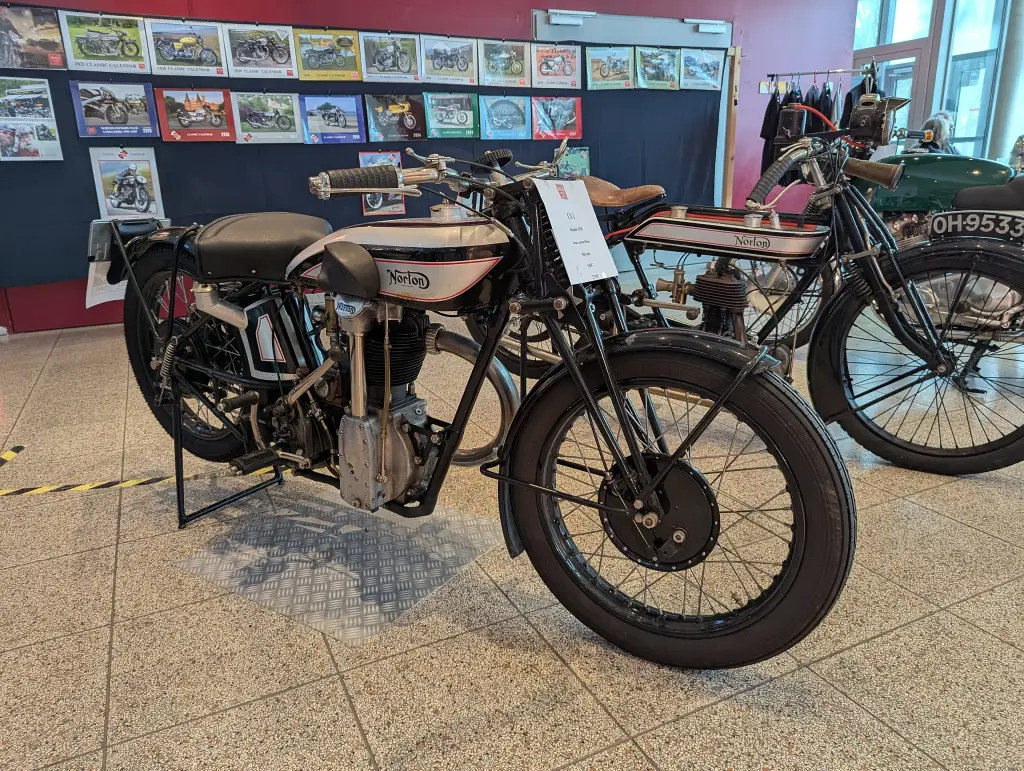
The Norton CS1 was a Norton motorcycle made between 1927 and 1939. It was originally built as a TT racer and was Norton’s first design of an overhead-camshaft engine, and it proved successful both on the track and as a TT Replica road bike.
Norton CS1 at a glance
| Maker | Norton, Bracebridge Street, Birmingham |
|---|---|
| Production | 1927-1939 |
| Type | 500 cc overhead-camshaft single |
| Engine | Camshaft Senior Model 1, designed by Walter Moore |
| Based on | Norton ES2 pushrod engine |
| Frame | full cradle |
| Gearbox | close-ratio, kickstart-less |
| Brakes | 8-inch drums |
| Carburettor | Amal TT |
| Ignition | Lucas Racing magneto |
| Fuel tank | 3 gallons |
| Sister model | Norton CJ1, 348 cc |
Based on one source, the English Wikipedia article on the Norton CS1.
History of the Norton CS1
Norton’s first cammy
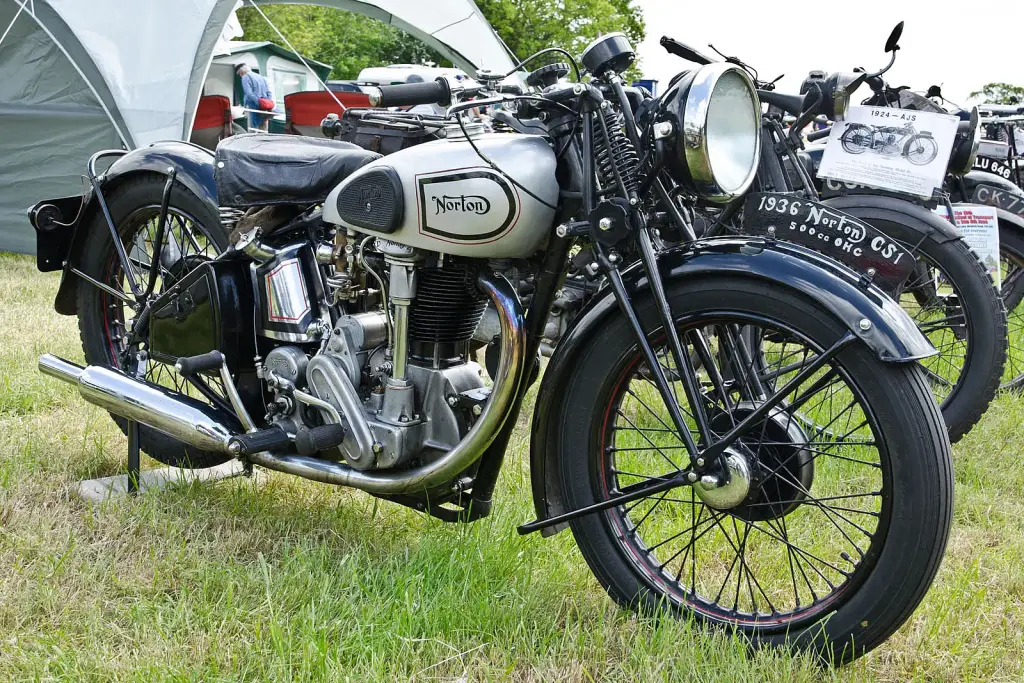
The Norton Camshaft Senior Model 1 engine was designed by Walter Moore in 1927, based on the Norton ES2 pushrod engine and re-using many of its parts. The motorcycle used a new full-cradle frame with a close-ratio, kickstart-less gearbox, 8-inch brakes, an Amal TT carburettor, a Lucas Racing magneto and a 3-gallon petrol tank. The magneto was moved to the rear of the engine, and in the side of the crankcase sat the oil pump housing and a pair of bevel gears driving a long shaft that ran in a tube up the side of the engine to a second pair of gears driving the overhead camshaft.
The CS1 was the standard racing Norton for the next twenty years. After the early 1930s redesign of Norton’s cammy models by Arthur Carroll it became an upmarket road bike, and the 500 cc CS1 and its smaller 350 cc sibling, the CJ1, continued until the outbreak of the Second World War in 1939.
Racing success
Alec Bennett riding the CS1 won the Isle of Man Senior TT in 1927, the model’s first race, while Stanley Woods set the fastest lap at 70.99 mph before retiring. The following year an unknown rider, Tim Hunt, won the Amateur TT on a CS1 and set a new TT record, then used the same motorcycle to win a gold medal in the Scottish Six Days Trial. In 1928 a Junior version with a 348 cc engine, the Norton CJ, was entered for the Isle of Man TT; its 71 x 88 mm engine looked promising, but technical problems with Walter Moore’s redesigned cambox made 1928 an unlucky year, with only one major race won. Reliability problems continued in 1929, when Norton won only the Spanish Grand Prix.
In March 1931 Joe Craig and Tim Hunt reached a best speed of 118 mph on the CS1 at Pendine Sands. That year the CS1 took the first five places in the Junior and Senior events, starting Norton’s most successful period, and the company dominated international racing until the end of the 1930s. Tim Hunt became the first rider to win two TT races in one week, taking the Junior TT in 3 h 34 min 21 s at 73.4 mph and the Senior TT in 3 h 23 min 28 s at 77.90 mph.
A road bike with racing parts
Many later touring CS1 models were upgraded for racing by adding and removing the optional racing parts listed for the International models; Norton’s catalogue carried a long list of such components. The identifying feature of 1930s CS1 models is the stub-fitted carburettor, whereas Inter models had a bolt-on TT carburettor.
Design and features
- Overhead camshaft: Norton’s first cammy engine, with bevel gears and a shaft driving the camshaft.
- Race record: a Senior TT win on its first race in 1927 and domination of the TT through the 1930s.
- TT Replica: a road bike derived directly from the racer, with a catalogue of optional racing parts.
- Long service: the CS1 layout remained Norton’s racing standard for two decades.
Norton CS1 versions
- CS1 (1927): the original 500 cc TT racer.
- CS1 TT Replica: the road version with the stub-fitted carburettor.
- CJ1 (1928): the 350 cc sister model with a 71 x 88 mm engine.
The CS1 was the ancestor of the Norton Manx racing singles, and its engine was developed from the Norton ES2. More Norton motorcycles are in the Norton collection.
Sources
- Norton CS1, English Wikipedia: development, racing, road versions