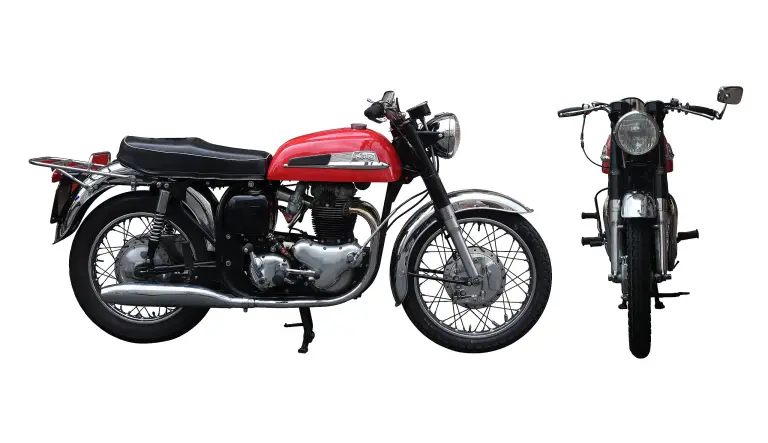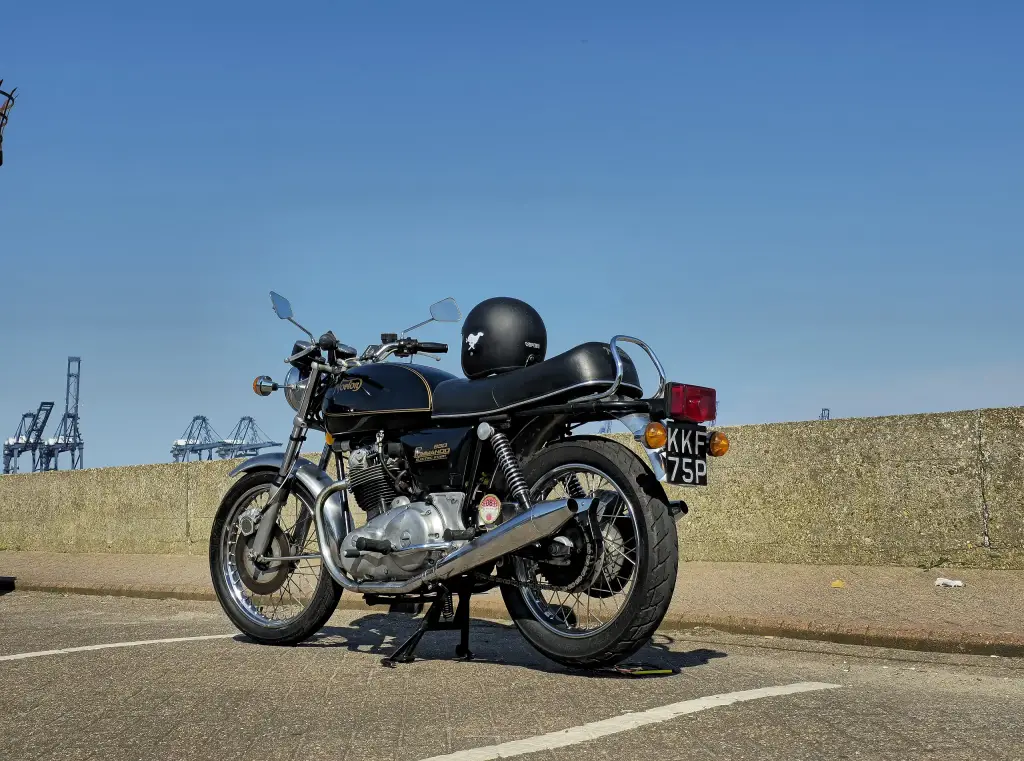
The Norton Commando is a British Norton-Villiers motorcycle with an overhead-valve, pre-unit parallel-twin engine, produced from 1967 until 1977. It started with a nominal 750 cc displacement, actually 745 cc, and became an 850 in 1973, actually 828 cc. Its rubber-mounted engine and single-tube frame made it a smooth and successful machine in a decade when most British twins vibrated.
Norton Commando at a glance
| Maker | Norton-Villiers, then Norton Villiers Triumph |
|---|---|
| Production | 1967-1977 |
| Engine | overhead-valve parallel twin, pre-unit |
| Capacity | 745 cc (nominal 750) until 1973; 828 cc (850) from 1973 |
| Bore x stroke | 73 x 89 mm |
| Compression | 8.9:1 |
| Frame | single 2.25 in top tube, rubber-mounted engine |
| Bodywork | one-piece fibreglass seat and tail by Wolff Ohlins |
| Awards | Motor Cycle News Machine of the Year 1968-1972 |
| Built | about 60,000 |
| Assembly | Wolverhampton, Birmingham and Plumstead, later Andover |
Based on one source, the English Wikipedia article on the Norton Commando.
History of the Norton Commando
A new flagship
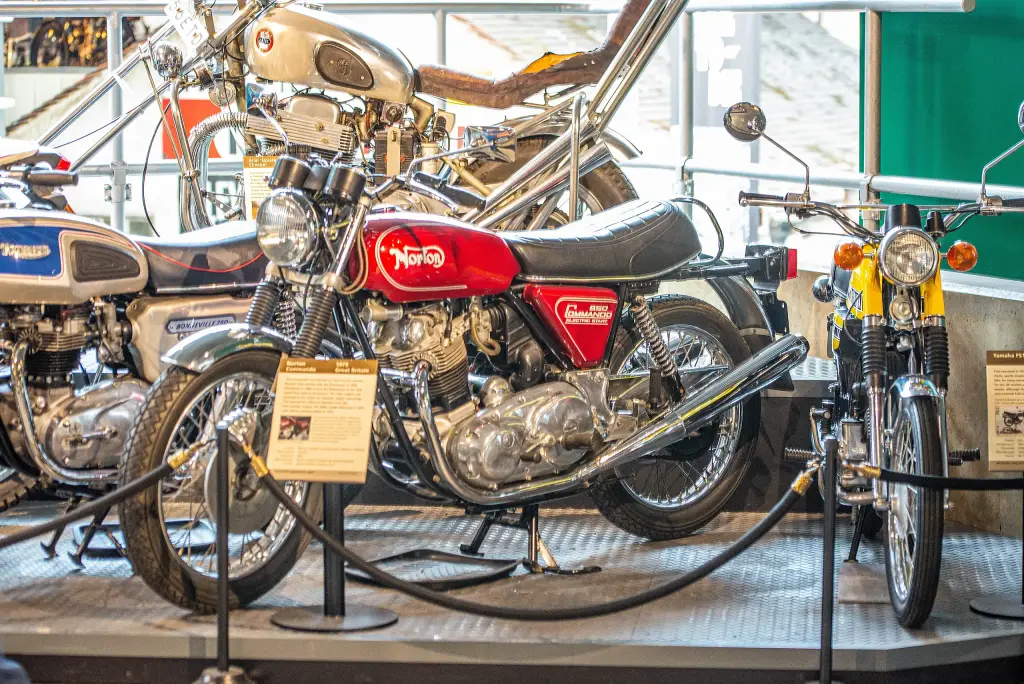
Associated Motor Cycles, Norton’s parent company, had become bankrupt in 1966 and was bought by Manganese Bronze Holdings, which already owned Villiers Engineering, forming Norton-Villiers. Chairman Dennis Poore saw the need for a new flagship motorcycle to replace the ageing 750 cc Atlas, whose engine design could be traced back to Bert Hopwood’s 1947 497 cc Norton Model 7 twin. Poore set a deadline for the machine to be ready for the 1967 Earls Court motorcycle show.
Former Velocette engineer Charles Udall had joined AMC in 1961 and designed an 800 cc double-overhead-cam twin, known internally as P10, built in a shortened Featherbed frame. Poore set up a design team headed by former Rolls-Royce engineer Dr Stefan Bauer to develop it. The P10 was complex, leaked oil and would have been expensive to manufacture, so the team began to redesign the engine with a new code, Z26.
Bauer believed the classic Norton Featherbed frame made the vibration of a vertical twin worse. He designed a new frame around a single 2.25 in top tube for stiffness and rubber-mounted the engine to isolate its vibration from the rider. By the summer of 1967 it was clear that the new engine would not be ready for the September show. In parallel, the existing Atlas engine had been developed and was now giving more power than the Z26, so the new engine was abandoned and an Atlas-engined model using Bauer’s frame was prepared for Earls Court.
Poore wanted the machine to look significantly different, so the engine was canted forward, where Nortons traditionally had upright cylinders, and the consultants Wolff Ohlins designed a one-piece fibreglass seat and tail unit blended into the tank. Rubber-mounting caused the rear mounts to distort under acceleration, making the chain jump off the engine sprocket; chief engineer Bernard Hooper and his assistant Bob Trigg solved this by mounting the swinging arm on the engine and gearbox plates rather than the frame, so that engine, gearbox and swinging arm moved as one.
Production
Production was initially complex and spread across England: engines were made in Wolverhampton, frames in Birmingham, and components and final assembly were at Burrage Grove, Plumstead, London. In late 1968 the Plumstead works was subject to a Greater London Council compulsory purchase order and closed in July 1969. With a government subsidy the assembly line moved to North Way, Andover, with the test department in an aircraft hangar at Thruxton Airfield. Engine and gearbox assembly stayed in Wolverhampton, where a second line produced about 80 complete machines a week and components were shipped overnight to Andover.
During its ten years of production the Commando was popular all over the world. In the United Kingdom it won the Motor Cycle News Machine of the Year award for five successive years from 1968 to 1972, and around 60,000 Commandos were made in total.
Norton Villiers Triumph and the end
Following the problems caused by the Combat engine, Norton’s finances deteriorated. By the middle of 1972 the BSA group was in serious financial trouble, and the government offered a rescue package on condition that the two groups merged; Norton Villiers Triumph was formed in 1973. NVT had four factories and decided to cut back to two. Redundancy notices at Andover in late 1973 were followed by a sit-in at the works, and notices at Meriden led to a sit-in that lasted two years. Commando production was transferred entirely to Wolverhampton. By the end of 1974 NVT had lost over £3 million.
In 1975 the Industry Minister recalled a £4 million loan and refused to renew export credits; the company went into receivership and redundancies were announced. To avoid liquidation, the government backed NVT Engineering Ltd to produce spares and complete the Commandos already started, and by September 1977 the outstanding 1,500 machines had been finished. The remaining spares were sold to Andover-Norton, which produced a further 30 machines.
Design and features
- Rubber-mounted engine: the vibration of the vertical twin was isolated from the rider, a rarity among British twins.
- Single-tube frame: Stefan Bauer’s stiff 2.25 in top tube frame, with the swinging arm carried on the engine plates.
- Distinctive styling: a canted-forward engine and a one-piece fibreglass seat and tail by Wolff Ohlins.
- Award-winning: Motor Cycle News Machine of the Year for five successive years, 1968 to 1972.
Norton Commando versions
- Commando 750 (1967-1973): the original 745 cc model, later offered with the Combat engine tune.
- Commando 850 (1973-1977): the larger 828 cc version introduced under Norton Villiers Triumph.
- Final NVT machines (1975-1977): the last 1,500 Commandos completed by NVT Engineering.
- Andover-Norton machines: a further 30 built from remaining spares.
The Commando replaced the Norton Atlas and used an engine descended from the Norton Dominator. More Norton motorcycles are in the Norton collection.
Video: Starting a ’72 Norton Commando
Video on YouTube.
Sources
- Norton Commando, English Wikipedia: design, production, company history