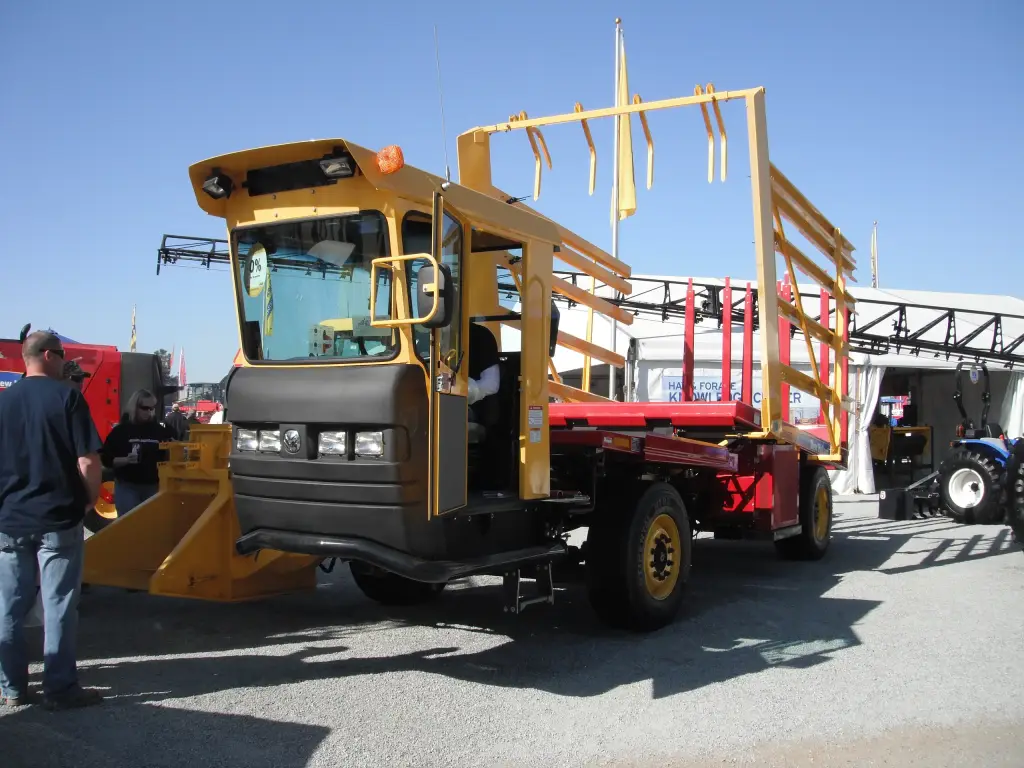
The New Holland 1049, known as the Super Balewagon, is a self-propelled bale wagon — a machine that collects bales from the field instead of leaving them for a trailer. The film below shows a working example. The sources used for this page describe the company and its hay equipment, not this particular model.
New Holland 1049 at a glance
| Maker | Sperry New Holland, New Holland, Pennsylvania |
|---|---|
| Type | self-propelled bale wagon |
| Job in the field | picks up bales and builds them into a stack |
| Company founded | 1895, as the New Holland Machine Company |
| Company name 1947–1986 | Sperry New Holland |
| Hay breakthrough | the haybine mower conditioner, introduced in 1947 |
| Owner from 1986 | Ford, as Ford New Holland |
| Owner from 1991 | Fiat, with an 80 per cent interest |
| Technical data | not given in the sources used here |
| Example filmed | a 1049 Super Balewagon working in the field |
The sources describe the company and its hay equipment, not the 1049 itself; its technical data is not repeated here because it is not in them.
History of the New Holland 1049
Hay equipment was the heart of the firm
New Holland began in 1895 in a horse barn in New Holland, Pennsylvania, where Abe Zimmerman built equipment for the farmers around him, starting with a feed mill. The company was incorporated in 1903. Its reputation in hay making was made in 1947, the year it was taken over by Sperry Rand and renamed Sperry New Holland: that year it introduced the haybine mower conditioner, a machine that cut and conditioned hay in one pass and stayed in production until 2023. Bale handling grew out of the same business, because a farm that baled hay also had to move the bales.
What a bale wagon does
A bale wagon is not a trailer towed behind a tractor: it picks bales up from the field itself and builds them into a stack that can later be tipped off in one piece, so the bales never have to be handled by hand. The 1049 belongs to that family of machines, and its Super Balewagon name was used by the company for the larger members of the line. The sources used here do not list its engine, capacity or years of production, and this page does not invent them.
The company around the machine
By the time machines like the 1049 were sold, Sperry New Holland had become part of a much larger group. Ford bought the company in 1986 and formed Ford New Holland, and in 1991 Fiat took an 80 per cent interest, which led in 1996 to the single New Holland brand launched at a convention in Orlando, Florida. The colour of the tractors changed with the owners: for a few years they were sold in Fiat terracotta red and Ford blue at the same time, and only in 2000 did everything become New Holland blue. The bale wagons kept their place in the hay range through those changes.
Design and features
- Self-propelled: the machine carries its own engine instead of being towed by a tractor.
- Stack building: bales are collected and arranged into a stack that can be unloaded in one piece.
- Sperry years: the 1049 belongs to the period when the company traded as Sperry New Holland.
- Hay heritage: it descends from the firm that introduced the haybine in 1947.
New Holland 1049 versions
- New Holland 1049: the Super Balewagon described here.
- Smaller bale wagons: the rest of the New Holland bale wagon line sold alongside it.
- New Holland balers: the presses that made the bales these wagons collected, including the round balers built at Płock in Poland after 1998.
Other hay and harvest machines of the brand are on the pages for the New Holland 1880 and the New Holland 66. More machines are in the New Holland section.
Video: New Holland 1049 Super Balewagon in action
Video by wagner59270 on YouTube.
Sources
- New Holland Agriculture, English Wikipedia: founding, haybine, owners
- New Holland, Dutch Wikipedia: Fiat and Ford colours, product range