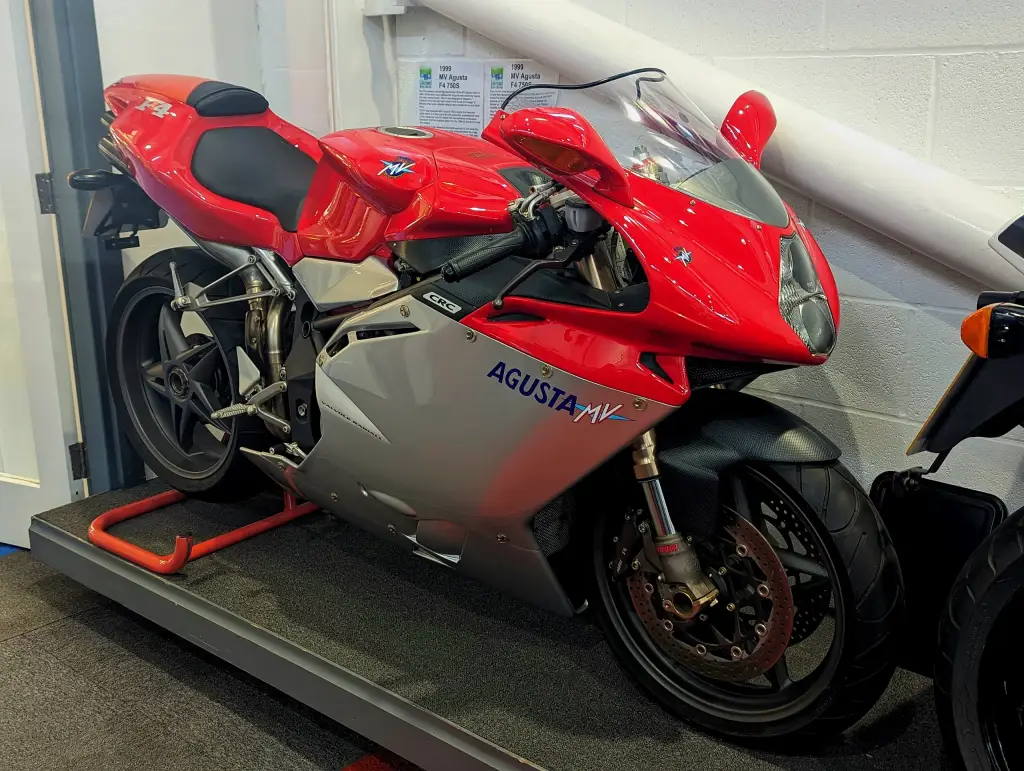
The MV Agusta F4 is the four-cylinder superbike that relaunched MV Agusta in 1999 and stayed in production until 2018. Designed by Massimo Tamburini at the Cagiva Research Center after his Ducati 916, it combined a radial-valve engine derived from Ferrari Formula One practice with a single-sided swingarm and the traditional red and silver livery.
MV Agusta F4 at a glance
| Production | 1999–2018 |
|---|---|
| Designer | Massimo Tamburini, Cagiva Research Center |
| Engine | liquid-cooled inline four, DOHC, 16 radial valves |
| Displacements | 749.5, 998 and 1,078 cc |
| Power | 126 hp (F4 750 S) |
| Frame | steel trellis with aluminium castings |
| Swingarm | single-sided |
| Forks | 49 or 50 mm upside-down |
| Weight | under 181 kg (750 Serie Oro) |
| Top speed | 162 mph (F4 750 S) |
This page is based on one source, the English Wikipedia article on the F4 series, which concentrates on the 750 generation; the later 1,000 cc models and special versions are covered only in brief.
History of the MV Agusta F4
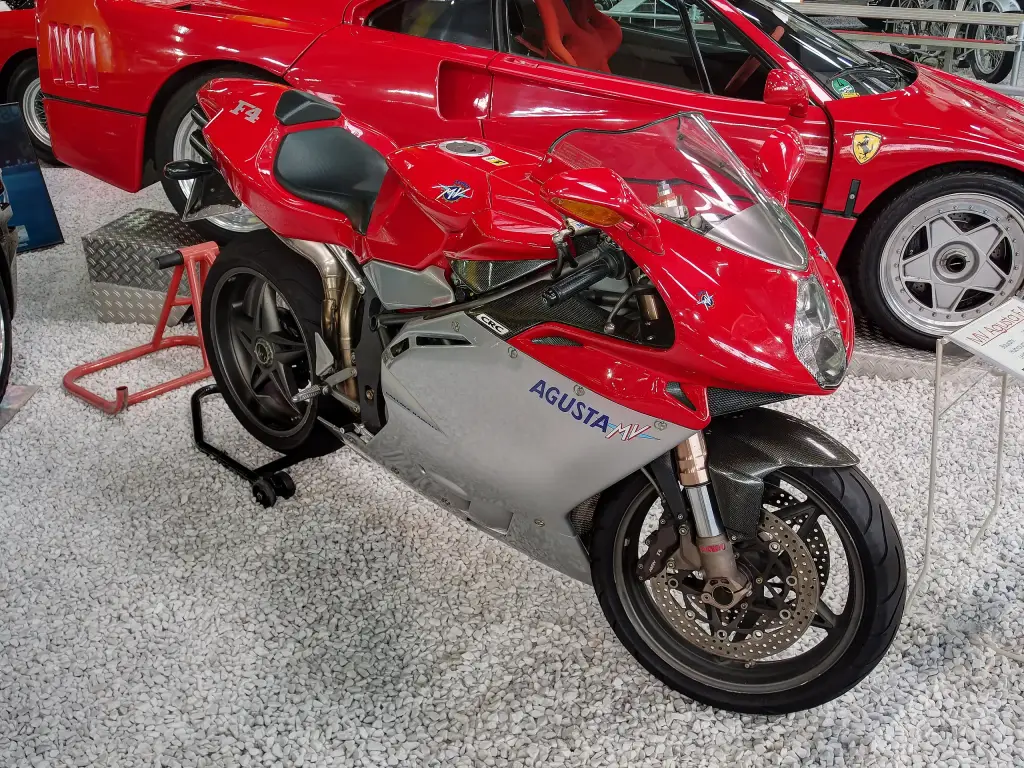
The F4 was created by Massimo Tamburini at the Cagiva Research Center after his work on the Ducati 916, and it launched the revival of the brand in 1998–1999. It has a single-sided swingarm, large 49 or 50 mm front forks and the traditional MV red and silver livery. Its engine is one of the few production superbike units with a hemispherical combustion chamber and four valves per cylinder.
Engine
The liquid-cooled inline four is set across the frame with two overhead camshafts, sixteen radial valves, multipoint fuel injection and electronic ignition, in 749.5, 998 and 1,078 cc. It came from the 1990–1992 Ferrari Formula One engine: Ferrari engineers helped early in the design, MV soon departed from their design but kept the radial valves, making it the only recently produced radial-valved multicylinder motorcycle engine. The F4 Tamburini, F4 Veltro and F4 CC have variable-length intake ducts called TSS, which shift peak torque from 10,000 to 9,000 rpm while keeping maximum power.
The 750 years
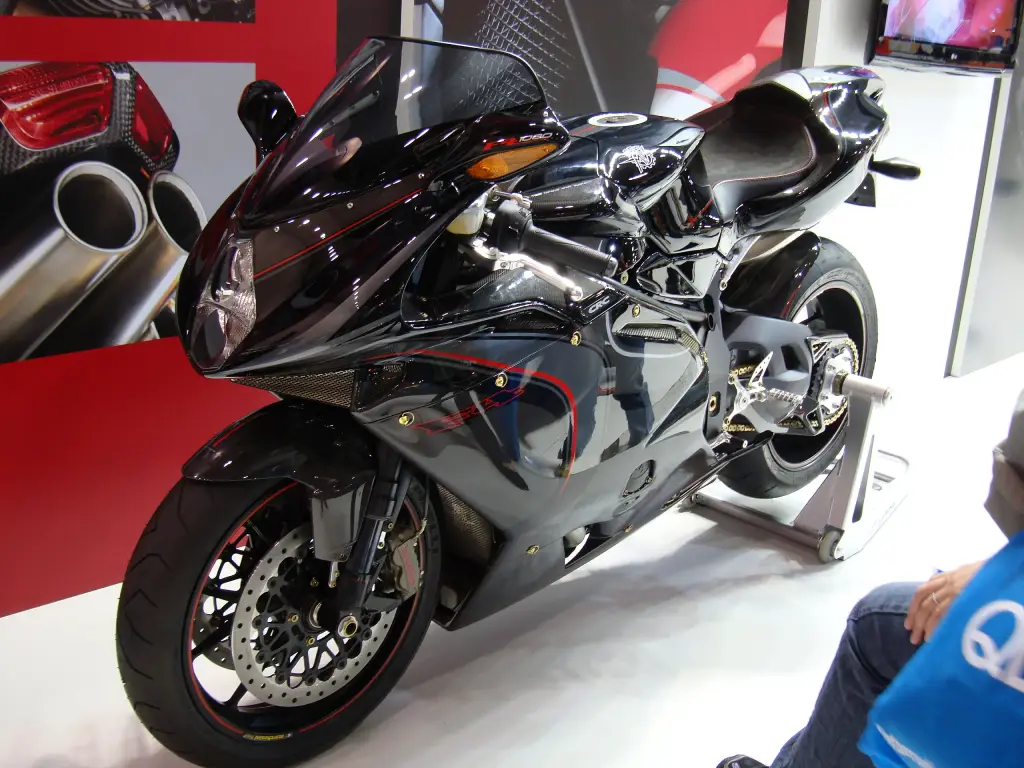
The 750 cc F4 went into production in 1999 and continued through various models until 2004, when it gave way to the newly introduced 1,000 cc machines. The first was the F4 750 Serie Oro, revealed at the 1997 Milan EICMA show; production began in May 1999 and was limited to 300 pre-sold examples with magnesium parts anodised gold, carbon fibre bodywork, a weight under 181 kg, a Showa fork with quick-release axle clamps and Nissin six-piston front and four-piston rear brakes, each with a certificate and a 24-carat gold badge; early owners included Giacomo Agostini and King Juan Carlos of Spain. The mass-production F4 750 S of October 1999 replaced magnesium with aluminium and carbon with ABS plastic, adding about 20 lb, and used a steel trellis frame with aluminium castings, 49 mm Showa upside-down forks and a Sachs shock on the single-sided arm; 126 hp at 12,500 rpm gave 162 mph and a standing quarter-mile of 11.09 seconds at 128 mph. It was a monoposto, joined in 2000 by the 1+1 biposto. The Neiman Marcus Edition of 2000 was sold only through the store’s Christmas catalogue, ten machines with a brass plate on the triple clamp. The 2002 Evo 02 brought reworked combustion chambers, valves and springs plus Mahle forged pistons for 137 bhp at 10,500 rpm; the 750 Senna of the same year, limited to 300, used 136 bhp, selected cylinder heads, a modified eprom and a 13,900 rpm red line, carbon bodywork and a black and red finish in aid of the Instituto Ayrton Senna. The Evo 03 of 2003 was mostly cosmetic.
Design and features
- Radial valves: a Ferrari-derived cylinder head with hemispherical chambers, four valves per cylinder and a layout unique among recent multicylinder engines.
- Tamburini styling: a single-sided swingarm, large-diameter front forks and the red and silver MV livery.
- TSS intake: variable-length intake ducts on the Tamburini, Veltro and CC models, shifting peak torque lower in the rev range.
- Limited editions: magnesium and carbon parts on the Serie Oro and Senna, with numbered badges and certificates.
MV Agusta F4 versions
- F4 750 Serie Oro (1999): 300 machines with magnesium parts anodised gold and carbon bodywork.
- F4 750 S (1999): the production model with aluminium and ABS parts; a 1+1 biposto followed in 2000.
- F4 750 S Neiman Marcus Edition (2000): ten machines sold through the department store’s catalogue.
- F4 750 S Evo 02 (2002): reworked head and Mahle pistons for 137 bhp.
- F4 750 Senna (2002): 300 machines for the Instituto Ayrton Senna, with a 13,900 rpm red line.
- F4 750 S Evo 03 (2003): a mostly cosmetic update.
- Later specials: the F4 Tamburini, F4 Veltro and F4 CC with TSS variable intake ducts, and the 1,000 cc generation from 2004.
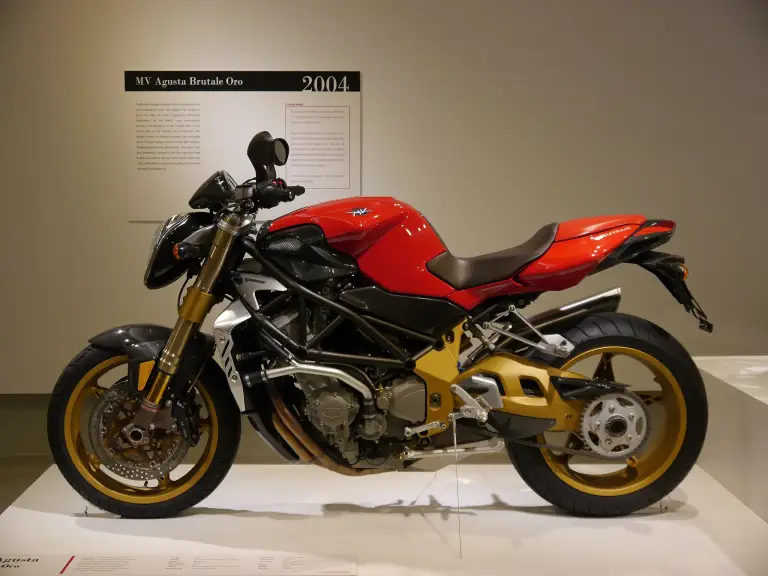
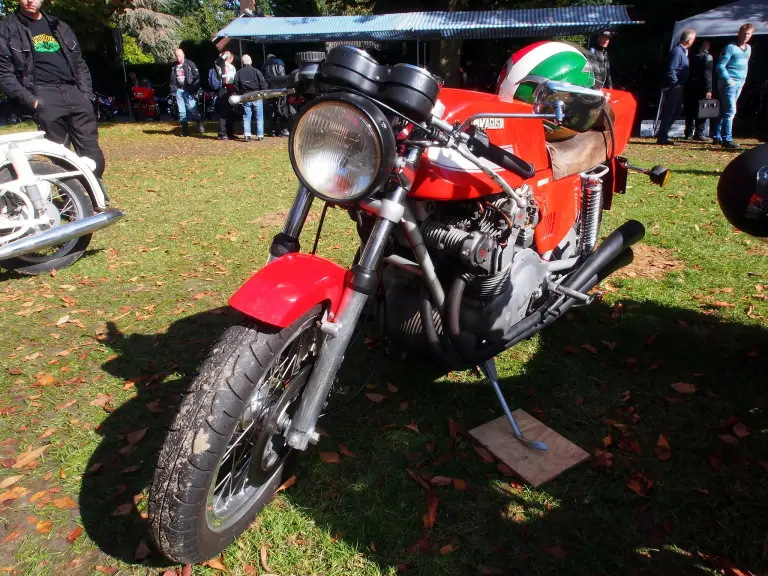
The F4 engine also powered the naked MV Agusta Brutale and led to the three-cylinder MV Agusta F3. Older MV fours are in the MV Agusta collection, such as the MV Agusta 750 Sport America.
Sources
- MV Agusta F4 series, English Wikipedia: engine, TSS, 750 models