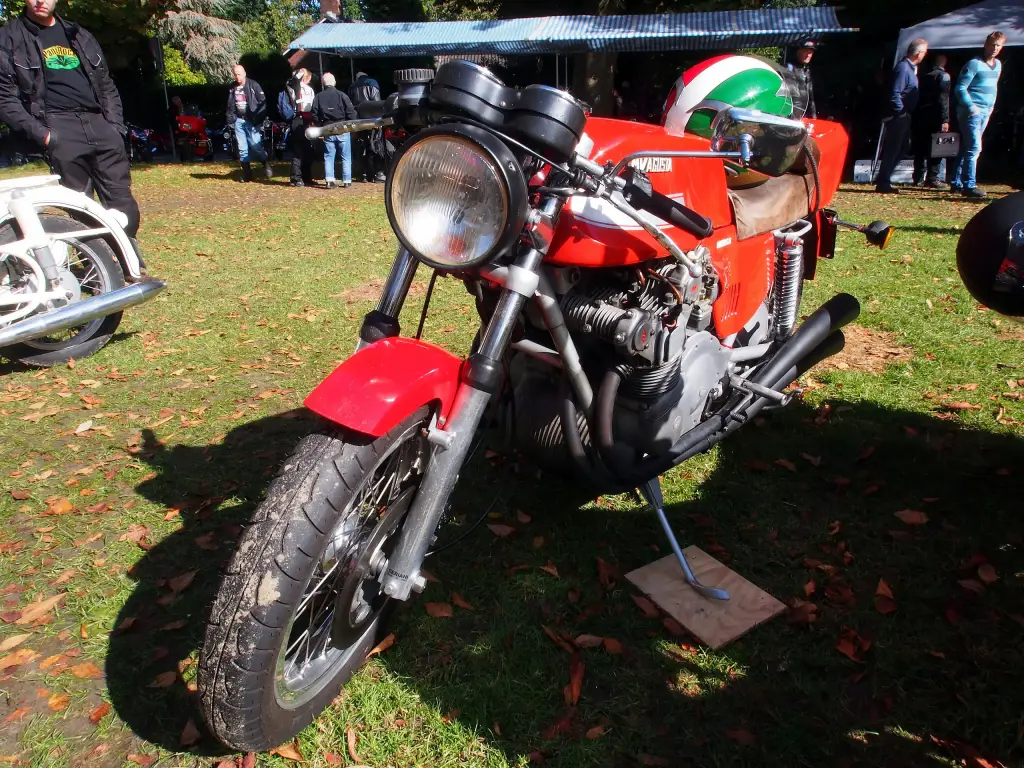
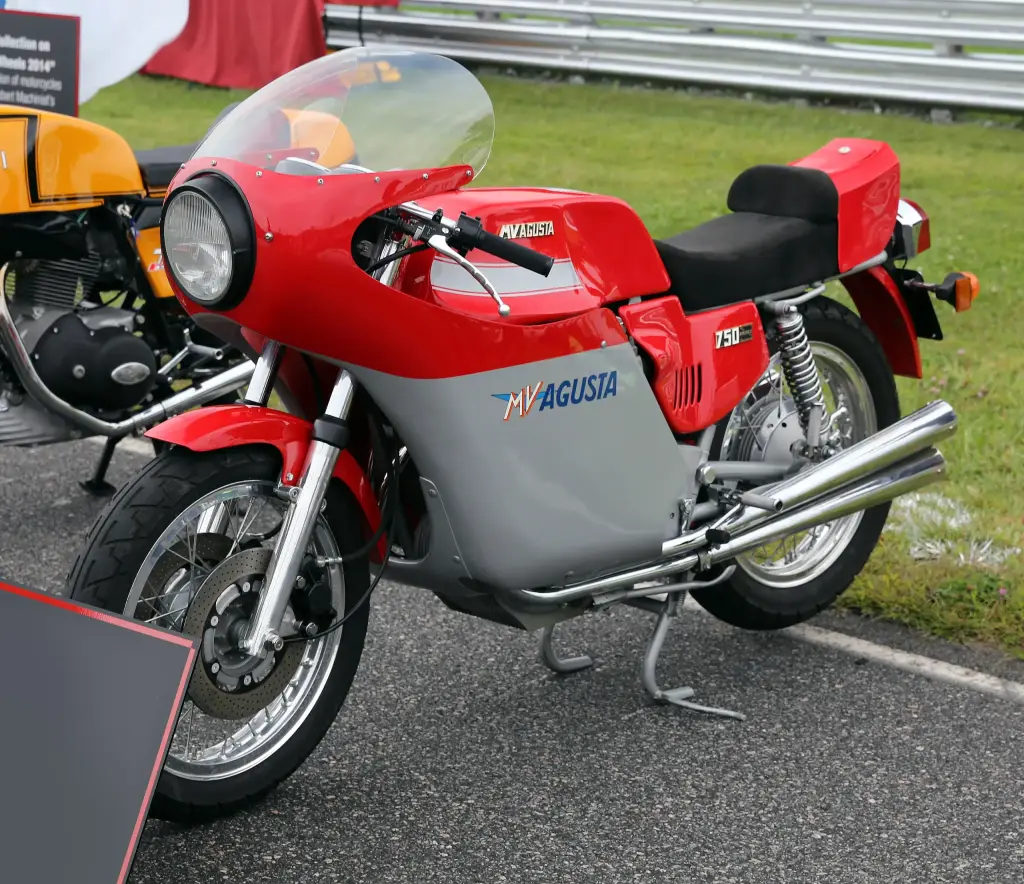
The MV Agusta 750 Sport America was the American-inspired revival of MV’s four-cylinder street bike, created in 1975 by the marque’s US importers and built until 1977, with derivatives until 1982. It combined a hand-built 789 cc four with a red livery, a suede seat and the racing look that MV’s American customers wanted.
MV Agusta 750 Sport America at a glance
| Production | 1975–1977, derivatives until 1982 |
|---|---|
| Origin | idea of Chris Garville and Jim Cotherman, Commerce Overseas Corporation |
| Engine | 789 cc inline four with two gear-driven overhead camshafts |
| Valvetrain | two valves per cylinder, bucket tappets |
| Gearbox | cassette gearbox, shaft final drive |
| Forks | Ceriani, 38 mm |
| Brakes | double discs |
| Instruments | Smiths round instruments |
| Four-cylinder output | 1,276 machines built from 1966 to 1980 |
This page is based on one source, the English Wikipedia article on the 750 Sport America.
History of the MV Agusta 750 Sport America
In 1974 MV Agusta was in financial difficulty and came under state administration. In 1975 Chris Garville and Jim Cotherman of Commerce Overseas Corporation, the marque’s American importer, proposed a new edition of the 750 S styled more closely on MV’s racing machines to lift sales in the United States. Their designs were implemented at the Gallarate plant within 50 days.
Engine and chassis
The core of the engine was the crankcase rack, which carried the nine-piece crankshaft in six bearing blocks on roller bearings together with the spur gears that drove the two camshafts; after loosening twelve nuts the assemblies could be lifted out. The bore was increased by 2 mm over the 750 S to give 789 cc, with individual light-alloy cylinders, cast liners and Borgo pistons. Each cylinder had two valves operated through bucket tappets by two gear-driven overhead camshafts, and the engine was assembled by hand like every MV four. The gearbox sat transversely in a cassette and drove the rear wheel through a shaft and a spiral bevel angle drive. Ceriani forks grew from 35 to 38 mm, every model had double disc brakes and the gear shift moved to the left. The red livery, suede-covered seat and Smiths round instruments completed the package.
Versions and the end
The basic 750 Sport America was joined by the 800 SS Super America of 1976–78 with 82 bhp at 9,000 rpm, optionally with a four-into-one Magni exhaust and magnesium wheels; the 800 SS Super Daytona America added a Magni kit and a full fairing; and the 850 SS Monza, also called the 850 SS Boxer, took the bore to 69 mm for 837 cc and 90 bhp at 9,000 rpm, with 27 machines made. The German importer Hansen & Schneider ordered further specials: the 900 S Arturo Magni Cento Valli of 892 cc, the 1000 S Corona and 1000 Agostini of 954 cc, and the 1100 Grand Prix of 1,066 cc. Arturo Magni, MV’s former race director, built his own machines from the same engines with an 11 kg frame based on the F750 S Imola racer, electronic ignition, 30 or 32 mm carburettors and chain drive, the Magni 832 and 861. MV left racing in 1976 and street production wound down; the last of 540 750 S Americas was sold officially in 1980, and 1,276 four-cylinder machines were built between 1966 and 1980.
Design and features
- Hand-built four: a 789 cc inline four with a nine-piece crankshaft and two gear-driven overhead camshafts, assembled by hand.
- American brief: created in 50 days at the request of MV’s US importer to sell the marque in the United States.
- Chassis: 38 mm Ceriani forks, double disc brakes and a cassette gearbox with shaft drive.
- Finish: red livery, suede seat and Smiths round instruments in the MV racing tradition.
MV Agusta 750 Sport America versions
- 750 Sport America (1975–1977): the basic 789 cc model derived from the 750 S.
- 800 SS Super America (1976–1978): 82 bhp at 9,000 rpm, with an optional Magni exhaust and magnesium wheels.
- 800 SS Super Daytona America (1976–1978): Magni kit and a full fairing.
- 850 SS Monza or Boxer (1977–1978): 837 cc and 90 bhp, 27 built.
- Hansen & Schneider specials: 900 S Arturo Magni Cento Valli, 1000 S Corona, 1000 Agostini and 1100 Grand Prix.
- Magni 832 and 861: chain-drive machines built by Arturo Magni on MV four-cylinder engines.
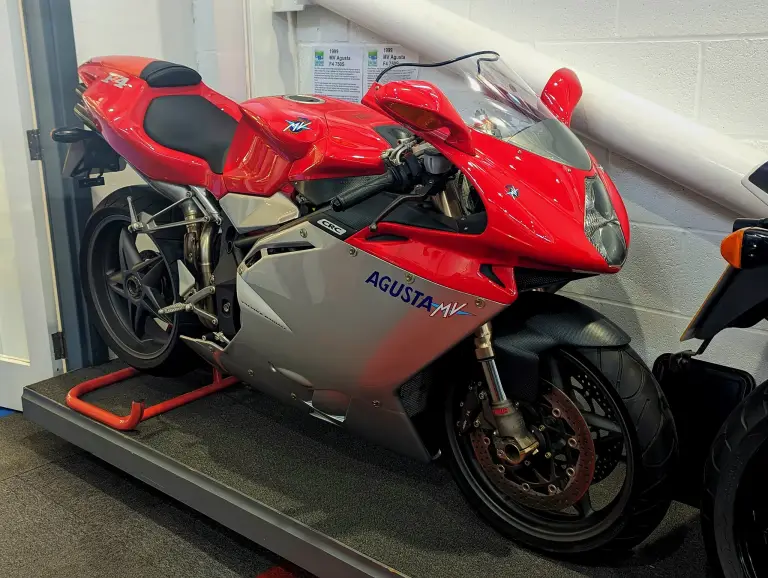
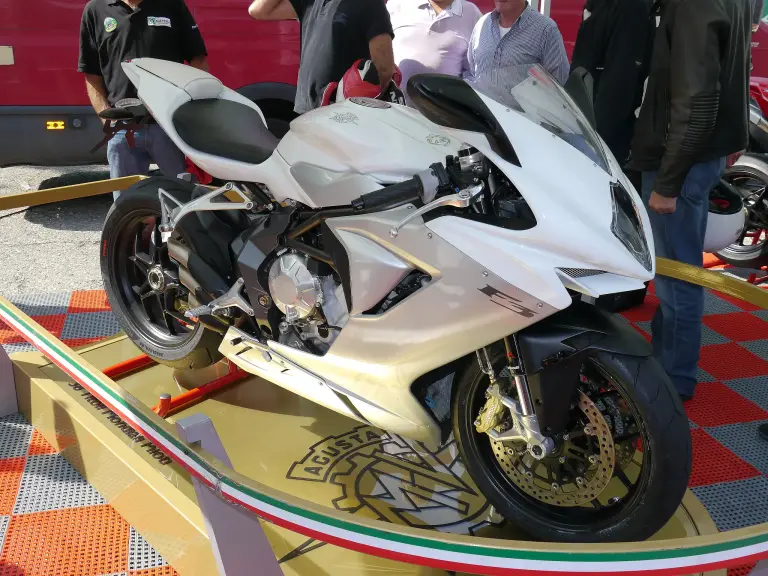
MV’s four-cylinder line began with racing machines and led to the modern MV Agusta F4. The middleweight of the same years is the MV Agusta 350 Ipotesi; more in the MV Agusta collection.
Video: 2011 MV Agusta 750 SPORT in Tokyo Japan.wmv
Video on YouTube.
Sources
- MV Agusta 750 Sport America, English Wikipedia: development, engine, versions, end of production