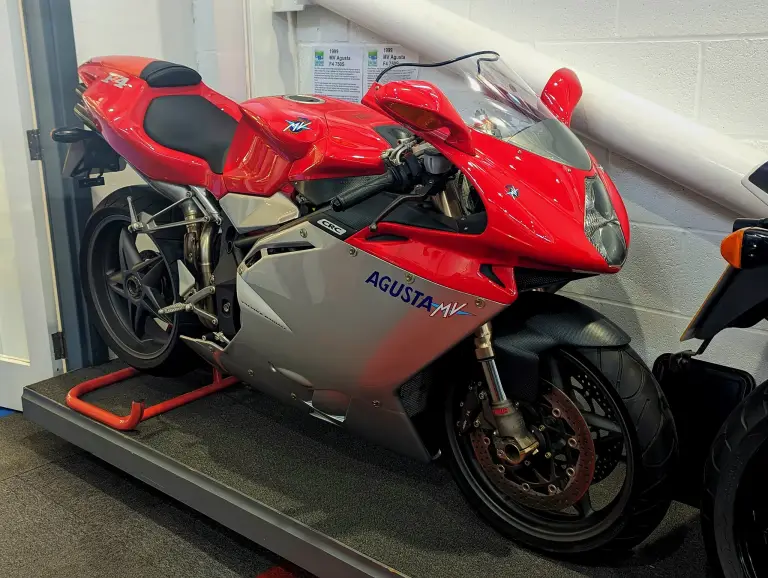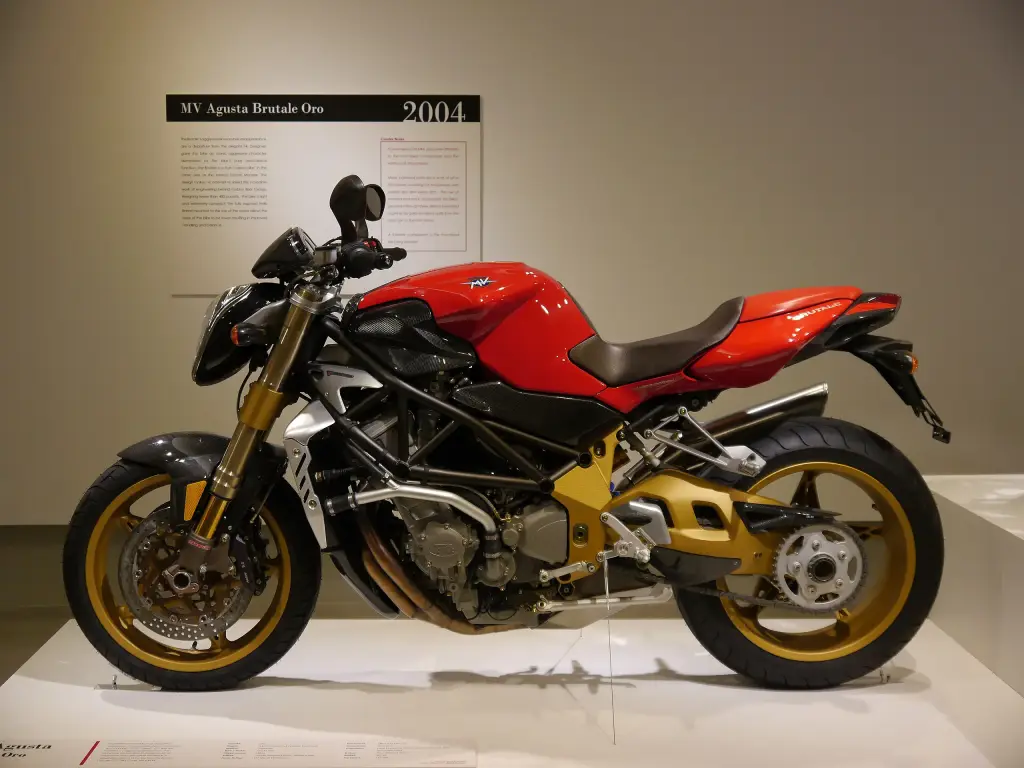
The MV Agusta Brutale is the naked bike with which the revived Italian marque expanded beyond the F4 superbike. Introduced in 2001, it used the F4’s four-cylinder engine in a trellis frame, later gained three-cylinder versions based on the F3, and has been built in capacities from 675 to 1,078 cc.
MV Agusta Brutale at a glance
| Production | from 2001 |
|---|---|
| Type | naked bike |
| Designer | Massimo Tamburini |
| Engine | liquid-cooled inline four, DOHC, 16 radial valves |
| Displacements | 749.5, 998 and 1,078 cc |
| Power | 127 bhp |
| Torque | 75 Nm |
| Frame | tubular steel, engine as a stressed member |
| Forks | 50 mm Marzocchi upside-down |
| Brakes | Nissin six-piston front, four-piston rear |
This page is based on one source, the English Wikipedia article on the Brutale series.
History of the MV Agusta Brutale
The Brutale was designed by Massimo Tamburini, and its engine was based on the F4 unit developed by Andrea Goggi: a liquid-cooled inline four set across the frame with two overhead camshafts, sixteen radial valves, electronic multipoint fuel injection and electronic ignition, in 749.5, 998 and 1,078 cc. The design descended from the 1990–1992 Ferrari Formula One engine, with Ferrari engineers helping early on; MV kept the radial valves, and the result is described as the only recently produced radial-valved motorcycle engine, with 127 bhp and 75 Nm. The chassis was created under technical director Massimo Parent: the engine hangs from a tubular frame as a stressed member, with 50 mm upside-down Marzocchi forks, a Sachs rear shock, Nissin six-piston front and four-piston rear brakes, and aluminium wheels and swingarm.
Evolution
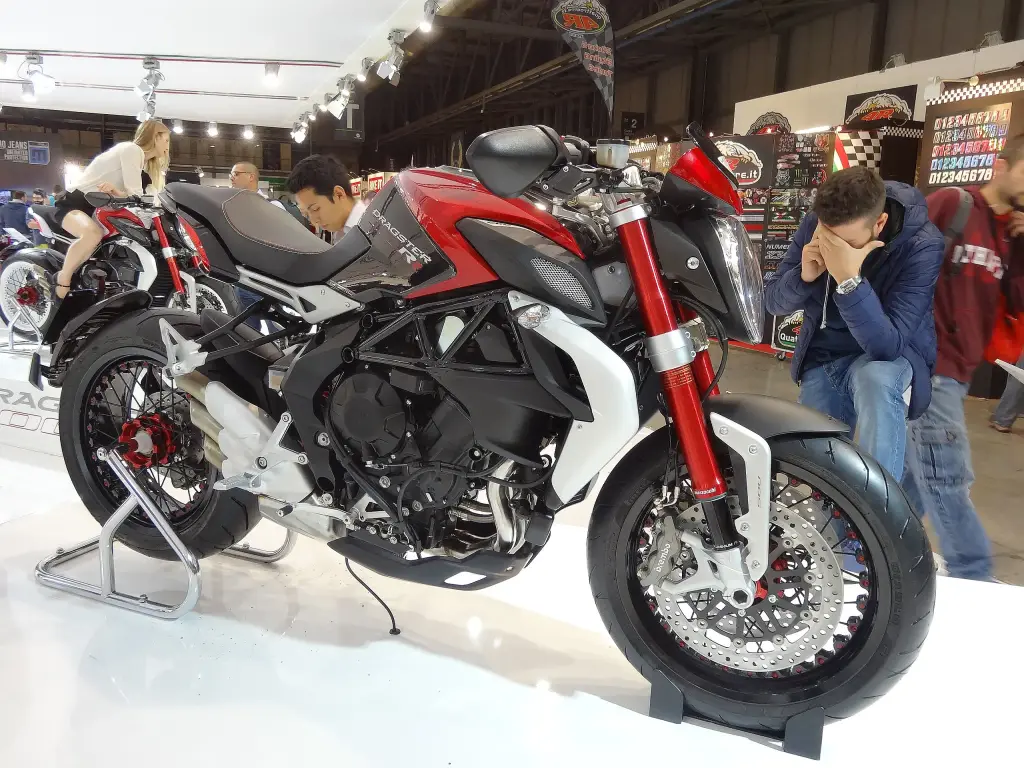
The first model of 2001 was the Brutale 750 Oro, a limited edition of 300 with magnesium parts, followed in 2002 by the 750 S. Late in 2005 a 910 cc engine arrived: the 998 unit from the F4 1000 S was too tall, so the 750’s bore and stroke grew to 76 × 51 mm for 909 cc. A 1,078 cc top model came in 2007 and a 982 cc variant in 2008. Under Harley-Davidson ownership the Brutale was redesigned for 2010 as the 990 R and 1090 RR, with 85 percent of components new and a more compact frame; a 921 cc entry model followed in 2011. In 2012 a three-cylinder Brutale based on the F3 appeared with the 675 cc engine, joined a year later by an 800, and the four-cylinder models were phased out. The four returned in 2019 in the Brutale 1000 Serie Oro, which MV claimed as the fastest naked bike in the world.
Design and features
- F4 engine: a radial-valve inline four derived from Ferrari Formula One practice, with 127 bhp and 75 Nm.
- Tamburini design: a naked version of the F4 look, designed by Massimo Tamburini.
- Chassis: a tubular frame with the engine as a stressed member, 50 mm Marzocchi forks and Nissin brakes.
- Three-cylinder range: 675 and 800 cc versions based on the F3 from 2012.
MV Agusta Brutale versions
- Brutale 750 Oro (2001): the first model, limited to 300 machines with magnesium parts.
- Brutale 750 S (2002): the first full-production model.
- Upgrade kits: Brutale America, CRC, Mamba and Gladio kits for the 750 S, limited to 300 each.
- Brutale 910 S (2005): the first big-bore model with a 909 cc engine.
- Brutale 990 R and 1090 RR (2010): the redesigned generation built under Harley-Davidson ownership.
- Three-cylinder Brutale (2012–): 675 and 800 cc models based on the F3.
The Brutale shares its engineering with the MV Agusta F4 and the MV Agusta F3. Older MV models are in the MV Agusta collection, such as the MV Agusta 750 Sport America.
Video: 2015 MV Agusta Brutale 800 Dragster RR
Video on YouTube.
Sources
- MV Agusta Brutale series, English Wikipedia: design, engine, evolution, variants