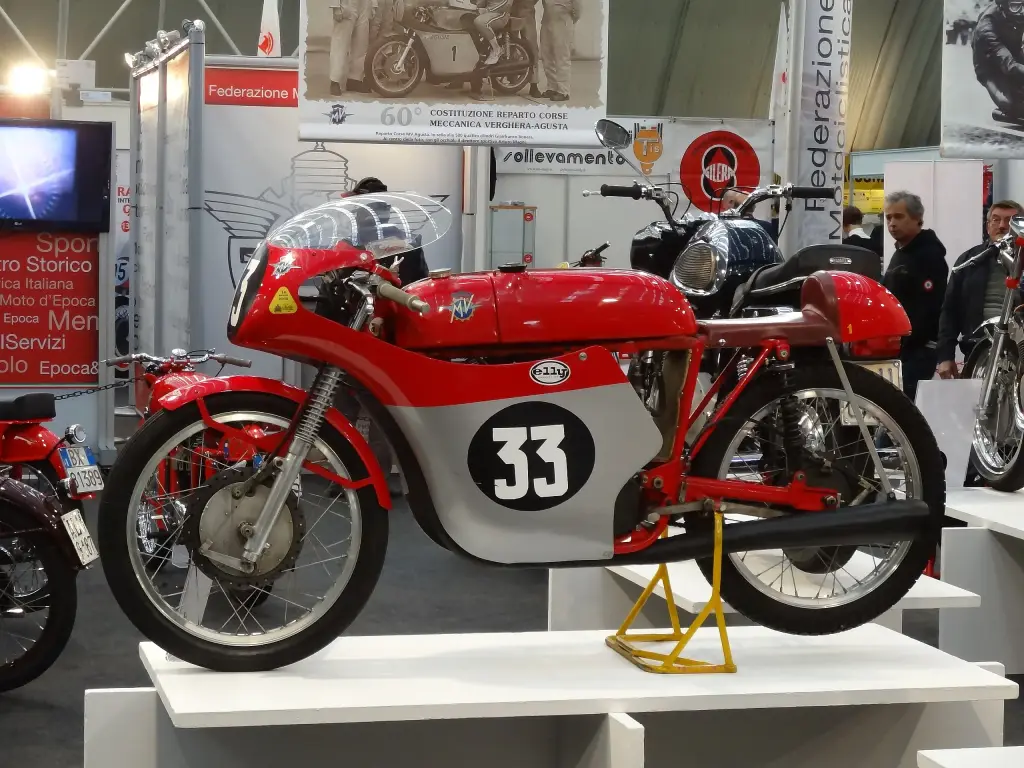
The MV Agusta 125 Bialbero was the 125 cc factory racer with which the Italian marque built its Grand Prix reputation in the 1950s. Produced between 1950 and 1960, the double-overhead-camshaft single won 34 Grands Prix, six rider’s world championships and one manufacturers’ title, and it gave MV Agusta the engineering base for the four-cylinder machines that followed.
MV Agusta 125 Bialbero at a glance
| Production | 1950–1960 |
|---|---|
| Type | 125 cc factory racing motorcycle |
| Engine | air-cooled single-cylinder four-stroke, double overhead camshafts driven by gears |
| Displacement | 123.54 cc |
| Bore × stroke | 53 × 56 mm |
| Power | about 12 hp in 1950, about 20 hp in 1960 |
| Valves | two per cylinder at 90° to each other, hairpin springs; 34 mm inlet and 32 mm exhaust by 1960 |
| Gearbox | four speeds, seven from 1955 |
| Frame | double cradle of 25 × 1.2 mm chrome-molybdenum tubes |
| Weight | 76 kg in 1952 |
| Racing record | 34 Grands Prix, six rider titles, one manufacturers’ title, four Italian championships |
This page is based on one source, the English Wikipedia article on the 125 Bialbero.
History of the MV Agusta 125 Bialbero
In 1949 Domenico Agusta hired Piero Remor and Arturo Magni, who had worked at Gilera on the four-cylinder 500 4C. Remor brought that knowledge with him, and MV profited from it while developing its own 500 4C, but his first assignment was to design a 125 cc four-stroke engine.
The Bialbero engine
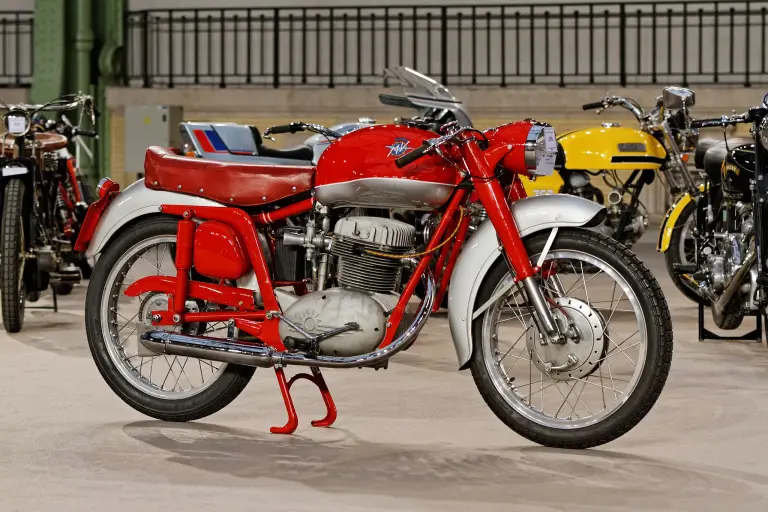
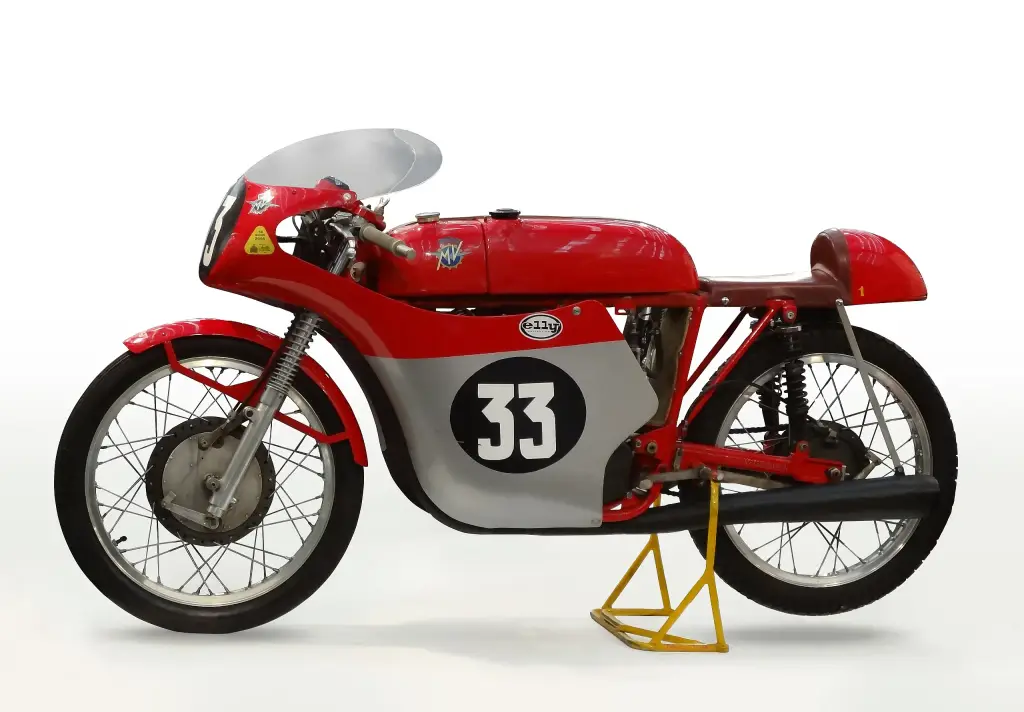
The name means two camshafts, and the layout was advanced for a 125 in 1950. The unit was an air-cooled single with double overhead camshafts driven by a gear train, valves set at 90 degrees to one another and closed by external hairpin springs, a bore and stroke of 53 × 56 mm and a displacement of 123.54 cc. Those dimensions matched the Mondial 125 Bialbero rather than the Gilera. A dry-sump oil tank sat under the tank at first and moved into the front of the petrol tank in the mid-1950s. Ignition came from a magneto until 1954, when twin coils and a rocker switch took over. Power rose from about 12 hp in 1950 to about 20 hp in 1960, with an 11:1 compression ratio by the end of the run. A dry multi-plate clutch drove through a four-speed gearbox, enlarged to seven speeds in 1955, and a chain took the drive to the rear wheel. The frame was a double cradle of 25 × 1.2 mm chrome-molybdenum tube; girder or sometimes Earles forks gave way to telescopics, and the friction dampers at the rear were replaced around 1954 by hydraulic spring units.
The racing years
The machine debuted at the Dutch Grand Prix in July 1950. Leslie Graham raced it twice in 1951, finished third at Assen and ended the season eighth in the 125 cc championship. For 1952 MV signed Cecil Sandford, who won the Ultra-Lightweight TT, the Assen TT and the Ulster Grand Prix, set a new lap record at the Isle of Man and took the 125 cc world title on a 76 kg, 15 bhp machine; MV also won the constructors’ championship. In 1953 a simpler 125 Monoalbero was offered to private riders, and eleven MVs lined up for the Isle of Man TT. Graham won the Lightweight 125 TT but was killed in the Senior; Carlo Ubbiali won in Germany, Angelo Copeta in Spain, and MV took the constructors’ title again. NSU’s Rennfox dominated 1954 until Rupert Hollaus died in practice at Monza and NSU withdrew; Ubbiali finished second in the championship. With NSU gone MV won every Grand Prix of 1955, with Ubbiali, Luigi Taveri and Remo Venturi filling the top three places, and an over-bored 175 Bialbero was built for the Italian 175 cc championship. Ubbiali won five of six races to take the 1956 title, and in 1957 he opened the season with a win at the Hockenheimring against the 18 bhp Mondials.
Design and features
- Double overhead camshafts: the Bialbero name came from its two gear-driven camshafts, a racing layout in a 125 cc engine.
- Valve gear: valves at 90 degrees to each other, closed by hairpin springs, with 34 mm inlet and 32 mm exhaust valves by 1960.
- Chassis: a double cradle of chrome-molybdenum tube, telescopic forks on later versions and hydraulic rear dampers from about 1954.
- Development: power climbed from about 12 hp to about 20 hp over ten racing seasons.
MV Agusta 125 Bialbero versions
- 125 Bialbero: the works racer, produced from 1950 to 1960.
- 125 Monoalbero: a simpler single-camshaft version sold to private riders from 1953.
- 175 Bialbero: an over-bored development for the Italian 175 cc championship, introduced in 1955.
Other MV Agusta racing singles and road models are in our MV Agusta collection: the MV Agusta 175 series and the MV Agusta 350 Ipotesi.
Video: 2012 August MV Agusta 125 SPORT in Japan
Video on YouTube.
Sources
- MV Agusta 125 Bialbero, English Wikipedia: engine, chassis, racing record