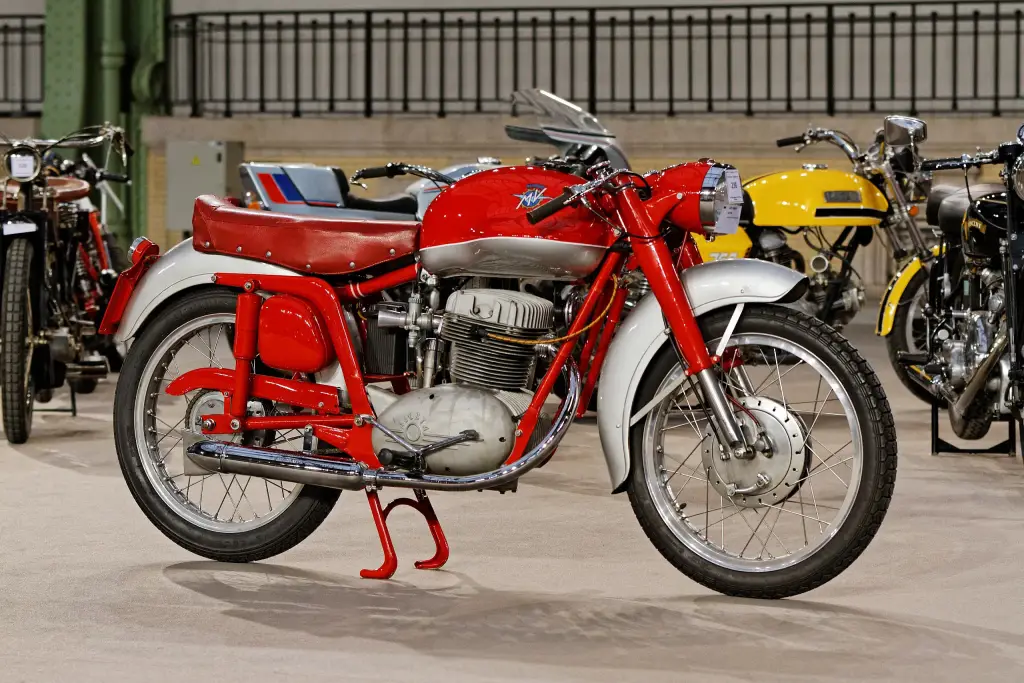
The MV Agusta 175 was the series that turned the Italian firm from a small racing workshop into a motorcycle manufacturer. Built from 1953 to 1960, it was MV’s first production model with a four-stroke engine and its best seller, offered as tourers, GTs, sports and supersports machines, and the sports versions earned the nickname Disco Volante, the flying saucer.
MV Agusta 175 at a glance
| Production | 1953–1960 |
|---|---|
| Launch | EICMA, Milan, 1952 |
| Types | touring, GT, sports, supersport, two racing versions |
| Engine | single-cylinder four-stroke with chain-driven overhead camshaft |
| Bore × stroke | 59.5 × 62 mm |
| Power | 8 bhp (CST) to 15 bhp (CSS) |
| Frame | duplex frame using the engine as a stressed member |
| Suspension | telescopic forks, swinging arm |
| Wheels | 17 or 19 inches, full-width alloy hubs |
| Nickname | Disco Volante (Flying Saucer) on the sports models |
| Racing version | 175 CSS-5V Squalo, about 200 built 1954–1957 |
This page is based on one source, the English Wikipedia article on the 175 series.
History of the MV Agusta 175
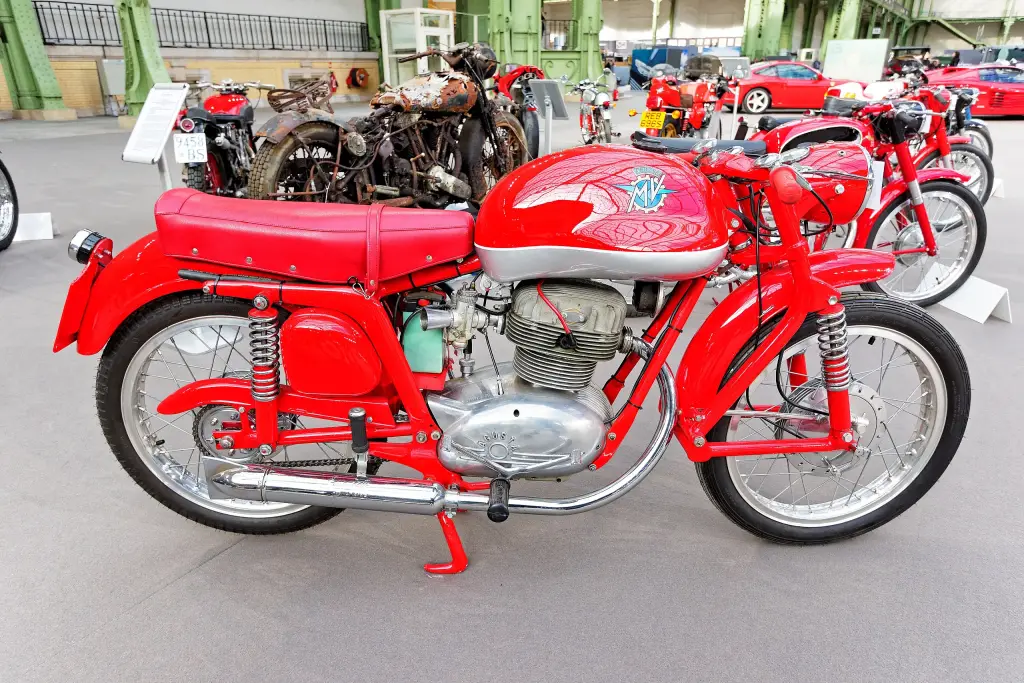
MV Agusta launched the 175 at the EICMA show in Milan in 1952 and began production in 1953. For the firm it was a milestone: the first production motorcycle with a four-stroke engine, and in the end its best seller. The unit-construction single had a chain-driven overhead camshaft working the valves through rockers closed by hairpin springs; the engine was inclined forward by 10 degrees, built in alloy, with a bore and stroke of 59.5 × 62 mm. The cycle parts were advanced for the class: a duplex frame that used the engine as a stressed member, telescopic forks, a swinging arm and full-width alloy hubs.
Model range
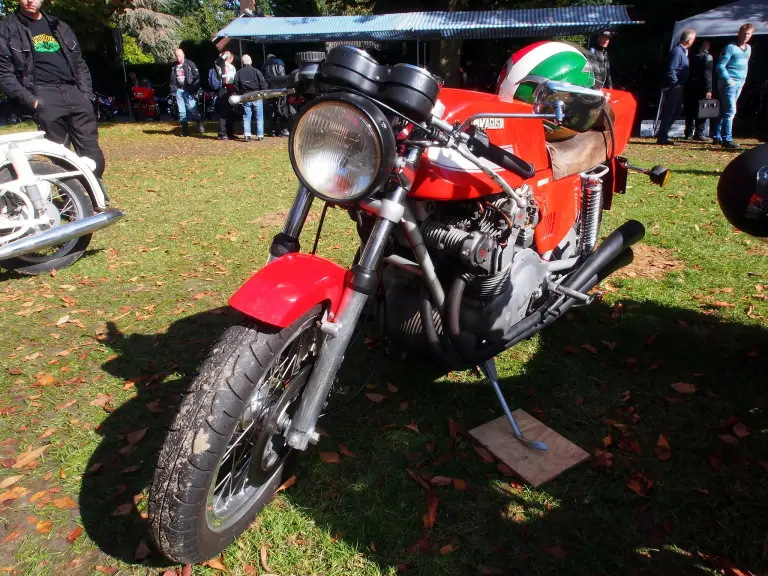
The first version was the touring 175 CST with 8 bhp at 5,600 rpm, 17-inch wheels and separate saddles, good for 60 mph; the CSTL added 19-inch wheels and a long dual seat. The 175 CS sports model arrived in 1953 with lower handlebars, a 22 mm carburettor and 11 bhp at 6,700 rpm for a 70 mph top speed, and about 4,500 were made; the shape of its tank earned it the name Disco Volante, and the model was also built under licence in Spain by Avello. An updated CS 57 came in 1957 with dynamo ignition and a revised exhaust. The supersport 175 CSS of July 1954 used a higher compression ratio and a larger carburettor to reach 15 bhp at 8,800 rpm, wore Earles forks and cost 280,000 lire; only about 500 were built, making it the rarest of the series. The 175 CSGT, also called Turismo Monoalbero, was made for one year only, 1957, with the CS engine and the CSTL cylinder head. From 1957 the pushrod AB models, in Economica, Turismo, America and America Lusso trim, offered 8 bhp at 5,200 rpm and 60 mph at a lower price. The 235 Tevere of 1959 enlarged the pushrod engine to 232 cc with a 69 mm bore; sales were slow because buyers wanting more than a 175 preferred the full 250 of the Raid, and production stopped in 1961. Avello built it in Spain as the 235 Deva.
Racing versions
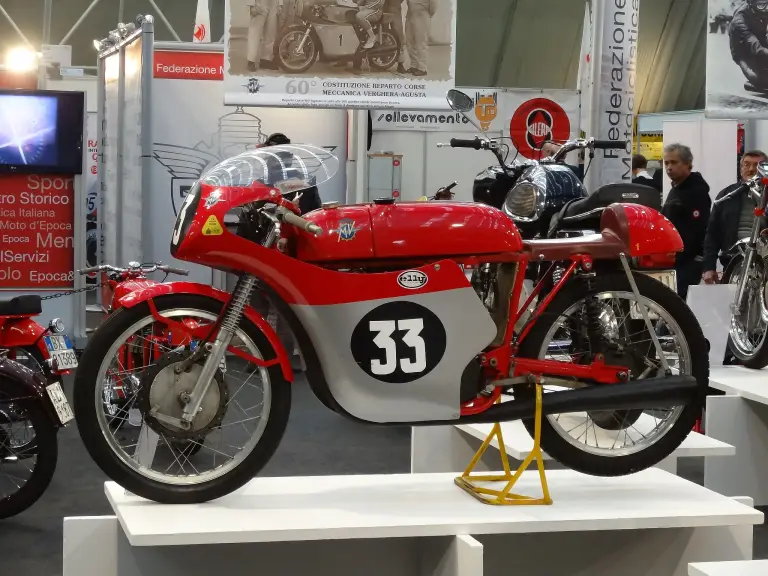
The 175 cc Formula Sport Derivata class was popular in Italy, and MV built the 175 CSS-5V for it. Known as the Squalo, or shark, it had a lighter frame based on the works racers, larger brakes, a magneto, Earles forks and a five-speed gearbox, and about 200 were made between 1954 and 1957; Mike Hailwood won his first race on one bored out to 196 cc at Oulton Park in 1957. The 175 Bialbero was an enlarged 125 Bialbero works racer with a 64 mm bore for 174 cc and 25 bhp at 11,500 rpm, built to answer Moto Morini and Mondial in the 175 class.
Design and features
- First four-stroke MV: the 175 was the firm’s first production motorcycle with a four-stroke engine and became its best seller.
- Advanced cycle parts: a duplex frame with the engine as a stressed member, telescopic forks and full-width alloy hubs.
- Disco Volante style: the sports tank shape gave the CS and CSS their flying saucer nickname.
- Wide range: tourers, GTs, sports and supersport models, pushrod economy versions and two racing machines.
MV Agusta 175 versions
- 175 CST and CSTL: touring models with 8 bhp, separate saddles on the CST and a long seat and 19-inch wheels on the CSTL.
- 175 CS: the 11 bhp sports model of 1953, about 4,500 built, also made in Spain by Avello; updated as the CS 57 in 1957.
- 175 CSS: the 15 bhp supersport of 1954 with Earles forks, about 500 built.
- 175 CSGT: a 1957 Gran Turismo with the CS engine and the CSTL cylinder head.
- AB models and 235 Tevere: pushrod versions from 1957 with 8 bhp, and the 232 cc Tevere of 1959.
- 175 CSS-5V Squalo and 175 Bialbero: the production-based racer and the 25 bhp double-camshaft works machine.
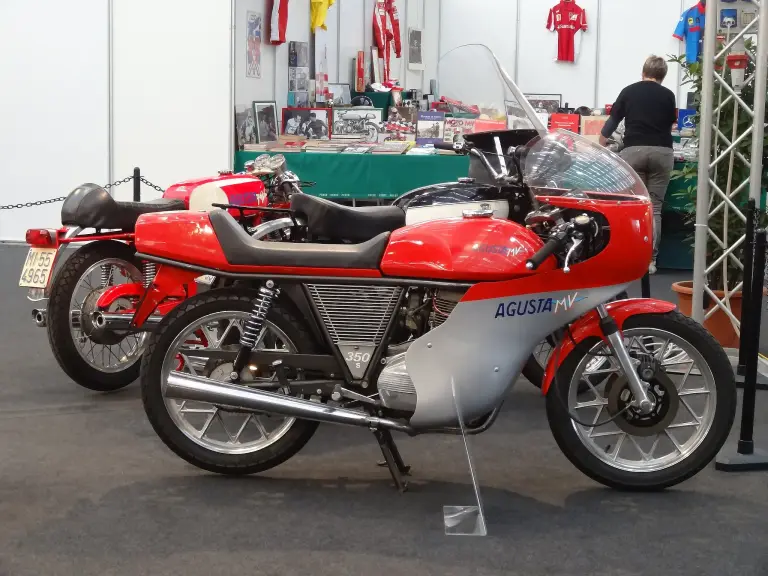
The 175 series grew out of MV’s racing singles such as the MV Agusta 125 Bialbero and was followed by the MV Agusta 350 Ipotesi. More in the MV Agusta collection.
Video: MV AGUSTA 175 CS 1° PARTE
Video on YouTube.
Sources
- MV Agusta 175 series, English Wikipedia: models, engine, racing versions