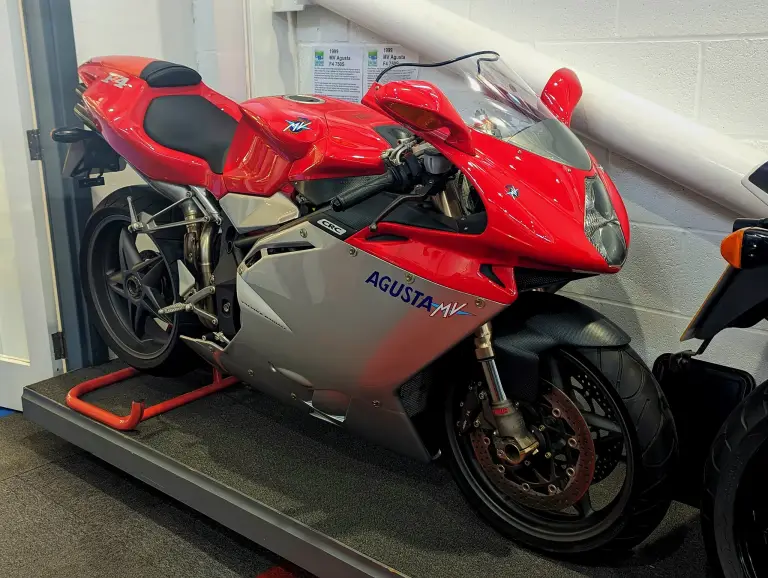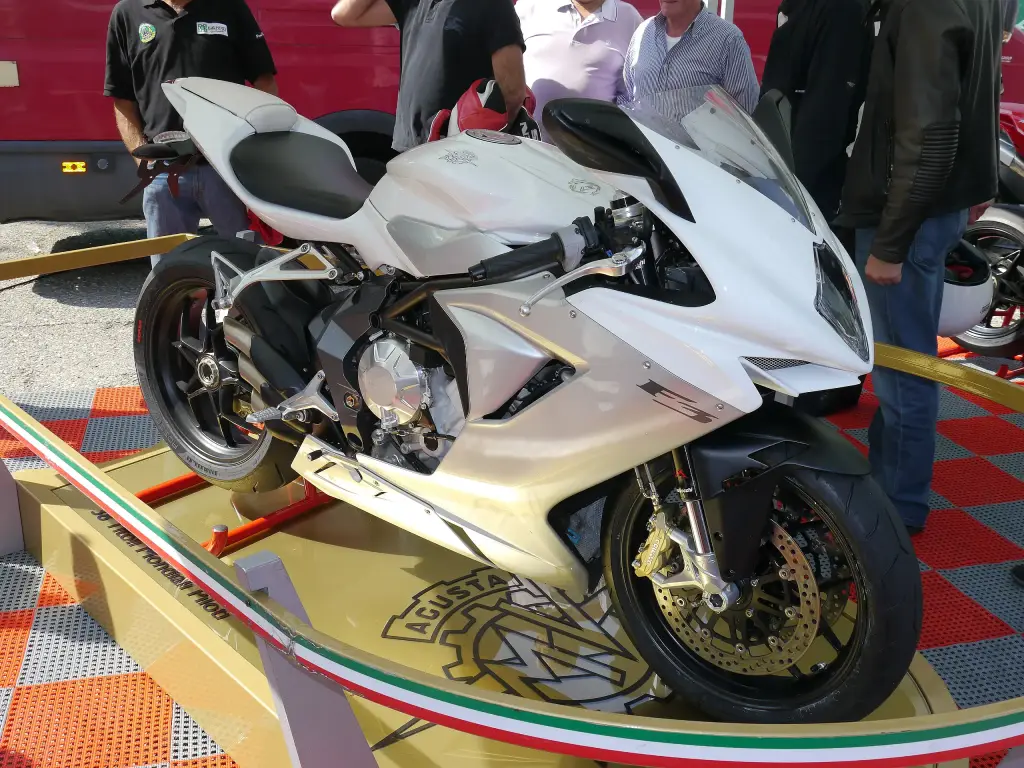
The MV Agusta F3 is the three-cylinder supersport that returned the Italian marque to the middleweight class in 2012 and revived a layout last used by its 1970s Grand Prix racers. Designed by Adrian Morton around a 675 cc triple, it was later offered with an 800 cc engine and became the basis of MV’s whole three-cylinder range.
MV Agusta F3 at a glance
| Production | from 2012 |
|---|---|
| Designer | Adrian Morton |
| Engine designer | Ezio Mascheroni |
| Engine | liquid-cooled inline three, DOHC |
| Displacements | 675 and 800 cc |
| Power | 126 bhp (675), 148 bhp (800) |
| Bore × stroke | 79 × 45.9 mm (675) |
| Frame | steel tubular lattice with a single-sided swingarm |
| Geometry | 66° steering head angle, 99 mm trail |
| Forks | 43 mm Marzocchi upside-down |
| Brakes | Brembo, two 320 mm front discs |
This page is based on one source, the English Wikipedia article on the F3 series.
History of the MV Agusta F3
The F3 was designed by Adrian Morton, with the engine by Ezio Mascheroni, and was first shown at the EICMA show in Milan on 2 November 2010. It takes the lines of the F4, with the diamond headlamp, the tapered seat shell and a single-sided swingarm that shows the rear rim, but its exhausts run along the right side of the bike instead of under the seat. The limited Oro went on sale in December 2011 and the standard model in January 2012; from 2013 two engine sizes were offered, 675 and 800 cc. The F3 was developed alongside the three-cylinder Brutale, and its engine became the basis of the whole three-cylinder range, including the Rivale, Stradale and Turismo Veloce.
Technology
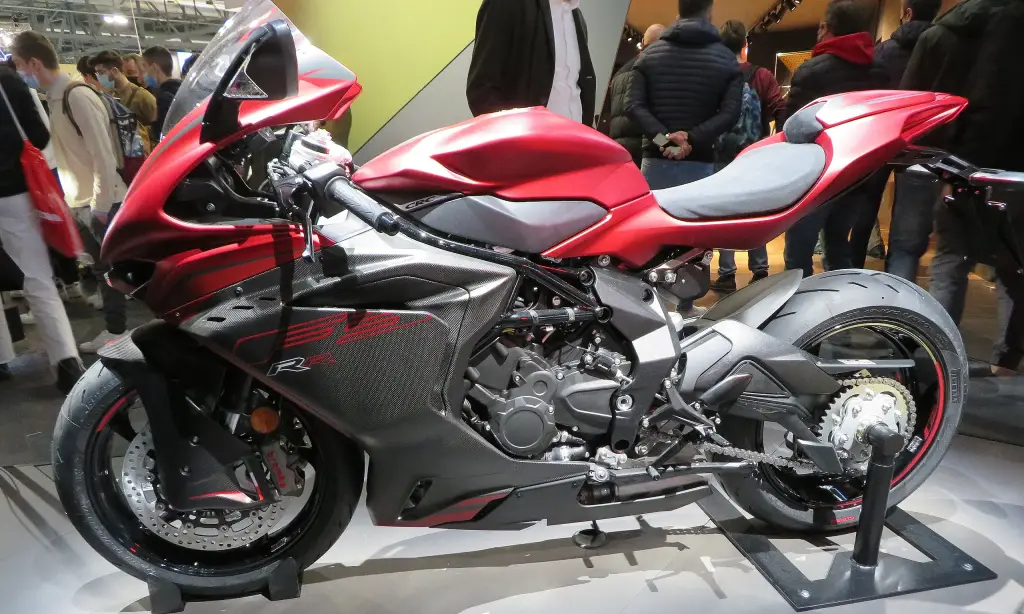
The 675 cc triple uses a counter-rotating crankshaft previously seen only on MotoGP machines such as the Yamaha YZR-M1, which counters the forces of the wheels, and a very short stroke of 45.9 mm against a 79 mm bore with titanium valves; it develops 126 bhp at 14,400 rpm. The MVICS system brings ride-by-wire with four preset maps and one adjustable, plus eight-level traction control. A short wheelbase, a 66 degree steering head angle and 99 mm of trail give quick handling, while the steel tubular lattice frame carries an aluminium swingarm support and a relatively long single-sided arm. The 43 mm Marzocchi upside-down forks and Sachs shock are fully adjustable, the cassette gearbox can take the EAS quickshifter, and Brembo brakes use two 320 mm front discs with radial four-piston calipers and a 220 mm rear disc. The 800 of 2013 stretched the stroke to 54.3 mm for 148 bhp at 13,000 rpm; in 2021 the engine was revised for Euro 5 with reduced friction, still giving 147 bhp, first in the Rosso and then the RR.
Design and features
- Three-cylinder engine: the first MV triple since the 1970s GP racers, with a counter-rotating crankshaft and a very short stroke.
- Electronics: MVICS ride-by-wire, four preset maps plus one adjustable and eight-level traction control.
- Chassis: a short steel lattice frame, long single-sided swingarm, fully adjustable Marzocchi and Sachs suspension.
- Brakes: Brembo radial four-piston calipers on two 320 mm front discs.
MV Agusta F3 versions
- F3 675 (2012): the baseline model with 126 bhp.
- F3 Serie Oro (2011): a limited edition of 200 with gold frame plates, swingarm and wheels, Ohlins suspension and carbon bodywork.
- F3 675 RC (2018): 133 bhp, titanium race exhaust, limited to 350 machines.
- F3 800 (2013): the larger 800 cc engine with 148 bhp.
- F3 800 AGO (2014): dedicated to Giacomo Agostini, 300 built, 171 kg with magnesium and carbon parts.
- F3 XX (2019), Rosso and RR (2021): a 160 bhp track machine, a Euro 5 entry model and the winglet-equipped RR.
The F3 shares the showroom with the MV Agusta Brutale, which used its engine, and the four-cylinder MV Agusta F4. More in the MV Agusta collection.
Video: MOTORRAD-Testride: MV Agusta F3 800
Video on YouTube.
Sources
- MV Agusta F3 series, English Wikipedia: design, engine, technology, model range