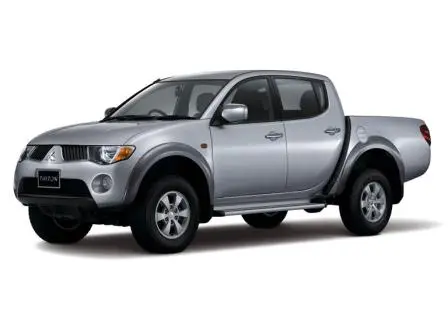
The Mitsubishi Triton, also known as the L200, is a mid-size pickup truck produced by Mitsubishi Motors. It has been sold under more names than almost any other Mitsubishi, including Forte and Strada in Japan, Mighty Max in the United States, Dodge Ram 50 and Plymouth Arrow Truck in America, and Fiat Fullback and Ram 1200 in recent years.
Mitsubishi Triton at a glance
| Maker | Mitsubishi Motors |
|---|---|
| Production | since September 1978 |
| Japanese names | Forte, then Strada from 1991 |
| Main export name | L200 |
| Other names | Mighty Max, Dodge D50 and Ram 50, Plymouth Arrow Truck, Rodeo, Colt, Storm, Magnum, Strakar, Fiat Fullback, Ram 1200 |
| First generation | 1978–1986 in Japan |
| Four-wheel drive | added in 1981 |
| First-generation engines | 1.6 petrol, 2.0, 2.6, 2.3 diesel |
| Sales | over 2.8 million for the first three generations |
| Not sold in | United States, Canada, Japan, India and China as of 2021 |
Based on one source: the English Wikipedia article on the Mitsubishi Triton, of which the material available describes the first generation in detail. No free photos of the model were found in the material, so the article keeps the earlier picture.
History of the Mitsubishi Triton
The Forte of 1978
The first generation went on sale in Japan in September 1978 as the Mitsubishi Forte and continued until late 1986, when the line was dropped in Japan for five years. Japanese buyers first had a 92 PS 1.6-litre 4G32, later replaced by an 86 PS 1.6 with two- or four-wheel drive, the four-wheel-drive version using the 2.0-litre 4G63T with 206 PS. It came in basic Deluxe trim or a leisure-oriented Custom with a smoother bed and fewer hardpoints for strapping loads. Export versions offered a 93 hp 2.0, a 105 hp 2.6 and, in many markets, a 67 PS 2.3-litre diesel, with a 73 PS 1.6 rounding out the range; some markets also had a bare cab and chassis.
Mechanically the truck had recirculating-ball steering, front disc brakes, rear-wheel drive and coil springs at the front. Four-wheel drive arrived in 1981 with torsion bars up front and leaf springs at the rear, controlled by an extra lever beside the four-speed gearbox with positions for two-wheel drive in high range, four-wheel drive in high range and four-wheel drive in low range. The transfer case was chain-driven to the front wheels, which made it lighter, quieter and easier to shift than the more common gear type, so the driver could move between two- and four-wheel drive in high range without the clutch, while low range required stopping. A warning lamp lit when four-wheel drive was engaged.
Chrysler badges
The Dodge Ram 50, called the Dodge D50 in 1979 and 1980, was a badge-engineered version sold by Chrysler from 1979 to 1994 over two generations. Plymouth had the Arrow Truck from 1979 to 1982. Chrysler had come late to the compact pickup market, where the Ford Courier from Mazda and the Chevrolet LUV from Isuzu had appeared in 1972 and the Toyota Hilux and Datsun Truck were already imported. Mitsubishi itself imported the truck as the Mighty Max when it began selling directly in the United States from 1982, when the Plymouth version ended. Dodge versions had quad rectangular headlights from the 1983 facelift, while Mitsubishis and earlier Dodges had single units; elsewhere importers could choose single or double rectangular or twin round lamps, the last being the original Japanese fitment. Four-wheel drive came for 1982, creating the Power Ram 50 in America, and a turbodiesel was offered there from 1983 to 1985: the 1983 unit used a non-wastegated TC05 turbo with 80 hp, and the 1984 and 1985 versions a wastegated TD04 with 86 hp.
Chrysler Australia launched the first generation in April 1979 as the MA series Chrysler D-50, with a Commercial model on the 1.6-litre Saturn engine and a Recreational on the 2.0-litre Astron. Both had a floor-shifted four-speed, the Recreational with a taller axle, and the Commercial was rated for a 1,000 kg payload against 500 kg for the softer-sprung Recreational. The Recreational came with radial tyres, electronic ignition, bucket seats, carpet, a radio, a sports steering wheel and an adjustable column, and an optional fibreglass canopy with a mattress was made by Challenge Industries.
Later generations
Cumulative sales of the first three generations exceeded 2.8 million. In Japan the truck was later called the Strada, and export markets have used names including Rodeo, Colt, Storm, Magnum and Strakar, a Portuguese portmanteau of Strada and Dakar used since 1999. In 2015 Fiat Professional launched a rebadged version as the Fiat Fullback, and in 2016 Ram Trucks sold a rebadged Ram 1200 in the Middle East. By February 2021 the pickup was sold in every Mitsubishi market except the United States, Canada, Japan, India and China.
Design and features
- Many names: Forte, Strada, L200, Mighty Max and Fiat Fullback among others.
- Early four-wheel drive: chain-driven transfer case from 1981.
- Chrysler versions: Dodge Ram 50 and Plymouth Arrow Truck.
- Australian D-50: Commercial and Recreational models with different payloads.
- Big seller: over 2.8 million in three generations.
Mitsubishi Triton versions
- Forte (1978): the first Japanese-market pickup.
- Dodge Ram 50 and Plymouth Arrow Truck: American Chrysler versions.
- Chrysler D-50 (Australia): Commercial and Recreational models.
- Mighty Max: Mitsubishi’s own American name from 1982.
- Strada: Japanese name from 1991.
- Fiat Fullback and Ram 1200: rebadged versions of recent generations.
The Triton is the basis of the Pajero Sport and the American Raider, and it shares its name history with the Express. More vehicles are in the Mitsubishi collection.
Sources
- Mitsubishi Triton, English Wikipedia: names, first generation, Chrysler versions, markets