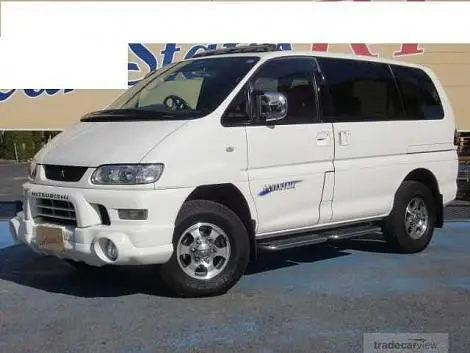
The Mitsubishi Delica is a range of vans and pickup trucks built by Mitsubishi Motors since 1968. The name is a contraction of the English phrase delivery car. In export markets the same vehicles have been sold as the L300 and later L400, as the Express and Starwagon in Australia and as the Mitsubishi Van and Wagon in the United States.
Mitsubishi Delica at a glance
| Maker | Mitsubishi Motors |
|---|---|
| Production | since July 1968 |
| Name | from delivery car |
| Export names | L300, L400, Express and Starwagon (Australia), Mitsubishi Van and Wagon (USA) |
| First generation | T100 pickup, 1968; van and coach added in 1969 |
| First engine | KE44 1,088 cc, 58 PS |
| Payload | 600 kg |
| Second generation | from June 1979 |
| Four-wheel drive | from October 1982, first in the Japanese van market |
| Passenger versions | Delica Star Wagon, then Delica Space Gear, then Delica D:5 |
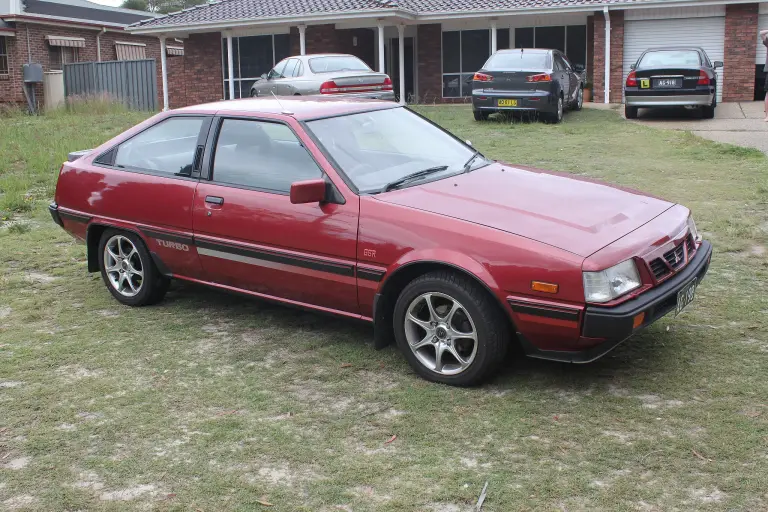
Based on one source: the English Wikipedia article on the Mitsubishi Delica. No free photos of the model were found in the material, so the article keeps the car’s earlier picture.
History of the Mitsubishi Delica
The cab-over delivery van
Production of the Delica light commercial cab-over pickup began in July 1968 under the chassis code T100, in line with the T90 Canter introduced that January. Its KE44 1,088 cc engine produced 58 PS, payload was 600 kg and top speed 115 km/h. A year later a cargo van and a passenger van were added; the passenger version, called Delica Coach, seated nine people in three rows and stayed until 1976, and the engine was upgraded to 62 PS in 1969.
In March 1971 a facelifted Delica 75, the T120, brought a small grille instead of the bare metal front and a new 1.4-litre Neptune 4G41 engine of 86 PS. After a facelift in autumn 1974 the range was sold only as the Delica 1400, and a longer-wheelbase one-ton truck, the T121, joined in 1976. Export cars were usually called Colt T100, T120 or 1400; the T120 was a great success in Indonesia, where Colt became a synonym for minibus, and stayed in production there until 1982.
The second generation and four-wheel drive
The Delica was replaced in June 1979 by an all-new design that used the full 1,690 mm width allowed for Japanese compact vehicles. It had independent wishbone front suspension and leaf springs at the rear, sliding side doors and a one-piece gas-strut tailgate, and the range grew to ten variants with eight-seat passenger, cargo and recreational bodies. Engines were four-cylinders already used in Mitsubishi cars: the 1,439 cc 4G33 with 80 PS, the 1.6-litre 4G32, a 1.8-litre 4G62 with 100 PS from May 1980 and a 2.0-litre 4G63B from November 1983, plus a 2.3-litre 4D55 diesel from October 1982, replaced by a 2.5-litre 4D56 in 1986.
Four-wheel drive arrived in October 1982, the first in the Japanese van market. It used a modified version of the Pajero chassis, usually with smaller engines than the Pajero, starting with the 1.8-litre petrol. After the third generation appeared, the separate-cab truck version of the second generation carried on until 1994.
Australia and later names
Chrysler Australia launched the SA series in Australia on 14 April 1980 as the Chrysler L300 Express, after showing it at the Adelaide Motor Show two days earlier. When Mitsubishi took control of Chrysler Australia that same month and renamed it Mitsubishi Motors Australia in October 1980, the van became a Mitsubishi. It came with a 1.6-litre engine and four-speed manual in three-seat van and eight-seat wagon forms; no pickup was offered because the L200 Express covered that market. The SB series of November 1981 brought radial tyres on larger wheels and raised payload from 925 to 1,000 kg.
Passenger versions were called Delica Star Wagon from 1979 until the Delica Space Gear of 1994, which became simply Space Gear in Europe. The current passenger model, sold without a commercial version, is the Delica D:5. Since 2011 Mitsubishi has also used Delica nameplates on rebadged models from other makers, including the Mazda Bongo and Nissan NV200 as Delica Cargo and D:3, the Suzuki Solio as D:2 and, from 2023, a kei car called Delica Mini.
Design and features
- Cab-over layout: a delivery van and pickup from 1968.
- Export names: L300 and L400 in Europe, Express in Australia.
- Four-wheel drive: the first four-wheel-drive van in Japan, from 1982.
- Pajero parts: the 4×4 version used a modified Pajero chassis.
- Passenger line: Star Wagon, Space Gear and today’s Delica D:5.
Mitsubishi Delica versions
- T100 pickup (1968): the first Delica, 1,088 cc and 600 kg payload.
- Delica Coach: nine-seat passenger van, 1969–1976.
- Delica 75 / T120: facelifted 1.4-litre model from 1971.
- Second generation (1979): wider body, sliding doors, ten variants.
- Delica 4WD (1982): Pajero-based four-wheel drive.
- L300 Express: Australian name from 1980.
- Delica Space Gear and D:5: later passenger versions.
The Delica shares its four-wheel-drive basis with the Pajero, and its small relative is the Minicab. The pickup side of the range belongs with the L200, and more cars are in the Mitsubishi collection.
Sources
- Mitsubishi Delica, English Wikipedia: generations, engines, four-wheel drive, markets