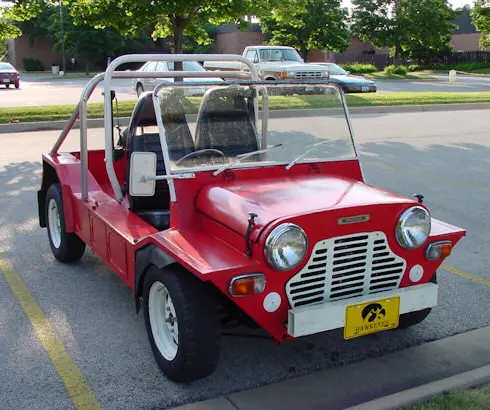
The Mini Moke is a small, doorless utility car built on Mini mechanical parts. Alec Issigonis designed it as a light military vehicle that could be dropped by parachute, but the army rejected it for its low ground clearance, and it was sold to civilians instead. It was built in Britain, Australia and Portugal between 1964 and 1993.
Mini Moke at a glance
| Maker | BMC, later British Leyland and Rover; also Austin, Morris and Moke brands |
|---|---|
| Designers | Alec Issigonis and John Sheppard |
| Prototype | “The Buckboard”, working prototypes by 1959 |
| Production | 1964–1993 |
| Built in Britain | 14,518, 1964–1968, at Cowley |
| Built in Australia | 26,000, 1966–1981 |
| Built in Portugal | 10,000, 1980–1993 |
| Engine | 848 cc A-Series four-cylinder, detuned for low-octane fuel |
| Layout | front-wheel drive, Mini suspension, gearbox and 10-inch wheels |
| Body | no doors, canvas top optional |
| Price at launch | £405 in Britain |
| Name | “Moke”, an archaic word for a mule |
The article is based on one source, the English Wikipedia page on the Mini Moke.
History of the Mini Moke
An army vehicle that was not wanted
Issigonis and John Sheppard designed the Moke to share the Mini’s mechanical parts with a tougher body, hoping to win part of the military market from Land Rover. By 1959 BMC had running prototypes codenamed The Buckboard, shown to the British Army as a vehicle that could be dropped by parachute. Poor ground clearance and a small engine failed the most basic off-road requirements, and only the Royal Navy showed interest, thinking of use on aircraft carrier decks.
An attempt to fix the problem produced The Twini, a Moke with a second engine and gearbox at the back and linked clutches and gear levers. It was shown to the US Army without success, and the complexity of the design stopped development. Three of these twin-engined cars were later used by the Brazilian Army after being captured from Guyanese rebels in the 1969 Rupununi Rebellion. Early advertising made a joke of the Moke’s limits, showing four soldiers being carried in it and then picking it up by its tubular bumpers.
A civilian car
BMC gave up on the army in 1963 and marketed the Moke to farmers and light commercial users; it reached the British market in 1964, built at Cowley. British Customs classified it as a passenger car rather than a commercial vehicle, so it attracted purchase tax and sold worse in the market it was made for. British Mokes used a low-powered 848 cc engine detuned for low-octane fuel, with the same suspension, gearbox and 10-inch wheels as the Mini. Seats, grab handles, a heater, a washer and the canvas top were optional extras fitted by the owner, and the base price was £405.
The Mk I had a single windscreen wiper, a floor-mounted headlight dip switch and came only in Spruce Green. The Mk II of 1967 added a wiper on the passenger side, moved the horn and headlight controls to the indicator stalk and was also sold in white. In 1968 the cigarette company John Player & Sons ran a team of Mokes in grass-track autocross, fitted with rollover protection and the 1275 cc engine of the Cooper S. British production ended in 1968.
Australia, Portugal and later Mokes
Australian production began in 1966, first as the Morris Mini Moke and from 1973 as the Leyland Moke. In 1968 Australian cars moved to 13-inch wheels with longer rear trailing arms and widened wheel arches, which made them more usable off the road and on beaches than the British version, and the solid metal seats were replaced by tubular-framed ones. Production then moved to Portugal, where 10,000 cars were built between 1980 and 1993 before the Moke went out of production after nearly thirty years. A new Chinese-made Moke appeared in 2013, assembled by several companies, but it is a new design that shares nothing with the original.
Design and features
- No doors: a simple open body with a removable canvas top and optional seats.
- Mini mechanicals: the 848 cc A-Series engine, Mini gearbox, suspension and 10-inch wheels.
- Very light: advertising showed four soldiers carrying the car by its tubular bumpers.
- Military experiments: a parachute-droppable prototype and the twin-engined Twini, neither adopted.
- Australian improvements: 13-inch wheels, longer trailing arms and wider arches from 1968.
Mini Moke versions
- British Mk I (1964–1967): one wiper, Spruce Green only, £405.
- British Mk II (1967–1968): second wiper, stalk-mounted controls, white also available.
- Australian Moke (1966–1981): sold as Morris and then Leyland, with 13-inch wheels from 1968.
- Portuguese Moke (1980–1993): the last of the original line, 10,000 cars.
- The Twini: a prototype with two engines and two gearboxes.
- Chinese Moke (2013): a new design using the name, unrelated to the BMC car.
The car it was built from is the classic Mini, and the estate of the same family is the Mini Clubman. The crossover concept that revived the idea of a rugged Mini is described under Mini concept cars. More cars are in the Mini collection.
Sources
- Mini Moke, English Wikipedia: design, military trials, production in three countries