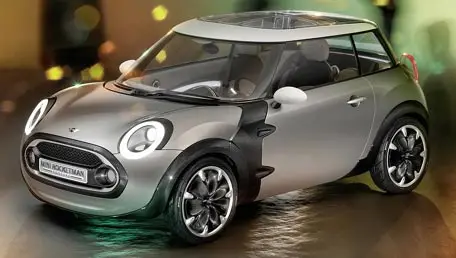
Mini concept cars were the studies built to show future ideas and forthcoming models at motor shows. Before BMW relaunched the marque, most of them were attempts to find a successor to the Mini itself. Issigonis worked on one from 1967 to 1979 and British Leyland tried again in 1972; none of the designs reached production, and the original Mini stayed in the catalogue until 2000.
Mini concept cars at a glance
| Maker | BMC, then British Leyland |
|---|---|
| Main study | 9X, designed by Alec Issigonis 1967–1979 |
| 9X engine | new four-cylinder with belt-driven overhead camshaft, 1000 cc |
| 9X layout | transverse engine, gearbox in a separate casing behind and below |
| 9X suspension | MacPherson struts in front, torsion beam axle at the back |
| Parallel project | Project Ant, cancelled in 1968 |
| Clubman front | 1967–68, by Roy Haynes |
| Replacement study | ADO74, from 1972, first known as Project Ladybird |
| Outcome | none produced; the Mini continued until 2000 |
The article is based on one source, the English Wikipedia page on Mini concept cars, which covers the pre-BMW studies in most detail. The video shows a later BMW-era concept, the Rocketman, which the source does not describe.
History of the Mini concept cars
9X, Issigonis’s own successor
From 1967 to 1979 Issigonis worked on a replacement for the Mini called the 9X. It grew out of an earlier project for a smaller Mini requested by Innocenti for Italy, known as the Mini-Mini and later the Innocenti 750; its engine and new in-sump gearbox were carried over. Market research at BMC doubted there was a market for such a car outside Italy, where it could not match the Fiat 500 on price.
The 9X set out to fix the weaknesses of the original: its complexity, its harsh ride and the refinement lost to the gearbox-in-sump layout. The first engineered prototype had a shorter wheelbase than the Mini but was four inches shorter overall, slightly wider, with more interior space and a hatchback body. The separate subframes were dropped and the body was simplified, so the 9X needed less than half the number of parts of a Mini.
Its power unit was a new four-cylinder with a belt-driven overhead camshaft, an aluminium crankcase and cylinder head with a cast-iron block held together by long through-bolts, giving 60 horsepower per litre against about 40 for the A-Series. The gearbox sat in its own casing behind and below the engine instead of sharing the engine oil, which cut transmission noise. Hydrolastic suspension was dropped in favour of MacPherson struts in front and a torsion beam axle at the back. Issigonis also drew a larger five-door version called the 10X. Politicking inside British Leyland meant the 9X never reached production.
Project Ant and the Clubman front
Project Ant, the Barrel Mini, ran alongside the 9X in 1968 as an attempt to keep the same space efficiency with a cheaper, simpler car needing fewer labour hours. It was cancelled that year but came back in a design comparison with what became ADO74 between 1972 and 1974, where it performed well, though the decision went to a supermini rather than a new Mini.
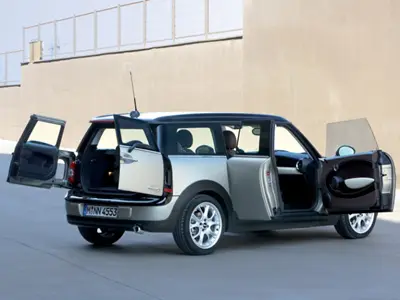
In 1967 Roy Haynes joined BMC from Ford and was asked to update the existing Mini. Several designs were considered, including a booted version based on the Riley and Wolseley Elf and Hornet and a hatchback with a Marina-like rear, and all were rejected except the new front end, which went into production as the Clubman. In 1967 and 1968 Pininfarina also designed two aerodynamic concept cars on BMC 1800 and 1100 bases; BMC rejected them.
ADO74
By 1972 British Leyland was again looking for a Mini replacement, at first called Project Ladybird. The thinking had changed: the superminis that had appeared since the 9X showed that the Mini’s very small size was not essential, and a slightly larger car could offer more space without the compromises. The outcome of that work was the ADO74 programme rather than a new Mini, and the original car carried on for another three decades.
Design and features
- Half the parts: the 9X was designed to be built from less than half the number of components of a Mini.
- New engine: a belt-driven overhead-camshaft four with an aluminium head and a cast-iron block.
- Separate gearbox casing: the gearbox came out of the sump, which cut transmission noise.
- Conventional suspension: MacPherson struts and a torsion beam replaced the rubber-cone and Hydrolastic systems.
- Unused ideas: Project Ant, the Clubman front and the Pininfarina studies all stopped short of a new model.
Mini concept cars versions
- 9X (1967–1979): Issigonis’s three-door hatchback replacement, with 10X as a larger five-door drawing.
- Project Ant (1968): a cheaper, simpler Mini-sized study, revived in the 1972–74 comparison.
- Clubman front (1967–68): the only Haynes proposal that reached production.
- Pininfarina studies (1967–68): two aerodynamic concept cars on BMC 1800 and 1100 bases, rejected.
- ADO74 (1972): the Project Ladybird replacement study.
The car these studies were meant to replace is the classic Mini, and the version that did reach production from the Clubman work is described under the Mini Clubman. The modern crossover that grew out of a later concept is the Mini Countryman. More cars are in the Mini collection.
Video: The Amazing MINI That Was Never Built – A Look at the ROCKETMAN (Design Showcase)
Video by Stunning Videos 4K on YouTube.
Sources
- Mini concept cars, English Wikipedia: 9X, Project Ant, Clubman, Pininfarina, ADO74