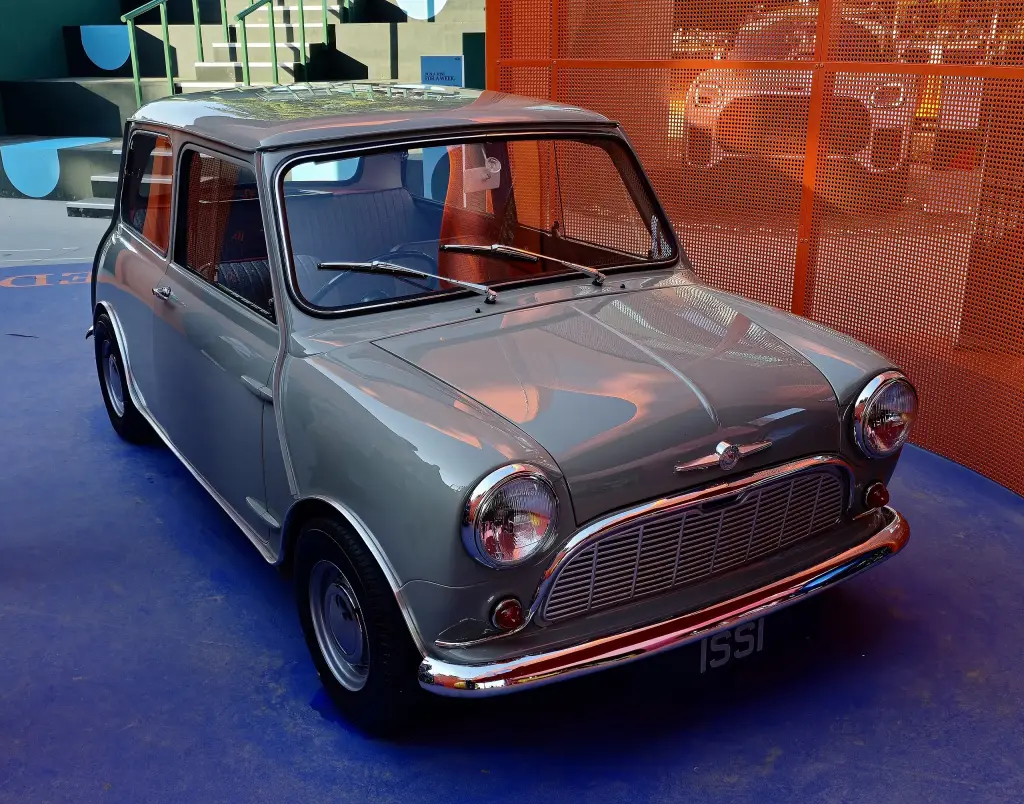
The Mini was designed by Alec Issigonis for the British Motor Corporation and built from 1959 to 2000 without a change of concept. Its transverse engine, gearbox in the sump and front-wheel drive let four adults travel in a car a little over three metres long, and the layout was copied across the industry. An estimated 5.38 million were built in all versions.
Mini (classic) at a glance
| Maker | British Motor Corporation, later British Leyland and Rover Group |
|---|---|
| Production | August 1959 – October 2000 |
| Designer | Alec Issigonis |
| Layout | front engine mounted transversely, front-wheel drive |
| Engine | BMC A-Series four-cylinder, 848, 998, 1098 and 1275 cc |
| Gearbox | four-speed, in the engine sump, sharing engine oil |
| Wheels | 10-inch, 1959–1984 |
| Suspension | rubber cones in place of steel springs; Hydrolastic on short cars 1964–1971 |
| Body styles | saloon, estate, van, pick-up, Moke |
| Names at launch | Austin Seven and Morris Mini-Minor |
| Rally | Monte Carlo Rally wins in 1964, 1965 and 1967 |
| Built | about 5,387,862 in total |
The article is based on two sources; the Italian Wikipedia page was not available and is not cited.
History of the Mini (classic)
A car for the Suez Crisis
The Mini came about because of the fuel shortage caused by the 1956 Suez Crisis. Petrol was rationed in Britain, sales of large cars fell and small German bubble cars sold well. Leonard Lord, the head of BMC, wanted a proper miniature car instead. He set the limits: the car had to fit inside a box of 10 by 4 by 4 feet, passengers had to occupy six of those ten feet, and the engine had to be an existing unit for reasons of cost.
Issigonis and his team built the first XC9003 prototype by July 1957, nicknamed the Orange Box for its colour. Lord approved it for production on 19 July and the project became ADO15. The A-Series engine was turned sideways, the four-speed gearbox was placed underneath it in the sump and drove the front wheels through primary gears — the arrangement that gave the Mini its characteristic transmission whine. The radiator sat at the left side of the engine bay so that the engine-driven fan could be kept.
One shape, many updates
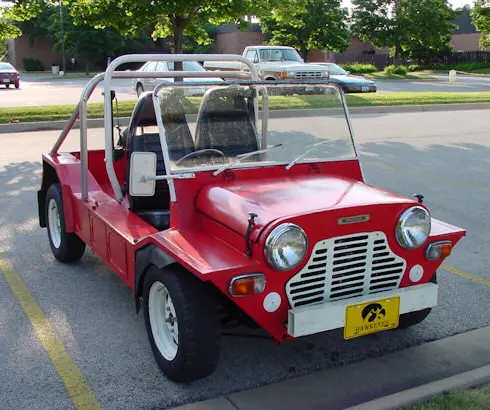
The first cars reached the market in Birmingham on 18 August 1959, sold as the Austin Seven and the Morris Mini-Minor after earlier models of both makers. The Austin Seven became the Austin Mini in 1962 and Mini became a marque in its own right in 1969. The Mark I was updated three times in Britain: as the Mark II, as the Clubman with its squared-off nose, and as the Mark III. Around them BMC offered an estate, a van, a pick-up and the jeep-like Moke, all on the same mechanical parts.
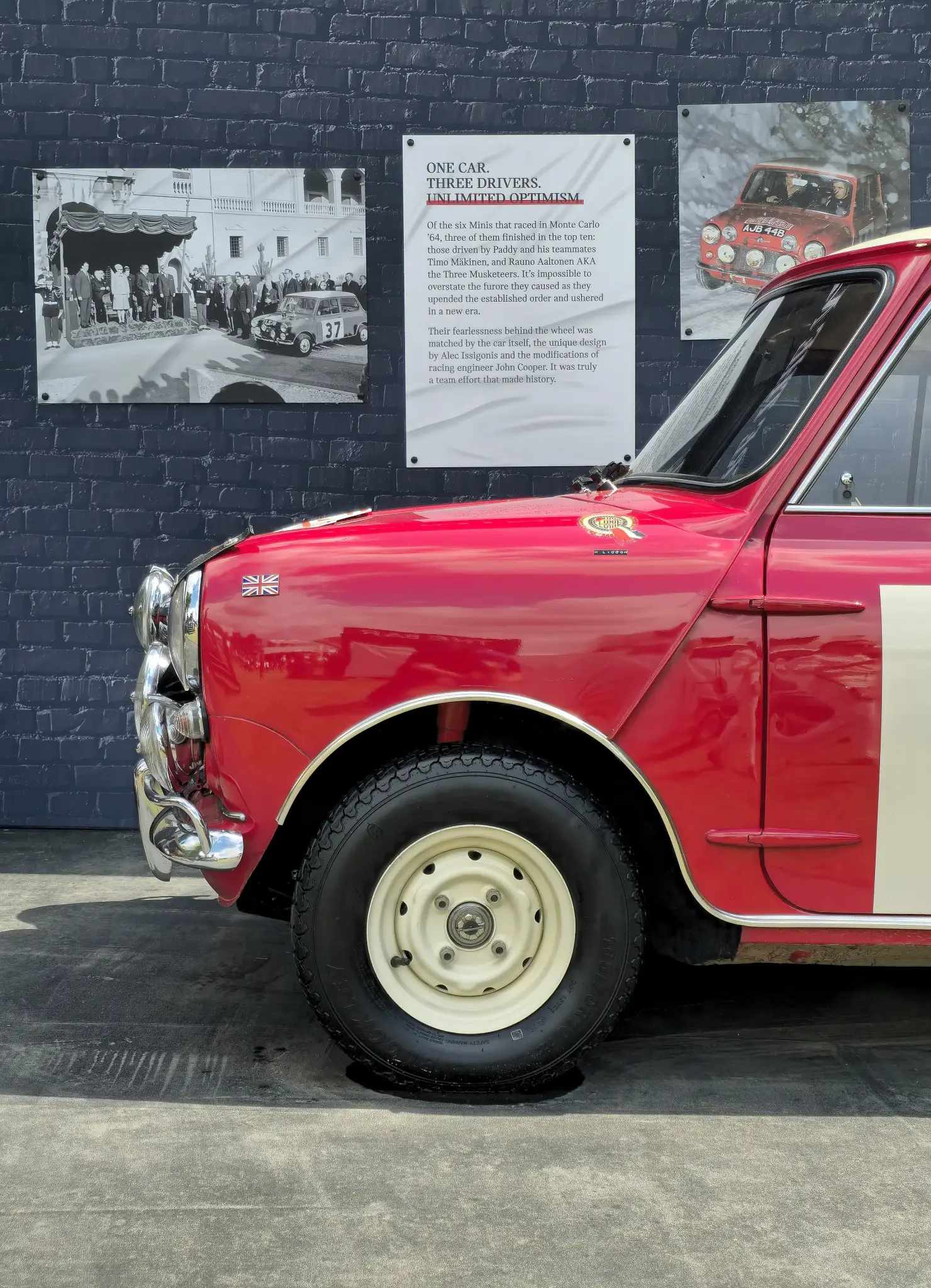
John Cooper, who had tuned the A-Series engine, turned the Mini into a competition car. The Cooper and Cooper S won the Monte Carlo Rally in 1964, 1965 and 1967. In 1999 the Mini was voted the second most influential car of the twentieth century, behind the Ford Model T.
Forty-one years at Longbridge
Minis were built at Longbridge in Birmingham and at Cowley, and under licence in Australia, Spain by Authi, Belgium, Italy by Innocenti, Chile, Malta, Portugal, South Africa, Uruguay, Venezuela and Yugoslavia. British Leyland launched the Austin Metro as the Mini’s successor in 1980, but the Mini outlived it. The last car left Longbridge on 4 October 2000, after 41 years in which the design had changed only in detail.
Design and features
- Ten feet of car: the whole design was fitted into Lord’s 10 by 4 by 4 foot box, with four seats inside.
- Transverse engine and gearbox in the sump: the first car with a transverse four-cylinder engine, and the layout most small cars still use.
- Rubber cone suspension: designed by Alex Moulton in place of steel springs; hard-riding but with handling that was hard to beat at the time.
- Small wheels: 10-inch rims from 1959 to 1984 kept the car short and left room for passengers.
- Endless variants: saloon, estate, van, pick-up, Moke and the Cooper models from one set of parts.
Mini (classic) versions
- 848 cc saloon: the standard car, later sold as the Mini 850.
- 998, 1098 and 1275 cc cars: the larger A-Series engines fitted to the normal models; the 1275 also powered the 1275 GT.
- Cooper and Cooper S: tuned models with 970, 1071 and 1275 cc engines and twin SU carburettors in Cooper S form.
- Estate and van: long-wheelbase bodies with rubber suspension only; the van had no rear side windows.
- Pick-up: an open load bay on the long-wheelbase floorpan.
- Moke: a doorless utility version on Mini mechanicals, covered on its own page.
The later BMW-built car is described in the article on the Mini Hatch. The open utility version has its own page, the Mini Moke, and the estate of 2007 is the Mini Clubman. More cars are in the Mini collection.
Sources
- Mini, English Wikipedia: history, design, production
- Mini (Auto), German Wikipedia: production total, engines, suspension, body styles