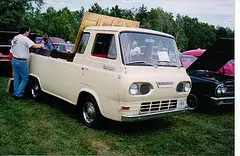
The Mercury Econoline was the Mercury-badged version of the Ford Econoline van, offered in Canada through the Lincoln-Mercury sales network. It was the same forward-control van that Ford sold as the Econoline from 1961, with a Mercury badge and a Mercury dealer network.
Mercury Econoline at a glance
| Based on | Ford Econoline (Ford E-Series) |
|---|---|
| Marketed in | Canada, through Ford and Lincoln-Mercury dealers |
| First generation | 1961–1967 |
| Layout | forward control, mid-mounted engine between the front seats |
| Base | Ford Falcon compact car |
| Wheelbase | 90 inches |
| Standard engine | 144 cu in straight-six, 85 hp |
| Optional engine | 170 cu in straight-six, 101 hp from 1961, standard from 1965 |
| Later engine | 240 cu in straight-six from 1965 |
| Body styles | cargo van, passenger van, forward-control pickup |
The Mercury-badged Econoline is mentioned only briefly in the English Wikipedia article on the Ford E-Series, which is the only source used here; most of the article therefore describes the Ford original, and it is based on one source.
History of the Mercury Econoline
A Ford van with a Mercury badge
Ford released the first-generation Econoline for 1961 on 21 September 1960. The van replaced both the Ford panel delivery, based on the F-100, and the sedan delivery known as the Ford Courier. It was developed as a three-vehicle family: a cargo van, a passenger van that also wore the Station Bus and Club Wagon names, and a forward-control pickup truck.
In Canada the Econoline was marketed through both the Ford and the Lincoln-Mercury sales networks, the latter selling it as a Mercury. The idea was to increase the model’s presence outside the cities, where Lincoln-Mercury dealers were often the only Ford Motor Company outlet. The Mercury version was therefore not a separate design but a badge-engineered Econoline, and it is remembered mainly as a Canadian market detail rather than as a model line of its own.
The mid-engined layout
The first-generation Econoline was based on the Ford Falcon compact. To fit a 90-inch wheelbase, the shortest for a Ford since 1908, Ford adopted a mid-engined layout with the engine placed between the front seats and behind the front axle. The arrangement produced a flat load floor apart from the engine compartment and allowed the rear doors to extend all the way to the bumpers. It also ruled out a V8. Chevrolet and Dodge adopted the same layout for their 1964 vans.
Power came from the Falcon’s 85 hp 144 cu in straight-six, with a 101 hp 170 cu in six as an option from the start. For 1965 the 170 became standard and a 240 cu in six joined the options list. A three-speed manual was standard, a Dagenham four-speed was offered in 1963 and dropped in 1964, and a three-speed automatic became available with the larger engines. Unlike the Falcon, the Econoline used solid axles and leaf springs at all four corners.
Bodies and the end of the line
The first-generation Econoline came as a six-door cargo van, with an eight-door version adding two doors on the driver’s side from 1963, a panel van without side loading doors from 1964, and a longer Super Van from 1965 with the body extended 18 inches behind the rear axle. A passenger Station Bus and the better-equipped Club Wagon covered family and fleet use, and the pickup used the van’s front body with a seven-foot bed. The first generation ran to 1967.
Design and features
- Mercury badge, Ford body: the same van as the Ford Econoline, sold by Lincoln-Mercury dealers in Canada.
- Mid-mounted engine: the engine sat between the front seats, giving a flat load floor.
- Short wheelbase: 90 inches, the shortest for a Ford since 1908.
- Three-in-one range: cargo van, passenger van and forward-control pickup.
- Falcon engineering: Falcon six-cylinder engines and solid axles on leaf springs.
Mercury Econoline versions
- Mercury Econoline cargo van: the basic six-door van, with an eight-door version from 1963.
- Mercury Econoline passenger van: the Station Bus and Club Wagon versions.
- Mercury Econoline pickup: the forward-control pickup with a seven-foot bed.
- Super Van (1965–1967): the extended-length body, 18 inches longer behind the rear axle.
The Econoline was followed much later in Mercury showrooms by the front-wheel-drive Villager. More cars are in the Mercury collection.
Video: 1966 Ford Econoline Van and 1957 Mercury Canned Ham Slammed on Air Suspension
Video by Brian Morris on YouTube.
Sources
- Ford E-Series, English Wikipedia: Econoline development, layout, engines, body styles and the Canadian Mercury sales